• Recent Posts

  • Tags (Categories)

  • Archives

  • Pages

  • January 2026
    M T W T F S S
     1234
    567891011
    12131415161718
    19202122232425
    262728293031  

Navy SEALS are Lying Conspirators

Or so it must be according to those who want more proof that bin Laden is dead. The word of a Navy SEAL is not good enough. Apparently.

Every American who believes that the U.S. Navy SEAL Team 6 didn’t kill bin Laden apparently thinks that the entire group of specially trained, best-of-the-best American soldiers are all involved in a lie and the cover-up of that lie. Sure, people have their political reasons for not wanting to believe Obama, and Hillary, and anyone else seen biting their lips in that “staged” photo in the “Situation Room” at the White House. After all, how could anyone ever believe a U.S. politician? The cable “news” channels see to it that we can never believe anything that comes from a politician.

And isn’t it convenient that there is no group officially called SEAL Team 6? Also convenient that they need to stay completely out of the public eye – such a shroud of secrecy. So yes, if you believe that the bin Laden killing is a scam and a hoax – then you also believe that U.S. Navy SEALs are a major part of the effort in pulling the wool over our eyes. It’s not as if Obama went over the wall of that compound himself and shot bin Laden in the head.

No, it was a U.S. Navy SEAL. Do you seriously not believe that?

(Okay. That should take care of my political ranting in this space for at least several months. We now return to our regularly scheduled programming.)  (Flickr-CC photo by The U.S. Army)

Resources for Webinar: Setting Expectations

On Monday, April 4, I hosted a free webinar titled Setting Expectations for e-Education. This webinar is one of the many services that I am providing through my new business called Excellence in e-Education, LLC (now shuttered). Here are the slides for this presentation.

During the webinar I referenced several different websites where you can find some examples of published expectations for online learners and online faculty. I highlighted sections of each of the following, although none of them represents a truly comprehensive list of expectations (in my opinion).

This first list shows a few examples of clarifying what is expected of online faculty members.

Penn State: Online Instructor Performance Best Practices and Expectations

UMUC: Expectations for Faculty Teaching at UMUC – see PDF for Online Teaching.

Lawrence Tech: LTU Online Faculty Expectations

St. Petersburg: Online Student, Faculty and Staff Expectations and Performance Targets

CCC Online: Policies & Procedures – Faculty Handbook – Evaluation – Faculty Gold

CUNY: Standards for Teaching and Learning in an Online Course

When it comes to shaping student expectations, many schools go no further than the basic online orientations or some sort of readiness quiz (“Is online learning right for you!?!”)  Here are a few examples of colleges and universities where they outline some expectations for online students:

Lawrence Tech:  Taking Responsibility for Online Learning

St. Petersburg: Online Student, Faculty and Staff Expectations and Performance Targets

Univ. of South Carolina:  Expectations for Online Students

Goodwin College:  Student Expectations

One of the services provided by Excellence in e-Education is helping a college draft a comprehensive set of online teaching and learning expectations, including:

  • What the college expects from online students.
  • What online students should expect from your college.
  • What the college expects from online faculty members.
  • What the online faculty should expect from the college.

Free Webinar – Setting Expectations for e-Education

In case you haven’t heard, I’ve launched a small business in an effort to make a living in my post-LSC days. It’s called excellence in e-Education and it resides on the web at XLENTS.com (where XLENTS is sort of like Excellence, but different).

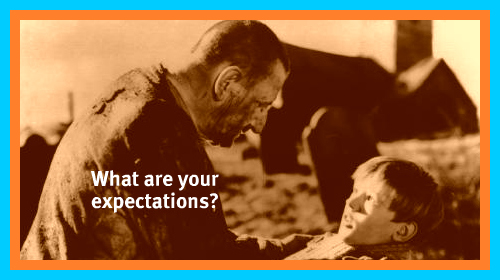
What are your expectations, Pip?

Your can learn much more about what I have to offer by visiting that website, but I’d like to especially draw your attention to a free webinar that is scheduled for April 4, 2011, titled: Setting Expectations for e-Education. The webinar will focus on the questions of why and how you should have a set of clearly developed and easily found expectations for your online learners, online faculty, and for the online administrators.

You expectations may be great ones, but does everyone know what they are? Register here.

State-Funded Accounting Research

Preface: Let it be assumed that every research professor who sees this post will be offended and/or angry. Please know that I don’t dislike you or have anything personal against any one of you. I count many research professors as friends of mine, and hope I can continue to do so. The point I want to make below is that I think way too many taxpayer dollars are being spent on academic research.

I’ve been watching all the hand-wringing, angst, and legitimate concern over the budget woes, especially in Minnesota and Wisconsin. At least in Minnesota they’re not threatening to take away collective bargaining rights for most state employees, most notably the teachers and professors who are state employees.

Even though it won’t completely solve the budget problems, I’m still amused that the cost of doing (what I will call EXCESSIVE) academic research at the state-supported colleges and universities hasn’t been studied. For example, consider this question:

HOW MANY ACCOUNTING RESEARCHERS SHOULD THE STATE OF MINNESOTA EMPLOY?

To help you form an answer, let me point out a few things based on my 17 years of experience as a faculty member in a few different accounting departments across the country, mostly at research universities.

  • Most research professors typically teach about half as large a teaching load as a teaching-only faculty member.
  • Research professors (with PhD) typically make $20K – $60K in extra salary over a full-time teaching professor/instructor (usually adjunct, usually without PhD)
  • Based on the data above, it would be typical for 24 credits of accounting courses to be taught for an adjunct at a cost (incl. benefits) of approximately $75,000 per year. The same 24 credits taught by two research-professors (12 credits each, per year) would cost about $250,000. To me, that means the cost of the research is about $87,5000 per research-professor. Some more, some less. (And yes, I realize that it’s a little more complicated than just this teaching cost vs. research cost dichotomy, but I think it covers the essentials.)
  • Tenured professors tend to be researchers first, and teachers second; while non-tenured instructors tend to have only teaching responsibilities and hired on a term-to-term basis (with some exceptions).
  • Teaching-only faculty members tend to be hired because they are good instructors. Tenure-track positions tend to be filled with those who the university believes will get published – whether they can teach a lick is not very important.

When I taught accounting at the University of Minnesota Duluth from 1987 to 1993, I was a non-tenure-track “teaching specialist” with a course load of 12 credits per semester/quarter. The tenured or tenure-track professors taught 6 credits per semester and were charged with getting extremely esoteric research articles published in the accounting journals.

It was my opinion then, and it is still my opinion now, that almost no one who works in the accounting industry gives a rat’s behind about the published research in the academic accounting journals. Most of it is completely irrelevant or totally incoherent to the people who actually work in the accounting profession (with a few exceptions, of course).

Around 1990, I conservatively calculated the cost of academic research in accounting at well over one million dollars, just in the state of Minnesota. My guess is that the cost is substantially higher today. Clearly, this doesn’t solve the budget problems, but keep in mind that this is only one discipline area. Add in several more disciplines where academic research is performed mainly for the benefit of the academicians who perform it. The calculation of $1M+ was based on what they were paying the researchers to teach compared to what it would have cost for that same number of courses to be taught by people in non-researching faculty positions (similar to the example added above in the bullet points).

I understand that this won’t solve the budget crisis – but it begs the question of whether we should be cutting K-12 teacher positions, increasing class sizes, taking away bargaining rights – instead of making some changes in areas such as this.

Without going through the accounting professor rosters at the University of Minnesota campuses and the MnSCU state university campuses, let me take an informed guess and say that there are at least 50 (FIFTY!) academic researchers in the accounting departments of these schools.

Maybe the state of Minnesota (insert your state name here) should pay the best 2 or 3 researchers in accounting to continue to produce this kind of product. I can’t imagine that there is a real need in society for any more than that. If every state did that, we would have 100-150 accounting researchers at public institutions of higher learning across the U.S. Then you can add in the researchers who work in the accounting field (non-academicians) and those who are employed by the private universities (they can do what they want with their money) and you still have one hell of a lot of accounting researchers out there.

On second thought, 100-150 academic researchers in accounting still sounds like too many to me.

To dissuade me from this argument, I will need someone to convince me that this very large use of public funding has a significant payoff for society as a whole, and that we would be better off with these millions of dollars be spent elsewhere.

Postscript: I do not lump all types of research into the same category. I am not proposing that we reduce the amount of spending on certain types of medical research or other things where added value for society as a whole can be demonstrated. I am not a hater of research or researchers, but I do think that the situation described above is an incredible waste of taxpayer dollars.

EDTECH HULK needs some love

As I write this, the EDTECH HULK only has 40 followers. Come on people, where’s the love for the big green tweeter wearing the purple pants? Several of us at #ITC11 were speculating about who was the David Banner behind the HULK, and although we came up with a list of 6 or 8 possibilities, chances are good that we don’t know who it is. We may never know, which makes it all the more fun.

And it is fun. EDTECH HULK certainly smacks us right on the funny bone. Here are a couple of gems – but you really need to just start following him (her?) and go along for the ride.

(HULK USING IRONY! IN CASE THAT NOT CLEAR! IRONY HARD PULL OFF WHEN SHOUTING EVERYTHING! PEOPLE SEE BIG GREEN HULK! MISS SUBTLETIES! #ITC11)

THAT @COGDOG CLEARLY NOT GET POWERPOINT! SLIDES SUPPOSED TO MAKE SPEAKER REDUNDANT! THAT WHAT PROFS ROUND HERE DO! #ITC11

“HULK” ONE OF MOST TWEETED WORDS AT #ELI2011! WHAT SECRET TO HULK’S SUCCESS?! TWEET LOTS! AND SPEAK IN THIRD PERSON!

STUDENTS USE BOOKFACE! SO WE SHOULD USE BOOKFACE TO TEACH! HUH?! STUDENTS USE DORM ROOMS TOO! HULK NOT GOING THERE TO HAVE CLASS!

Zoho Apps Interface in Zoho Mail

While preparing for an upcoming presentation, I stumbled onto something in Zoho that I didn’t know existed. I’ve been a Zoho fanboy for several years, but never really felt the need to use their mail program – mainly because I already have 4 or 5 different email accounts for different purposes. Not using the mail program means that I missed this feature when they rolled it out in the business version of their Mail client.

I find this to be incredibly convenient. Zoho continues to beat Google Apps (by a long shot) when it comes to innovation, performance, and functionality.

FERPA and Social Media in Education

Was really wishing that I could have been in attendance at this session at #ELI2011 in Washington D .C. today. Titled: “Bag It and Tag It”: Implementing a Course-Level Learning Portfolio Using CMS-Based Tools to Document Student Learning When Teaching in Wild, Open Spaces with Cloud-Based Tools,” by Kelvin Thompson of UCF.

A couple of tweets drew my attention to the session:

bwatwoodFERPA = dark cloud over using blogs w students #eli2011

tedcurran: why NOT teach in the free cloud? 1) can’t preserve the work! 2) FERPA3) Socialmediaphobia #cmsfolio #eli2011

Based on the session description, it appears that Thompson was providing ways of using Web 2.0 and social media tools in a “FERPA-friendly” way. Hallelujah for that. There’s been way too much FUD surrounding how these things impact upon FERPA.

The single best piece of writing that I’ve seen on this topic comes from John Orlando in a Faculty Focus article titled: “FERPA and Social Media.” I highly recommend that you check it out. Here’s an excerpt.

“FERPA is one of the most misunderstood regulations in education. It is commonly assumed that FERPA requires all student coursework to be kept private at all times, and thus prevents the use of social media in the classroom, but this is wrong. FERPA does not prevent instructors from assigning students to create public content as part of their course requirements.”

Higher Ed Loves the iPad

Fast Company publishes an article that is getting retweeted and re-facebooked all over the net. The title is “Apple’s iPad Officially Passes the Higher Education test [Exclusive]”

“Officially” appears to mean that the iPad scored high marks overall in a student pilot project at Reed College in Portland, OR. Let’s see – students were given an iPad to use for the course and then could buy it at 50% off at the end of the course. That sounds like an unbiased sample, now doesn’t it? The glorious iPad received it’s high marks in spite of the following:

The virtual keyboard is a pain for composing anything beyond short notes. The nonexistent file system makes finding important documents difficult and sharing across applications nearly impossible. Finally, managing a large number of readings in PDF format becomes a major time-suck. Syncing PDFs via iTunes was found to be “needlessly complicated,” emailing marked-up versions back to oneself was “prohibitively time-consuming,” and even the cloud-based storage, Dropbox, “failed to work seamlessly with PDF reading/annotating applications.”

Apparently, it’s just so cool that they don”t care about what it can’t do. And 50% off the cost of buying your own is enough to make any college student a bit giddy.

Tweet This!

Looking forward to the eLearning 2011 conference hosted by the Instructional Technology Council (ITC) on Feb. 19-22, 2011. This is always one of the best eLearning conference of the year. There’s a great lineup of keynote speakers again this year. The ITC board has done a great job over the past several years of getting some of the best speakers in the fields of educational technology and eLearning.

Full Title: Tweet This! social Networking in Higher Education

Pre-conference workshop, Feb. 19 from 12:15 to 3:00 at St. Petersburg College.

Presenters: Audrey Williams, Director of Educational Technology Services, Pellissippi State Community College and Barry Dahl, Excellence in e-Education.

Description: Do you believe in the premise that “none of us are as smart as all of us?” If so, what are you doing to take advantage of that? Are you connecting with your peers in meaningful and useful ways? Are you learning from others and are they learning from you? These are some of the questions we will explore in this session as we see how social networking is changing the way the world works, and especially how education works. Twitter, Facebook, and LinkedIn are some of the tools we will examine in this hands-on workshop. We will help you build your own network of educators and show you how to benefit from it. We will place particular emphasis on who is effectively using these tools in higher education and how. We will discuss uses both inside and outside of the classroom.

Not Returning to the Nest

For the purposes of bringing some closure to the last few posts about my very public job interview in Cheyenne, Wyoming, let me just say that LCCC chose to “go in a different direction.” I’m very disappointed in the outcome. The rumor mill and/or grapevine has given me reason to believe that they might not have liked the fact that I am a blogger and that I share things so freely. Not sure if that’s accurate, but if it is, then I don’t really have to worry about ever being a college president – and I’m okay with that.

One other possible explanation is that they saw those pictures of me on Facebook from some of our college parties back in the late 70’s.