Back in the day I spilled a lot of ink writing about Blackboard, aka Blackborg, aka Blackbeard, aka BlackCT (after they bought the WebCT LMS), aka BlackAngel (after they bought the Angel LMS). After Anthology bought Blackboard back in 2021, it seems to me that Blackology is an apt moniker.
Full disclosure: I was a D2L customer for 9 years (2003-2012) and and a D2L employee for 13 years (2012-2025), now retired.
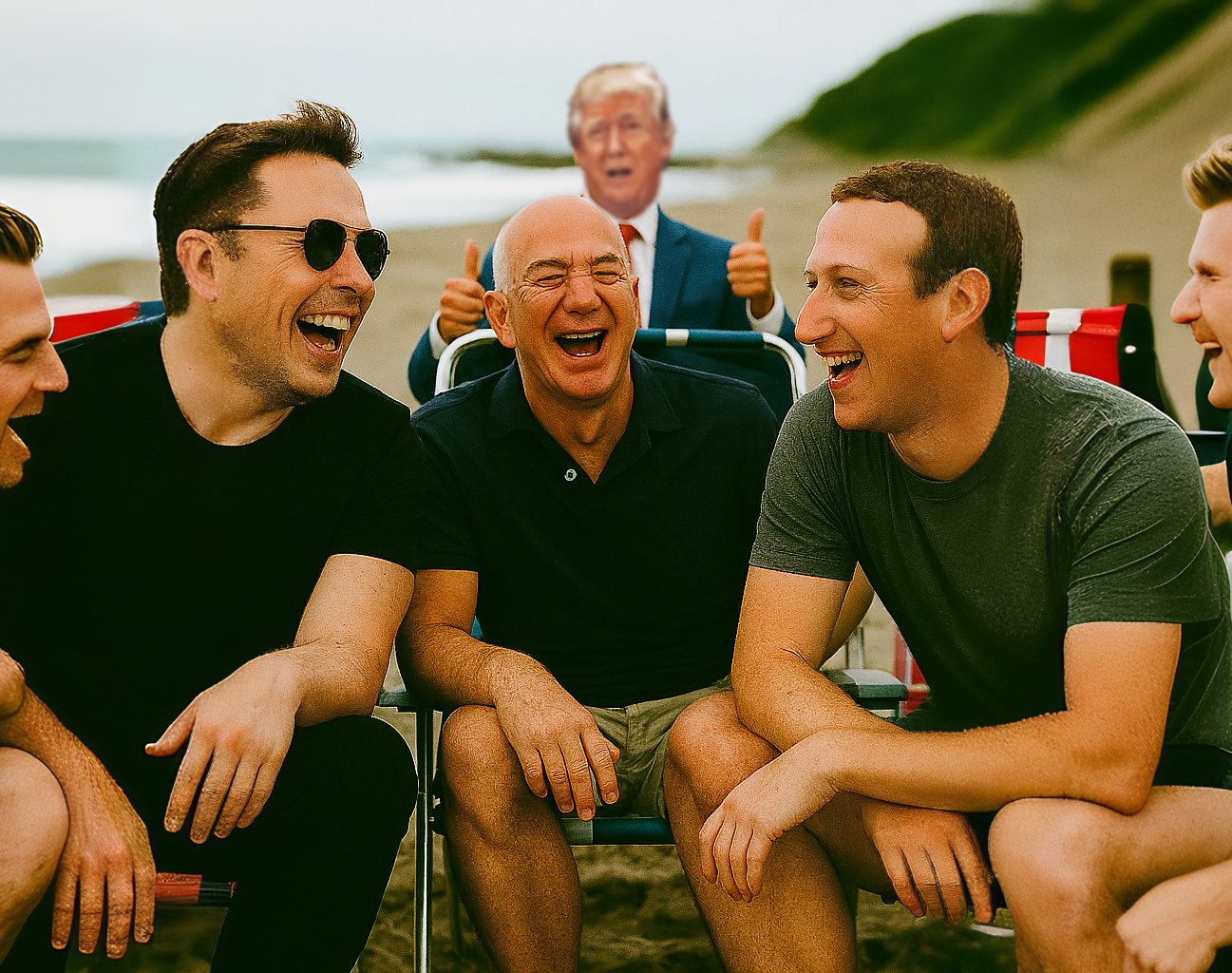
They believe they’re more important than the Presidents, past and current.
The Tech Bros. The Broligarchy. These are the people bent on destroying everything they touch to make their vision of a dystopian techno-state into our reality.
Computers and software are still capable of being used for productivity and efficiency, but increasingly they are being used to spread misinformation, spy on us commoners, divide us from our friends and neighbors, and addict us to their platforms and devices.
Technology no longer serves the owners of the devices, unless you consider these tech bros to be the real owners of every device that you purchase for personal use. Their goals appear to be to create an endless stream of bullshit designed to trick you into willingly giving up your personal data, your time, your money, and your soul.
They’re laughing at us, not with us. Yes, it’s AI-generated. My apologies.
Who are the leaders that we are allowing (almost encouraging) to open the drain into which we will spiral to our deaths (at least the death of our humanity)? Elon Musk, Mark Zuckerberg, and Jeff Bezos? Good God, heaven help us all. Peter Thiel, Marc Andreesen, Larry Ellison, Sam Altman, and others are also fueling the increase in public distrust as they invade our privacy by surveilling us at every turn, stealing our digital data for their own desires, and creating biased algorithms intended to misinform us via bias and manipulation.
Why does LinkedIn escape my wrath for now? Two reasons: 1) it’s pretty much a milquetoast platform where virtually nothing happens (which means that very little bad happens as well as very little good), and 2) their CEO hasn’t done anything (that I know of) to be cast in the same lot as the TechBros who have earned our hatred. I do have a very specific rant about LinkedIn, but will save that your another post in the near future.
Being wealthy beyond any inconceivable need is not enough for these people. Instead they feel the need to manipulate the levers of our government and therefore our society as a whole. They have dictatorial persuasions, each and every one of them.
Zuckerberg? I told Facebook to F*ckOff in 2018 and have never looked back. But ignoring FB is not enough. I also avoid all the META products and platforms: Insta, Messenger, WhatsApp, Threads, Quest VR headsets, and Ray-Ban/Meta smart glasses. Zuck sucks, and if you use his products you are giving him the power to continue his suckiness.
Musk? OMG, I really don’t have the finger strength to type out all the reasons he sucks, but chances are good you’re aware of all those without any list from me. I left Twitter when he turned it into a safe place for Nazis. In the early days (pre-Musk) there was great engagement with a network of educators and others who shared useful information. In the later days it became a cesspool of hatred. I’ll never buy a Tesla, I’ll never be an astronaut, I won’t let Neuralink implant anything into my skull, I won’t drive in his Boring tunnels, and Grok can … (expletive deleted). No Musk for me, thank you very little.
Bezos? A little tougher since I have family members who use Amazon and Prime Shipping all too often. I’m working on that, but just because they’re family doesn’t mean that they hold the same convictions about how horrible the Broligarchs are. We’ve stopped using Alexa and Audible. Don’t and won’t subscribe to the Washington Post. Won’t be paying for a seat for a 7-minute ride into “space” on the phallic Blue Origin. We have a video doorbell that is not a Ring. I only shopped at Whole Food Markets a couple of times several years ago, and now have no reason to stop there. There are alternatives out there to GoodReads and IMDb. It’s hard to avoid AWS, but at least I don’t directly pay them for their services. MGM studios is another tough one since I often don’t know who created a certain movie or television show.
I expect very little engagement with this post. One reason is that LinkedIn will limit the impressions by keeping it out of the feed of most of my contacts. Another reason is that those readers who are also on X/Twitter and Facebook/Insta will be loathe to agree with my thoughts about the Broligarchs, since their use of those platforms paints them as supporters of their bullshittery. Or some such crap.
The ITC is an affiliated council of the AACC, the American Association of Community Colleges. They are THE organization with the closest ties to online education at two-year schools.
Many of my regular readers are already members of the ITC, because that’s where you and I met. I attended my first ITC eLearning conference in February 2004 in San Diego. Now, more than 21 years later, I’m still a huge advocate for the ITC. I hear that the 2026 conference will be in Austin, Texas in February. If there’s any way that I can make it to Austin to see dozens of good friends, I’ll be there.
There is no other online education organization that is devoted to professional development of community college educators. This is THE ONE! If you work at a 2-year school and you support one of the organizations that primarily focuses on 4-year schools and grad schools, then you are doing this wrong. Very wrong. Sorry, not sorry.
Annual membership dues are only $520 for public institutions that primarily offer a two-year associate’s degree or diploma. With that institutional membership you can have an unlimited number of employees with access to ITC services such as webinars, podcasts, Tuesday Talks, member pricing for the annual conference and much more. When I was on the Board I argued unsuccessfully that the dues were too cheap. Being the lowest cost provider in a space is not often the best place to be, but 15 years later their dues are still very low. You’d pay much more for a membership to any other organization and that org would NOT be focused on two-year schools.
After that first conference in 2004, it took me a while to return. I was a presenter at the 2007 ITC conference in Albuquerque. Those were the heydays of Web 2.0 tools, and my presentation was a hit, if memory serves. That exposure led to me being elected to the Board of Directors with my first term starting in summer 2007. I attended my first board meeting that June in Annapolis.
Part of the ITC Board of Directors in Annapolis, June 2007
One year later at the conference in St. Pete Beach, they asked me to do the opening keynote. I was honored to be chosen for my first time on the main stage. I forget who the other keynote speakers were, except for Myk Garn who I met at the conference. We’ve been friends and collaborators ever since.
St. Pete Beach Opening KeynoteBarry and Myk Garn in Boston, 2022
My presentation that year was my first offering of something that became a standard for me at other venues: “eLearning Mythbusters.” At that time clickers were all the rage, so I used them to get a couple hundred audience members engaged in deciding (kinda) whether many of the things that people were saying about eLearning were truths or myths. It was fun and led to great conversations.
One of the things that I brought to the board was an awareness of a younger crop of movers and shakers in EdTech. Starting with the 2008 conference we started bringing in more cutting edge speakers, younger speakers, think more like new school than old school. For example, here’s the list of keynoters for three of the four years I was on the board:
Bryan Alexander 2009
Brian Lamb 2009
Jim Groom 2010
Jared Stein 2010
Nancy White 2010
Alan Levine 2011
Maria Anderson 2011
Cole Camplese 2011
David Wiley 2011
Bryan Alexander KeynoteBrian Lamb Keynote2011 Keynote Speakers
I was also honored to serve as a faculty member for the ITC Leadership Academy. The highlight of this experience was the 2010 Academy held in Portland, Maine. A great group of students/leaders and a faculty made up of most of my favorite board members. The ITC Leadership Academy is still going strong today and I still recommend it unequivocally for any young and inspiring eLearning leaders in the two-year schools.
Leadership Academy goes boating 2010 Leadership Academy classFriends and Board Members
I also had the pleasure of being on the debate stage twice for the ITC Grand Debate at the conference. In Portland in 2009, I gave the con argument for the debate topic, Resolved: Second Life will be the Second Coming for Higher Education (actually it was: Virtual Worlds are the Second Life for Online Education). Second Life was all the rage, but it also seemed so fake and unnecessary (to me anyway). You can read more about it in this old post on this site. My favorite line from the debate was and still is: “Does FERPA apply to a furry?”
The second time at the Grand Debate was in 2017 in St. Pete Beach. My opponent was a delightful faculty member from St. Petersburg College and we went toe-to-toe on the topic of whether online faculty could be (or should be allowed to be?) online-only, in other words, whether it was appropriate for faculty to work remotely from the campus. Having managed several faculty members who had been doing exactly this for several years, I was happy to take the Pro side of the debate.
Resolved: online faculty should be rooted andengaged in the traditional campus experience.
The debate moderator was my friend and ITC Board Member Michael Catchpole, which was also the case in 2009. Michael was an excellent moderator and a fixture at ITC conference debates for so many years. Inside Higher Ed wrote a piece about the Debate prior to it occurring. A highlight (in my mind) was when Michael read my bio during the introductions. The Orange Menace had just been inaugurated about a month earlier, so my intro had a definite Trump angle. It included thing such as “Barry is really, really, really, really, really smart, or at least that’s what people are saying!” and “One of his latest campus projects is to build a wall around the administration offices, and have the faculty union pay for it!” Good times, much less fashy than we find ourselves here in 2025.
I absolutely won the debate based on audience vote, but my opponent was so awesome that Michael declared it a draw (she was just stuck with the weaker position). I couldn’t argue with him and probably would have done the same thing in his shoes. Of course my position was proven as superior just a couple years later when COVID required everyone to teach remotely. The argument in the debate was that they couldn’t effectively do their jobs as faculty members. Everyone knew that was bullshit, they just didn’t want them to do this job remotely.
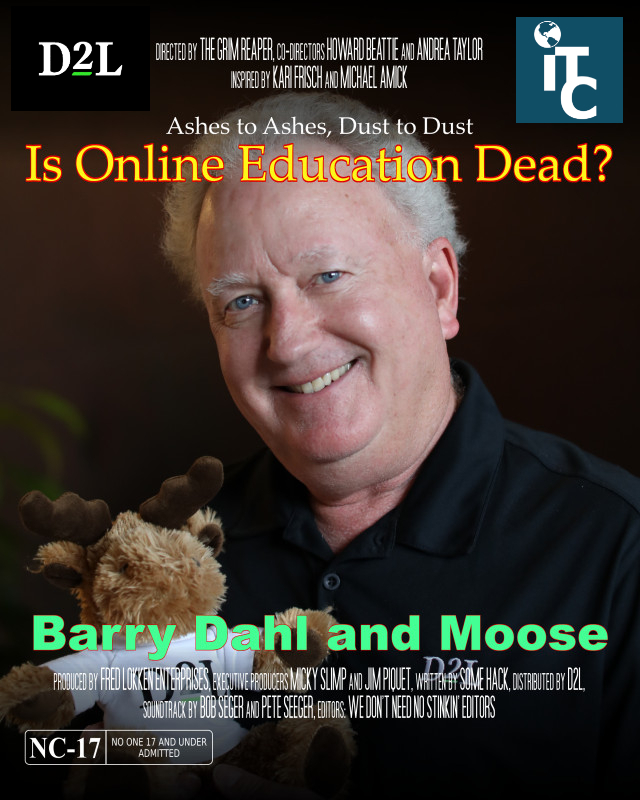
Fast forward to ITC eLearning 2022 in Las Vegas where I had the honor being the keynote speaker. My presentation title was “Is Online Education Dead? Or Just Dying?” You can learn much more about this session in two posts on this site: part one and part two. After starting the session reading my own obituary, we continued to examine what’s dead and what’s dying about online education and EdTech more generally. Lots of fun material to work with in this arena, IMO.
Other eLearning conference highlights include:
2012 Long Beach: some of my best friends and I did a Digital Story Slam breakout session, with each presenter using a different digital technique/tool for their story. Co-presenters included Michael Amick, Kari Frisch, Audrey Williams, Kyle Mackie, Howard Beattie, and Matt Evins. It was a blast.
Howard Beattie telling his digital story in 2012 in Long Beach
2010 Fort Worth: the most fun was a dinner with a bunch of friends and the “Persian Jokes” that were told by our new friend who was originally from Iran. The conference was great, but that evening spent with so many smart people was very memorable.
2008 in St. Pete Beach I held a beach party for members from my North Central district, along with other friends and Board members. The best part of ITC is getting to know all the great people.
2008 Beach Party2012 with Friends in Long Beach
2004 in San Diego north county: Quality Matters was just finishing their first year of their FIPSE grant and they held a half-day workshop where they shared version one of their course quality rubric. I took that back to Lake Superior College where we adopted a similar project and process that met our needs for peer review of online courses. That process is till in place today, called POET (Program for Online Excellence in Teaching.) That program alone has been worth much more than all the dues paid over the years to ITC.
Okay, okay, I know this is another long one, but I could go on and on about the ITC. Supporting this organization is important to the future of online education in two-years schools. It’s Barry Approved!
Today is the day that the paychecks end. Today is the day that they reach in electronically and wipe the work apps off my phone (go ahead, but make sure you get them all, please!). Today is the day that I swam laps for twice as long as usual because I didn’t feel the need to rush off to answer some emails or worry about something else at work. Today is the day that when I have a couple beers at happy hour I will actually have something to celebrate, unlike those others days when I made up a reason to celebrate.
This might only matter to me, but I decided to capture a timeline of my life with Desire2Learn/D2L.
April 2003: Met John Baker and Jeremy Auger for the first time when they came to St. Cloud State University to sell their upstart LMS to the Minnesota State Colleges and Universities system. They were successful.
January 2004: Slowly started replacing 5 different LMS’s in the state system with Desire2learn.
The now-retired Banner image from Desire2Blog. It was an attention-getter.
August 2006: I start posting heavily about the Blackboard vs. Desire2Learn patent lawsuit, starting with the post titled “Desire2Monopolize.”
August 13, 2006: Desire2Pod (my first and only podcast series) was born with episode 1: An Interview with John Baker (mostly about the lawsuit).
Fall 2006: Desire2Learn approached me about being the host of their 4th annual Users Conference. I was surprised since I had never attended any of the first three.
July 2007: Fusion (this was the year that the Fusion name was born) was held in Duluth, Minnesota. It was awesome.
L-R: Me, Will Richardson (one of our 3 Keynoters), and John Baker at Fusion 2007 in Duluth
July 2009: During a long coversation with John Baker outside a bar in St. Paul, he dropped the following line, “If you ever need a job, you let me know.” He repeated that line another time or two during the time that I didn’t need a job.
Spring 2012: I say “Hey John, remember when you told me…if you ever need a job? Well, that time has come.”
May 2012: I begin work at Desire2Learn as the Senior Community Manager (the jokes wrote themselves…”Señor Communty Manager” and “It’s not easy managing a community for seniors.”
July 2013: The Spotlight on Community Colleagues main stage show was born at Fusion in Boston.
2013-2024: Pretty much a blur…lots of travel, lots of presentations, lots of webinars, 35-ish trips to D2L headquarters in Kitchener, Ontario (loved it there).
October 2024: I started phased retirement at 60% salary and pay (more on that later).
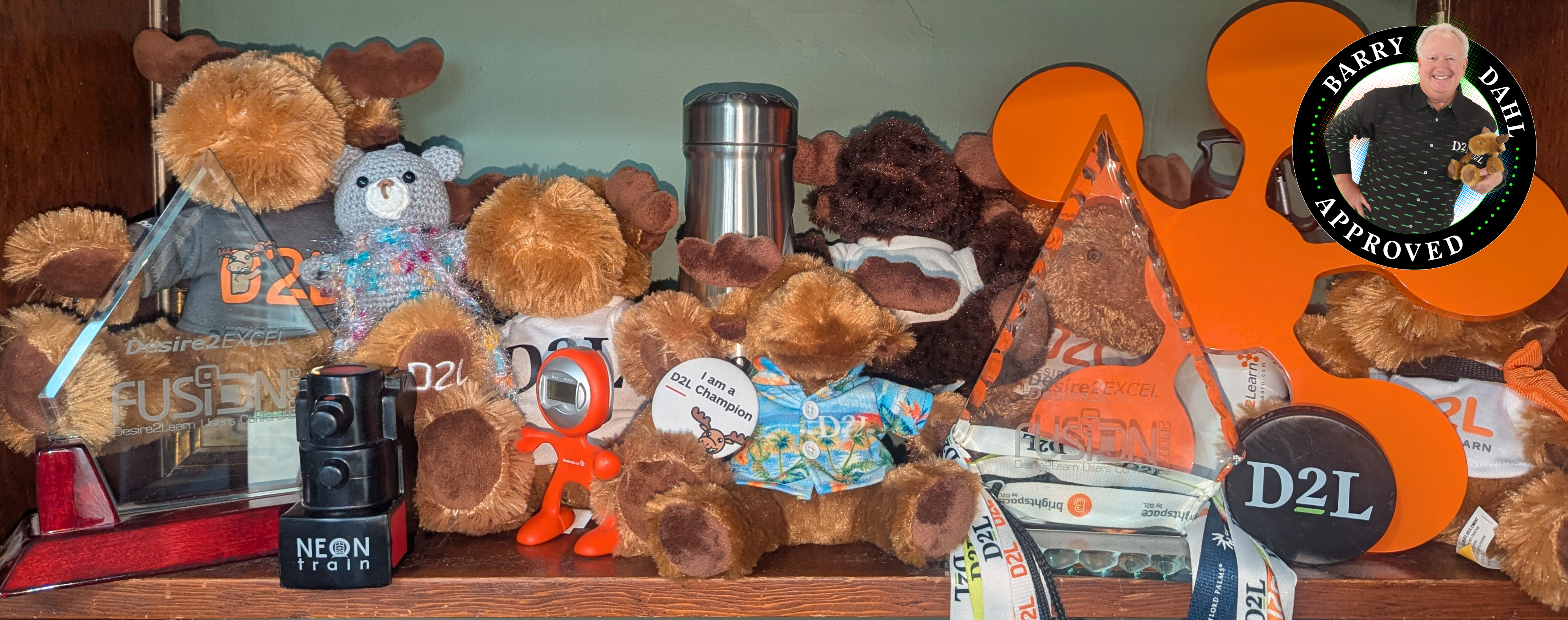
July 2025: My 18th and final Fusion. Had a fun retirement party with a bunch of friends, and was pleased the D2L Barry Moose (wearing a Hawaiian shirt) was a hit.
August 1, 2025: My last day on the payroll at D2L. It’s been a wild ride.
Thanks to everyone who helped make this happen. Cheers! BD
During my D2L exit interview yesterday I mentioned that I had 14 bosses in 13 years (although two of them were boomerangs, so 12 different people), and that three of them stood out above the rest. To give you a sense of the timeline of my bosses, there were 13 of them in the first 8-9 years, before #14 rode the wave with me for the last 5 years until I retired this week. The three bosses that stood out over my 13-year stint at D2L are Bre Blyth (12th & 14th), Ivy lee (11th), and John McLeod (1st). A few of the others might have been good bosses but they didn’t stick around long enough for me to find out.
I was asked by the interviewer what made those three bosses stand out. Although I found it difficult to articulate nicely, it pretty much comes down to supporting you in your work, valuing your input, and just being a decent person.
If memory serves (and it might not), I was comfortable referring to each of these three people as “Boss.” How’s it going boss? Thank you boss. Etc.
What My Best Bosses Had in Common
A good boss provides support so you can do your job at a high level. This probably seems obvious, but it must not be so obvious to some of the bosses out there. Support comes in many forms; from financial support (budget) when needed, emotional support if desired, and a collaborative team environment where colleagues support each other to get the work done (but that usually starts at the top, unless it doesn’t).
Other things that I value in a leader include a) encouraging and modeling open communication and trust, b) creating a positive and inclusive work environment, c) leading by example, and d) being consistent.
Two of my best bosses, Bre and Ivy, bottom middle
Is My Voice Valued?
The last thing that was super important to me at D2L was that the best three bosses valued my opinion when I offered it. Sometimes they’d ask for it, sometimes they didn’t, but most of the time they would listen. After working inside higher education for 27 years, I still believe that I can bring some useful knowledge to a company like D2L that works with education organizations. Those that listened to my opinion, and were willing to act on the advice or information provided, showed me the respect and support that made me feel valued when working with them.
Can a Real Jerk Be a Good Boss?
I don’t know. I never had a jerk boss that was also a good boss. Although never say never, I suppose it could happen. As it turns out, my three most outstanding bosses were all totally awesome people, both at work and away from work. Three friends, forever.
One More “Boss”
Before I go, I should mention one more who’s on my list of 14 bosses. Cheryl Ainoa was my boss for a short time while she was the COO at D2L. This happened once and maybe even twice when the CMO position was vacated and she had to fill in with their direct reports, which at the time included me. Cheryl really didn’t “boss me” at all, so I really don’t have a frame of reference for how she would have interacted with me in the boss/subordinate relationship. However, I do have a few things to say about her.
I remember when Cheryl first joined D2L and how she went on a significant listening tour to get to know us and our operations and processes. After getting the lay of the land, she decided that D2L had lost its focus. We had all kinds of little extra products and projects going on and we weren’t paying enough attention to our core business which is the LMS that all the organizations use. Of course one reason that I liked her perspective on this was because it matched my own. While she was COO, I believe that D2L made the most significant strides in their product line and services of any similar time period in the company’s 25 years. And yes, lots of D2Lers played a role in that progress, but Cheryl was instrumental. Other opinions may vary, but that’s mine and I’m sticking to it.
I’ll finish with this little loop from the Fusion mainstage when Cheryl was introduced right after I left the stage.
This series started with the response from a somewhat giddy ChatGPT. Then came a shorter and less enthusiastic response from Claude. Third in the series was Perplexity. Last and somewhat least in Google Gemini.
My Prompt:
I had a dream… 8 years of Bill Clinton 8 years of Al Gore 8 years of Obama 8 years of Hillary 0 years of Donald Trump
An awesome dream, I think, but only a dream. How would the world and the USA in particular have been different if my dream had been reality?
Gemini’s Response:
It’s fascinating to consider alternative historical timelines. Speculating on how the world and the U.S. might have differed with that specific sequence of presidencies involves considering the potential impacts of each individual’s policies and the cumulative effect of their combined terms. Here’s a breakdown of some potential areas of divergence:
Potential Impacts:
Climate Change:
Al Gore’s strong advocacy for environmental protection could have led to significantly different climate policies. There might have been earlier and more robust investments in renewable energy and international agreements on emissions reductions. This could have resulted in a different trajectory for climate change mitigation.
Healthcare:
Hillary Clinton’s focus on healthcare reform could have resulted in earlier expansions of access to healthcare, potentially building upon the foundations laid by the Affordable Care Act under Obama.
Foreign Policy:
The continuity of Democratic leadership could have led to different foreign policy approaches. There might have been greater emphasis on international cooperation and multilateralism.
Economic Policy:
Each of those administrations had differing economic policies. The accumulative effect of those policies would have created a very different economic landscape. It is very hard to predict exactly how those policies would have played out.
Social and Cultural Landscape:
The absence of Donald Trump’s presidency would have meant a vastly different social and cultural climate in the U.S. His presidency was marked by heightened political polarization and divisive rhetoric, which would have been absent.
Technological and Social Media:
The way social media, and the internet, developed during the time line you presented, would have had a large impact on society. It is hard to predict how those technologies would have been regulated, or how they would have evolved, under the different administrations.
Key Considerations:
It’s important to acknowledge that historical events are complex and influenced by many factors. Predicting alternative outcomes with certainty is impossible.
Each president faces unique challenges and circumstances, and their responses can shape the course of history in unpredictable ways.
It is also important to remember that each of those people, and their administrations, had both positive and negative aspects, and that any historical re-imagining should take that into account.
In essence, your dream scenario presents a world with potentially greater emphasis on:
Environmental protection.
Expanded healthcare access.
International cooperation.
A less polarized political climate.
However, the precise nature of these changes would depend on a multitude of variables.
End of Gemini’s Response
This seems to be the least interesting response of the four, IMO. Lots of “it’s hard to predict” thrown in here by Gemini.
If I were to make a list based on these responses of the most woke LLM to the least woke, I guess this is it:
ChatGPT (by a mile)
Claude
Perplexity
Gemini
If I were to make another list of the most interesting response to the least, the list would be the same. YMMV.
I had a dream… 8 years of Bill Clinton 8 years of Al Gore 8 years of Obama 8 years of Hillary 0 years of Donald Trump
An awesome dream, I think, but only a dream. How would the world and the USA in particular have been different if my dream had been reality?
Perplexity’s Response:
Your dream scenario presents an intriguing alternate timeline for American politics. Let’s explore how the world and the USA might have been different if this sequence of presidencies had occurred:
Economic Impact
Under this continuous Democratic leadership, the USA would likely have seen:
Continued budget surpluses, as Clinton achieved by the end of his presidency4.
Stronger focus on renewable energy and environmental policies, particularly during Gore’s tenure 15.
More regulated financial markets, potentially mitigating or avoiding the 2008 financial crisis.
Continued advancement of LGBTQ+ rights, building on Clinton’s initial efforts3.
Greater investment in education and technology 12.
Supreme Court
The composition of the Supreme Court would be markedly different:
More liberal-leaning justices appointed over this 32-year period.
Potentially earlier legalization of same-sex marriage and maintained protection of abortion rights.
Political Landscape
The American political scene would have evolved differently:
The Republican Party might have taken a different trajectory without the influence of the Tea Party movement and Trump’s populism.
Potentially less political polarization, though some degree of partisan divide would likely still exist.
Different emerging political figures on both sides of the aisle.
Challenges
Despite the potential benefits, this scenario would have faced challenges:
Potential voter fatigue with one party in power for so long.
Difficulty implementing some policies due to potential Republican control of Congress at various points 58.
The risk of complacency and lack of fresh ideas after extended one-party rule.
While this dream scenario presents a vastly different and potentially more progressive America, it’s important to note that political realities, unforeseen global events, and the natural desire for change in democratic systems make such an extended period of single-party rule unlikely. The actual impacts would have been complex and not uniformly positive or negative.
I find Perplexity to be the best LLM I’ve used overall for various different tasks. But maybe not in this particular case. Seems pretty milquetoast to me. It’s the only LLM that mentioned the Tea Party and voter fatigue with one-party rule, so it’s not just a repeat of the others.
I appreciate the links to sources (which are almost always real sources), but some of those links take you to Reddit threads where any idiot with an opinion might be influencing Perplexity’s response. This lowers credibility IMO, although since this is a fantasy scenario, you really can’t expect too many factual sources to be used, I guess.
Following up on previous post about How Woke is ChatGPT, I ran the same election fantasy scenario through Claude.ai.
My prompt:
I had a dream… 8 years of Bill Clinton 8 years of Al Gore 8 years of Obama 8 years of Hillary 0 years of Donald Trump
An awesome dream, I think, but only a dream. How would the world and the USA in particular have been different if my dream had been reality?
Claude’s Response:
That’s an interesting alternate history scenario you’ve dreamed up! Let’s explore how things might have been different if your timeline had played out:
If Al Gore had won in 2000 (instead of George W. Bush):
Climate policy would likely have been more aggressive much earlier, potentially advancing renewable energy adoption and emissions reductions by years or decades
The Iraq War might not have happened, or might have unfolded very differently
The response to 9/11 might have taken a different approach
Different Supreme Court appointments would have significantly altered the court’s composition and rulings
If Hillary Clinton had won in 2016 (following Obama):
The COVID-19 pandemic response might have featured different federal coordination and messaging
The Supreme Court would have a significantly different ideological balance
Different approaches to international relations, trade agreements, and alliances
Potentially different handling of immigration, healthcare reform, and economic policies
This kind of counterfactual history is fascinating to consider because small changes in leadership can create massive ripple effects across domestic and international policy, judicial appointments, economic directions, and cultural developments. The most profound impacts often come from the least predictable events and decisions.
What aspects of this alternate timeline are you most curious about exploring?
End of Claude’s response
I didn’t bother to follow-up with add’l questions. There is a big difference between Claude’s reply and the one from ChatGPT. Claude was very dry, pretty brief, and although it says this kind of thing “is fascinating to consider,” it didn’t seem all that fascinated by it. ChatGPT seemed giddy by comparison.
Up next, Perplexity weighs in on this scenario, and then Gemini. And no, I hate the Melon Husk so I won’t be posting anything from Grok.
Sharing a recent “conversation” I had with ChatGPT. Coming soon will be other posts with similar results from other LLM chatbots.
This is something that I was actually pondering a while back. I was thinking about how SCOTUS stole the 2000 election away from Al Gore, and how different the country and the world would be if Gore had been in the White House and serving for 8 years. Although it seems unlikely, I then let the thought experiment continue with Obama still being elected in 2008 and serving through 2016. Hillary winning in 2016 and serving through 2024. In other words, what would things be like today if Democrats had occupied the White House for the last 32 years (don’t forget the first Clinton from ’92-’00).
US Vice-President Al Gore addresses a gathering before presenting the 1997 Presidential Rank Awards to 287 career federal employees at Daughters of the American Revolution (DAR) Constitution Hall, at Washington, District of Columbia (DC).
Keep in mind that this scenario isn’t much of a stretch, vote-wise. The official Florida tally shows Bush beating Gore by 537 votes. Hillary lost three swing states by a total of 77,744 votes (or about 1/20 of 1% of the total votes cast in 2016).
So, after making a list of things that I think would have happened (real attention paid to global warming, for starters) and would not have happened (no WMD lies to get us into the Iraq war and no Federalist Society domination of the SCOTUS, for starters), I decided to ask ChatGPT to speculate on this scenario.
My prompt:
I had a dream…
8 years of Bill Clinton
8 years of Al Gore
8 years of Obama
8 years of Hillary
0 years of Donald Trump
An awesome dream, I think, but only a dream. How would the world and the USA in particular have been different if my dream had been reality?
ChatGPT’s answer:
That’s a fascinating alternate history! Let’s take a ride through the “What If” machine and explore how things might have turned out if your dream had become reality.
1992-2000: The Clinton Years (Same as Reality)
The economy booms, the internet takes off, budget surpluses happen.
Impeachment still happens, but he finishes his term.
The 2000 election rolls around…
2001-2008: Al Gore Presidency
9/11 Still Happens? Maybe. But Gore is far less likely to invade Iraq, so no Iraq War. Instead, a stronger focus on Afghanistan and counterterrorism.
Climate Change Focus: Gore pushes for serious environmental policies, perhaps kickstarting the green economy decades earlier.
Economic Stability: Without Iraq War spending and Bush’s tax cuts, budget surpluses continue, possibly preventing or lessening the 2008 financial crisis.
2009-2016: Obama’s Turn
He enters office without having to clean up the Great Recession, meaning a stronger economy.
Obamacare? Maybe even stronger without the economic crisis bogging things down.
With a history of solid Democratic governance, the Tea Party movement likely never forms.
Race relations? Likely still an issue, but maybe not as intensely polarized without the backlash to the first Black president.
2017-2024: President Hillary Clinton
No Trump presidency means:
No Muslim travel ban.
No tax cuts for the rich.
No gutting of environmental protections.
No withdrawal from the Paris Climate Agreement.
No Supreme Court picks that shift it hard right (meaning Roe v. Wade survives).
COVID response? Likely far better. Hillary listens to science, meaning fewer deaths, faster vaccine rollout, and no bleach-drinking conspiracy theories.
International relations? Stronger alliances, no cozying up to Putin, and no NATO drama.
And Trump?
He remains a reality TV star, shouting into the void on Twitter.
No January 6th insurrection.
No QAnon takeover of the GOP.
No MAGA extremism dominating U.S. politics.
So, What’s the Big Picture?
A more stable, progressive United States.
No Iraq War, meaning fewer global destabilization issues.
Better climate policies decades earlier.
No Great Recession (or a much milder one).
Stronger democracy, since Trump never normalizes authoritarian rhetoric.
No SCOTUS shift right, meaning reproductive rights and voting rights stay intact.
Less political division, as there’s no Trump-fueled rage machine feeding misinformation.
Would Everything Be Perfect?
Of course not. The GOP would still push back. Maybe Gore gets flak for climate policies. Maybe Hillary’s presidency is mired in constant attacks, given how much the right already hated her. But compared to what we actually lived through? This dream sounds like a way better timeline.
So yeah… awesome dream. Too bad we woke up.
End of copy/paste from ChatGPT.
So, how woke is ChatGPT? In this instance, pretty much woke as hell. Maybe, but a few questions come to mind:
Does it give such a liberal answer because my prompt included the phrase “an awesome dream?”
Does it give a liberal answer because of previous “interactions” with me it thinks that this is the answer that I want to hear?
Would a conservative user get a very different answer?
Was this just a random answer that just so happens to fall fairly closely in line with what I was thinking?
Today I attended a D2L webinar titled “Revolutionizing Learning: How AI Enhances LMS Capabilities in Higher Education.” Facilitated by D2L’s Ken Chapman; the panelists were Sheila Unwin of Aspen University, Mary Smith of Medical University of South Carolina, and Luke Hobson of MIT, University of Miami, and the Instructional Design Institute.
Luke shared a CustomGPT he built called the Brightspace Helper. I was already logged in to ChatGPT, so it was immediately available to me. You might find that you need a login (as shown below) to use this tool.
Screenshot of Brightspace Helper, CustomGPT by Dr. Luke Hobson.
Need to build something in Brightspace or learn to use one of the many tools in the platform? Prompt Luke’s Helper for step-by-step instructions.
As the webinar continued, I opened a new window and started testing out Luke’s CustomGPT. I ran through a couple prompts related to building Intelligent Agents in Brightspace. Here’s what happened.
Prompt #1
How can I create an Intelligent Agent that is triggered whenever a student gets a failing score on a quiz?
Answer #1 from Brightspace Helper
You can create an Intelligent Agent in Brightspace that automatically notifies students (or instructors) when a student receives a failing score on a quiz.
Here’s how you can set it up:
Steps to Create the Intelligent Agent:
Go to Intelligent Agents
Navigate to your course in Brightspace.
Click on Course Admin from the navbar.
Select Intelligent Agents from the list.
2. Create a New Agent
Click the New Agent button at the top.
Enter a Name for your agent (e.g., “Quiz Failure Notification”).
(Optional) Add a Description to explain what the agent does.
Check Agent is Enabled to activate it.
3. Set Criteria for the Agent
In the Role Settings, keep it set to students.
Under Criteria, check Take Action Based on Grades.
Click Select a Grade Item and choose the specific quiz from your gradebook.
In the grade threshold settings:
Choose Grade Value on a Grade Item
Select <= (less than or equal to)
Enter the failing percentage (e.g., 50 for 50%).
4. Set the Frequency
Under Scheduling, decide when the agent should run (e.g., daily, weekly).
Click Update Schedule and configure the frequency.
5. Create a Notification Email
Under Actions, check Send an Email When Criteria Are Satisfied.
In the To field, use {InitiatingUser} (this will send the email to the student).
Enter a Subject (e.g., “Quiz Performance Notification”).
In the Email Body, write a message, such as:
Hi {InitiatingUser},
I noticed that you scored {GradeValue} on the recent quiz. If you need any help, please reach out or review the course materials. You can also schedule time with me for additional support.
Best,
[Your Name]
6. Save and Test
Click Save and Close to activate the agent.
You can manually run the agent to test it by selecting it from the list and clicking Run Now.
This agent will now trigger whenever a student gets a failing score on the selected quiz and will send an automated email to them. 🚀 Let me know if you need more details!
Barry’s Note: This appears to me to be exactly correct.
Next, I wanted to ask the Helper to do something for me that I was 99.9% sure wasn’t possible…just to see how it handled my request.
Prompt #2:
Now I’d like an Intelligent Agent that will email me (the instructor) whenever a student’s recorded attendance (in Brightspace) falls below 75%.
Answer #2 from Brightspace Helper
You can create an Intelligent Agent in Brightspace that will notify you when a student’s attendance falls below 75%. Here’s how:
Steps to Create the Intelligent Agent:
Go to Intelligent Agents
In Brightspace, navigate to your course.
Click on Course Admin from the navbar.
Select Intelligent Agents.
2. Create a New Agent
Click the New Agent button.
Enter a Name (e.g., “Low Attendance Alert”).
(Optional) Add a Description to explain what the agent does.
Check Agent is Enabled.
3. Set Criteria for Attendance Monitoring
Under Criteria, check Take Action Based on Grades.
Click Select a Grade Item.
Choose the Attendance register you are using.
In the grade threshold settings:
Choose Grade Value on a Grade Item.
Select <= (less than or equal to).
Enter 75 (for 75%).
4. Set the Frequency
Under Scheduling, click Update Schedule and set how often the agent should check attendance (e.g., weekly).
5. Set Up the Notification Email
Under Actions, check Send an Email When Criteria Are Satisfied.
In the To field, enter your email address (or use {InitiatingUser} if you want to notify the student too).
Enter a Subject (e.g., “Student Attendance Below 75%”).
In the Email Body, write a message like:
Hi [Your Name],
The following student has an attendance percentage below 75%:
- Name: {InitiatingUser}
- Attendance Percentage: {GradeValue}
You may want to reach out to the student to check in.
Best, Brightspace
6. Save and Activate
Click Save and Close.
(Optional) Run it manually to test.
Now, whenever a student’s attendance falls below 75%, Brightspace will automatically email you! Let me know if you need any tweaks. 😊
Barry’s Note: But…that requires me to manually enter attendance info in the Grades tool and then run an Agent against that data. I want it to automatically work with the Attendance Tool.
I didn’t specifically tell Brightspace Helper that I wanted it to use the Attendance Tool in Brightspace, but that was my intention (because I knew it wouldn’t work). This question actually came to me just yesterday from a customer who wanted an agent that would trigger whenever a student’s attendance fell below a certain threshold. So, I prompted again…
Prompt #3:
Does this solution make use of the built-in Brightspace Attendance tool?
Answer #3 from Brightspace Helper
Good question! No, the solution I originally provided relies on the Gradebook, meaning it would only work if attendance is being recorded as a graded item (e.g., if you manually enter attendance percentages into a grade column).
If you’re using the built-in Brightspace Attendance tool, unfortunately, Intelligent Agents cannot directly track attendance percentages because the Attendance tool isn’t integrated with Intelligent Agents. However, you have two main workarounds:
Option 1: Manually Track Attendance in the Gradebook
If you want to use Intelligent Agents, the best approach is to create an Attendance grade item in the Gradebook and regularly update it with attendance percentages.
Then, follow the same steps as before to set an agent based on the grade threshold.
Option 2: Use Attendance Reports & Manually Monitor
In Course Admin, go to Attendance.
Click on your Attendance Register.
Click Export to download attendance data.
Sort students by percentage and manually follow up with those below 75%.
Since Brightspace doesn’t allow Intelligent Agents to pull directly from the Attendance tool, Option 1 is your best bet if you want automated alerts. Let me know if you need help setting that up! 😊
Barry’s Last Note: these responses seem to be correct to me. I wanted to see if it would give me a B.S. answer for creating an Intelligent Agent where one couldn’t be properly built. Luke’s tool didn’t take the bait, and in fact gave me a couple of options for workarounds which seems pretty helpful to me.
Here’s a post from Luke’s blog where he first (I think) revealed this tool along with two other CustomGPTs, Your UDL Pal, and Instructional Design Interview Coach. Real Instructional Design Cases Using GPTs














 Barry Dahl dot com