• Recent Posts

  • Tags (Categories)

  • Archives

  • Pages

  • January 2026
    M T W T F S S
     1234
    567891011
    12131415161718
    19202122232425
    262728293031  

Public Speaking as an Online Class

For the past twelve years or so, I’ve heard the same argument time and time again. I wish I had a nickel (or preferably a beer) for every time someone has said something like:

“You can’t possibly offer an online public speaking course!”Barry Dahl speaking at tech conference

Of course they don’t mean that you can’t offer it, they mean that you can’t possibly have a high-quality public speaking class if it’s offered online.

I say bull. Emphatically.

First. This class has been taught and taught well for at least ten years at various schools. The naysayers (and there’s lots of them) do not want to hear about people who have developed effective techniques for teaching this class – they (the naysayers) just aren’t willing to believe or accept any evidence that differs with their world view.

Second. Just because we use the word “online,” doesn’t mean that the entire class occurs only in front of a computer screen. Many online classes require students to engage in active learning or various other techniques that do not involve the computer – except maybe to document the work they’ve done or for other class communications. The idea that an online course eliminates face-to-face interactions is just plain wrong – unless you design it to avoid all interaction. You can absolutely require the F2F interaction, as you’ll see below (see fourth).

Third. This one is my favorite. The naysayers seem to think that there is something special about the traditional way of teaching the Public Speaking class on college and university campuses. Please explain this to me: How can you possibly call it “PUBLIC SPEAKING” when a student is standing at the front of the closed classroom with a dozen fellow students (mostly friends) and one instructor? What exactly is public about that? In what ways does that possibly resemble standing up in front of an audience in a normal public speaking venue? How did this ever become the gold standard for college public speaking courses?

Fourth. Although it is possible that some instructors primarily have their students record their speeches and post them online (more on that later), many that I am aware of require their students to speak in front of live audiences such as Kiwanis Clubs (Lions, Rotary, etc.), church groups, senior centers, Toastmasters groups, or many other similar groups. Compare this experience with the “classroom speech” described in number three above. It begs the following question: why don’t all public speaking classes (regardless of delivery method) have this same requirement?

Fifth. Last time I looked, the calendar says 2012. YouTube and other sites that allow anyone to communicate with the public are the norm, not the exception. Being able to communicate and effectively present yourself through electronic media is an extremely important skill for future success. Doesn’t matter whether you like that situation or not – it is what it is. A whole new audience opens up for those students when they record their speeches and post them online. That’s an interactive audience that can leave comments and suggestions, but not be restricted to being in the same room at the same time as the speaker. Does a student have extra incentive to do well knowing that both Grandma and a future employer might see this speech – or are they more motivated by their 12 classmates in the classroom?

Sixth. Even better than just recording a speech and posting it online, use live broadcasts via tools like Ustream.tv, LiveStream.com, or Justin.tv – or several other similar tools. All these free tools allow for the live broadcast to be recorded for future viewing and critique, but they also have the pulse-racing feature of going live to an unknown audience. A while back I asked someone if she would be willing to tune in to the LiveStream Internet channel to watch college students give their speeches for the online public speaking class. She replied that as long as she was not already booked, that she would “absolutely tune in to watch and comment.” The person that I was talking to was the college president. Hmmh, both grandma and the president (and many others) can watch your students perform in your public speaking class. Game changer?

Want to build an audience for student speeches? Embed your Livestream channel on the college Facebook page.

There’s also a Facebook app for Ustream.

All of these work on mobile devices (Ustream page).

Through face-to-face live events and both live and recorded Internet broadcasts, an instructor with a little imagination can build a high-quality, 21st century, online version of the college Public Speaking course.

But of course, all of this stuff is just nonsense, right?

Why can’t students just be students?

This conversation came up many times over the years when I was working on the inside of higher ed. It would usually have a prompt like one of these:

“Are students customers?” or “What shall we call our students?” or “Should we treat our students as customers or as _______ (fill in blank)?”

Recently I engaged in a discussion forum on Linked In where the thread was started with this question: “Why is it that Higher Education … Universities … continually fail to acknowledge that students are customers?” Sorry, no link to share since that forum is locked unless you’re a member of the Inside Higher Ed group.

I know that what I’m about to say is an incredibly wacky, totally nutty, and mostly bizarre suggestion, but how about this …

wait for it …

How about we call them “students?”

Crazy talk, I know. Apparently (for most people), that word just isn’t descriptive enough. We MUST call them something else. But why is that, exactly?

  • Doctors have their patients (but they should call them customers, right?).
  • Consultants have their clients (but they should call them customers).
  • I.T. staffs and drug dealers have their users (and they could call them customers).
  • Football teams have their fans (most certainly they are customers, right?).
  • Libraries have their patrons (except, of course, college libraries, who should call them customers).
  • Governments have their taxpayers (you certainly wouldn’t want to be a customer of the govt, would you?).
  • Restaurants and hotels have their guests (never mind that their “guests” have to pay).
  • Publishers have their subscribers (people willing to commit to being long-term customers).
  • Co-ops have their members (who might never actually cooperate except by buying stuff).
  • Landlords have renters or tenants (but we really should start calling them customers).
  • Taxis and airlines and such have passengers (who are clearly customers).
  • and of course I could keep going with this (see dead horse here).

Is there something not fulfilling enough about the word “students?” Does it confuse people and thus we need a new word? Does it not allow us to compare our students with the “customers/clients/patients/fill in the blank” that people deal with in other walks of life?  How would that be important?

Even more importantly, if the whole world decided to call students something other than students, would that really change the relationship between those of us who work in education and those (students) who come to us for an education?

I certainly hope not. In fact, by calling them students, then we (all of us, collectively) get to decide what it means to provide “student service” rather than “customer service.”  The key points are related to how educators interact with students during the educational process – not what we call them.

I would say this:

  • When people are sitting in our classrooms, they are students.
  • When they are shopping in the campus bookstore, they are customers.
  • When they are visiting with the prof during office hours, they are students.
  • When they are talking with the college counselor about a personal problem, they are clients.
  • When they are registering for classes for the next term, they are students.
  • When they are screaming at the college football (I mean hockey) game, they are fans.
  • When they are borrowing a book from the college library, they are patrons.
  • When they are writing a term paper, they are students.
  • and of course I could keep going with this (see dead horse here).

Seriously, what the hell is wrong with the word “STUDENTS?”

Say What You Mean

Seems like I’ve been allowing myself to get lathered up lately by people using words that don’t really mean what they’re supposed to mean. Our language is screwed up enough without us intentionally making it more so.

For example, I made a full post recently about how “Best Practices” is a terrible use of the word “best.” Even gotSign asks "what's in a name?" some feedback that said that it’s obvious that we don’t really mean “best,” but that it’s still the best way to get the point across. No, it isn’t! Say what you mean, and mean what you say.

Then, the most recent post prior to this was about how ROI (return on investment) is used in all kinds of ways that don’t really match with what that term technically means. Sure, there’s no great harm in using the term incorrectly, as long as you think the dumbing down of society is no great harm.

Another inexact (actually, just plain wrong) use of our words comes in the form of “open source.” If I had a nickle for every time in the past couple of years that I saw a presentation where the presenter talked about all these great open source tools they were using, such as Evernote, and Google Docs, and PBworks, and Prezi!! No, no, no; a thousands time no. Do they feel the need to use the term “open source” because they think that makes them cool? A free web-based tool is not necessarily (in fact, not usually) an open source tool. Please learn what the term really means.

Maybe you’re saying that it matters not what we call something; it mainly matters what that something is and what we do with it. “A rose by any other name…”? Yes, I suppose that sounds pretty good – but it probably isn’t going to work for me. We’ve been told that Abe Lincoln was a man of sizable intellect. One of my favorite Lincolnisms provides good evidence of that intellect, I think. One of his stories is something that I have brought up in conversation dozens of times over the years. The tale (tail?) goes something like ‘How many legs does a dog have if you call his tail a leg?’ Many people jump to the answer of five. Lincoln’s comeback would be that there are only four legs, for calling a tail a leg does not make it a leg.

Calling a calf's tail a leg, does not make it a leg.

Just because you say your practices are best, doesn’t make them the best. Just because you say that you invested in your education doesn’t make it an actual investment. Just because you say I’m an idiot, doesn’t make … oh, never mind on that one.

And now about the Lincoln story. Saying that it was about a dog doesn’t make it about a dog.

This very cool article seems to set the record straight about Lincoln’s quote. And from that blog post you can find the original book from the 1800’s that includes this story on pages 241-242.

Sign photo (at top) By jack dorsey (CC-BY)

Original “Calf in Autumn” photo (CC-BY) By Glen Bowman

ROI on Tuition Paid – Another Bunch of Hooey

One of the greatest lies ever told: “Come to our college and you’ll get a 16% (or whatever) return on investment for your dollars spent on tuition.”

A company called EMSI gets lots of work in this arena, and I’m sure they’re a fine company. Here is an example of their work: Quantifying the Economic Contribution of Washburn University.

I have no quarrel with what is probably the major part of this study – their attempt at measuring the economic impact of WU (or any college or university) on the surrounding area. A college’s economic impact is usually very significant on the local area. No big surprise there. Nothing wrong with that either, unless the pundits make it out to be something more special than it is – large employers always make a big economic impact on the area – that’s not news. It’s also not news that some WU grads stay in the area and add to the economic vitality of the region. It WOULD be news if most the grads left and took their economic power with them. It would ALSO be news if the surrounding area started to attract large numbers of imported residents who were educated elsewhere (using someone else’s money) and added to the vitality of the region. The fact that the WU service region benefits from WU is exactly the same story that most of the other 4000+ institutions of higher learning can tell. Having said that, I’m really not bothered by that part of the article.

Flickr photo of Bill Gates by tvol (CC-BY licensed)

The part I take great exception to is the individual student impact that they tout in these studies. For example: “Students see a 15.9% average rate of return on their investment in WU and an increase of $5.60 in discounted lifetime income for every dollar invested in the four-year school…”

First off, the average rube (pretty much all of us) has no idea what “$5.60 in discounted lifetime income” means, but it sure sounds good. I do know what it means, and I can tell you that it is a worthless figure for anyone to use when deciding whether he/she should go to college. Let’s focus instead on the 15.9% average return on investment.

All the ROI talk in education makes me a bit crazy. It’s a business concept that means something very specific – then we apply it to education in a very different and non-specific way. I taught cost accounting and finance for 17 years , and investment analysis was a big part of the curriculum. Maybe that’s why my ears perk up every time someone utters the letters R-O-I.

In no particular order, here are my beefs:

  1. There is no “investment” by students in the way that it is used in “real” ROI analysis. An investment means that there is an identifiable asset on a balance sheet somewhere. College students have neither identifiable educational assets nor balance sheets. So, when someone tells you that students will see a 15.9% ROI, they’re just absolutely making that up.
  2. Students are spending, that’s true, but there’s a big difference between spending and investing. It’s more complicated than that though since students are often not spending their own dollars. Should a student apply for grants and scholarships and then SPEND that money on education? Absolutely, especially since that money can’t be spent on anything else (except those who game the grant system to pay their living expenses when they have no intention of actually getting an education – but that’s a whole different conversation). But when students are taking out loans or spending money out of their (parent’s) bank accounts, then it is a question of how much of a benefit they will see in the future on those dollars spent (yes spent, not invested).
    • As an aside. I was once told by a fresh-faced sales person what a great investment it is to buy an aquarium. Sadly, I went with my first reaction which was to LOL in his fresh little face. I went on to explain to him that an investment is something that either produces income in the future or increases in value, or both. If it doesn’t do that, then you’re just spending your money, not investing it. He then asked if I wanted to spend my money on an aquarium. I did not.
  3. The biggest problem I have with the student ROI (fantasy) figures is that they are based on the “average” student (apparently). That’s not the way that ROI analysis works in the business world. We don’t say that we should invest in a new product line because on average, when we invest our money in new products, we get a 15.9% ROI. That would be a very poor management strategy. We need to analyze each decision independently and determine if it is a good use of our limited funds. Some products promise higher returns, some promise lower returns.  Same thing with students. The average (fantasy) ROI is a product of extremes. No doubt there are students who lose financially (incur a negative return) by going to college, and others who benefit greatly. Telling an incoming student that they can expect a 15.9% ROI is total bull. The level of future benefits they might reap from their spending on a college education will be influenced by dozens of factors, many of which are out of their control. Some of the factors that will make a difference include a) degree program choice, b) regional employment outlook in that field, c) general economic condition of region/state/nation, d) willingness to relocate, e) high-achiever, low-achiever, or in between, f) destructive vices or hobbies, g) creativity quotient, h) schmooze factor, i) friends in high places, j) well-connected parents or other relatives, k) then add in a whole bunch of other factors. Then you’ll still be wrong.

Makes for great articles though, doesn’t it?

Too bad it’s a bunch of crap.

(NOTE: original CC-BY photo by Flickr user tvol)

Interregional Accreditation Guidelines for Online Programs

Map of U.S. showing regional accrediting territoriesThe regional accrediting bodies have recently published their updated document: the Interregional Guidelines for the Evaluation of Distance Education (Online Learning). The new guidelines were developed through C-RAC (Council of Regional Accrediting Commissions) and  have been endorsed by all regional accrediting organizations in the U.S.

Here is that doc: Guidelines for the Evaluation of Distance Education Programs (PDF)

These guidelines will be used “to assist institutions in planning distance education and to provide an assessment framework for institutions already involved in distance education. The Guidelines are also intended for use by evaluation teams.” 

There are nine “Hallmarks of Quality.” They are:

  1. Online learning is appropriate to the institution’s mission and purposes.
  2. The institution’s plans for developing, sustaining, and, if appropriate, expanding online learning offerings are integrated into its regular planning and evaluation processes.
  3. Online learning is incorporated into the institution’s systems of governance and academic oversight.
  4. Curricula for the institution’s online learning offerings are coherent, cohesive, and comparable in academic rigor to programs offered in traditional instructional formats.
  5. The institution evaluates the effectiveness of its online learning offerings, including the extent to which the online learning goals are achieved, and uses the results of its evaluations to enhance the attainment of the goals.
  6. Faculty responsible for delivering the online learning curricula and evaluating the students’ success in achieving the online learning goals are appropriately qualified and effectively supported.
  7. The institution provides effective student and academic services to support students enrolled in online learning offerings.
  8. The institution provides sufficient resources to support and, if appropriate, expand its online learning offerings.
  9. The institution assures the integrity of its online offerings.

These nine items cover quite a bit of ground and are pretty hard to argue with. But let me take a few minutes to argue against the overall “tone” (or something like that) which seems to perpetuate the idea held by many that online learning is fundamentally different from on-campus (or traditional learning, as they say) and fundamentally “less than.”

Every time they feel the need to say something like “Online learning is incorporated into the institution’s systems of governance and academic oversight,” it sounds to me that this wouldn’t be expected to happen unless they explicitly state that it should. Same goes with almost all of these “hallmarks” which are things that we would expect in traditional learning settings – so why would we start with the assumption that we won’t find them in online learning? I think the accrediting bodies give the appearance of starting out on the side of the e-Learning skeptics (thinking that e-Learning sucks) and expect us to convince them that we really are providing an education to the students enrolled online. This is a pretty sad statement, but not at all a new one.

Although the basic hallmarks may be hard to argue with, C-RAC went further down the road by providing some examples  of meeting the hallmarks – not all of which are as easy to agree with.

“institutions are asked to include evidence of the extent to which they meet these hallmarks. Examples of the types of evidence that institutions might use are provided in this booklet. These lists are not meant to be exhaustive; it is likely that institutions will include additional types of evidence in their reports.”

Here are a few of the examples they provide (called “Analysis/Evidence” in the document):

Hallmark 4:  Curricula delivered through online learning are benchmarked against on-ground courses and programs, if provided by the institution, or those provided by traditional institutions;

  • I take exception with the continued denigration of online learning to second-class status. By saying that online learning should be “benchmarked against on-ground courses and programs,” C-RAC is saying that the on-ground learning is the gold standard against which online should be measured. Hogwash.
  • I’ve seen examples of where the on-ground learning should be benchmarked against what is happening in the online courses of that discipline/department/college. I think they dropped the ball on this one.

Hallmark 7:  Publications and advertising for online learning programs are accurate and contain necessary information such as program goals, requirements, academic calendar, and faculty;

  • Say what? They’re talking about advertising in the accreditation guidelines? And saying that advertising needs to include program goals, calendar info, etc.? That’s crazy talk.
  • We produced a series of award-winning online learning video ads at my former college and they don’t fit that description at all – but they were damn good ads.

Hallmark 8:  The institution provides evidence of a multi-year technology plan that addresses its goals for online learning and includes provision for a robust and scalable technical infrastructure.

  • Once again I take exception to something that C-RAC probably just thought was a given. This is mostly related to the age-old (okay, 10-15 year-old) debate about whether online learning is a technology function or an academic function. That debate mainly comes from all the silos in higher ed, and the need to fit e-learning into one of them.
  • I suppose there is nothing wrong with online learning being addressed as part of the technology plan – especially as far as software/LMS purchasing and other clearly tech-related items are concerned. However, it is a HUGE OVERSIGHT to not encourage colleges to include online learning in their ACADEMIC PLANS!! Yikes. After all, it is about the learning, not about the technology.

That’s a wrap for this time. (P.S. If your school will be going through an accreditation change request for online programs, I know someone who can help with that.)

Online Student “Readiness” – Say What?

Regardless of what you call it: “readiness,” “preparedness,” “willingness,” “capability,” “aptitude,” “adroitness,”“alacrity,” or “whatever;” everyone seems to want to measure whether students are “ready” for online learning.

But what are they measuring and what difference does it make? What is it that they really SHOULD be measuring, if anything at all?

These questions (and more) were addressed in a recent webinar by Excellence in e-Education (my company). All the links and resources are shared here – scroll down to Feb. 7, 2012..

We could frame this conversation with some very basic, broad questions:

  1. What does “ready” mean?

  2. How does being “ready” for online learning differ?

  3. Does being “ready” translate into academic success?

There are no “case-closed” types of answers for these questions, but we are learning more all the time about how to develop an informed opinion in this arena.

According to research done by my guest presenter, Melissa Miszkiewicz from Buffalo State College, the question of what constitutes “ready” is another one of those areas where conventional wisdom isn’t backed up by results from research being done.

In a nutshell, what they have found is that being ready for online learning is pretty much the same thing as being ready for learning. Everyone benefits from well-developed time management skills, and the ability to use a computer reasonably well, and self-confidence about your abilities, and purpose or motivation that spurs you on. Even then, there are too many factors at play to guarantee success in online learning or any other kind of learning. Read more about it (and watch the webinar archive) at Excellence in e-Education.

My tweet below led to this reply from Jared.

https://twitter.com/#!/jstein/status/166944494753820672

Even though many of those readiness surveys are rather lame, I do think there’s some value in them (although they could still be much better). As was pointed out near the end of the webinar, these surveys can be useful in helping students understand what they’re getting into if they are totally unfamiliar with online learning. It’s one more way of clarifying the college’s expectations about online learning – or at least it could/should be.

Better yet – just make a clear, concise list of what an online learner can expect when they take online courses from your college. Simple to do, and more effective.

CC-attribution photo By Philo Nordlund

No More Best Practices

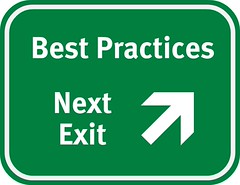
Those of us engaged in e-Education have a difficult time using various terms and words consistently and accurately. Therefore, we have a Best Practices Highway Sign - Next Exithard time communicating with others and they have a hard time understanding what the heck we’re talking about.

My term for today is “best practices.” It sort of makes me crazy every time I hear this because the practices are not always very good, let alone the BEST!! “Best practices” seems to be very egotistical and most likely just dead wrong. During many of my presentations I’ve made a remark something like this: “Every time I hear the phrase ‘best practices,’ I flip a little switch in my brain that converts the phrase into ‘practices that don’t totally suck out loud.’” That’s very different from “best,” and certainly more accurate.

Unfortunately, some people don’t like it when I use my favorite word (suck), so I’ve been trying to curb that urge.  For a while I found myself saying “good practices,” but that also bugs me, although a bit less than “best.” I always feel as though I’m comparing appliances at Sears – Good, Better, Best (I have no idea if they still do that, but they did about 40 years ago).

From this point forward, I am going to try to use the term “effective practices.” Unless, of course, the practices haven’t been effective and Best Practices Road Sign - Turn Around, you missed them completely.then I’ll call them something else. Effective practices sends me the message that these practices or methods have been tried and been found to be useful or worthwhile. Doesn’t say they’re the most effective; just that they have been at least somewhat effective. Also indicates that there can be several different practices that are effective, but there should only be ONE best – and I doubt that anyone has discovered that one just yet. Especially in an emerging field such as e-Education. But just in case you are the best, and you’ve discovered the best practice: More Power to Ya!!

Now let’s continue to document, to share, and to celebrate our effective practices.

(Graphics are my own. Creative Commons Attribution 3.0 Unported License.)

Adjunct Appreciation Dinner at SC4

I had the pleasure of presenting at the annual Adjunct Appreciation Dinner at St. Clair County Community College (SC4) in Port Huron, MI. This is both an appreciation dinner and a night of professional development for the adjunct instructors at the college.

My topic was Myths and Realities of Teaching with Technology. I’ll post the slides soon, but here are most of the links that I referred to during the address.

1) My Excellence in e-Education site:  http://xlents.com

2) Infographic that says 90% of faculty are using social media in courses they’re teaching (which I don’t believe)
Source: http://www.seo.com/blog/internet-changed-education-infographic/
Same source for Wikipedia/library use by students

3) Pearson Learning (& Babson Group) paper on faculty use of social media:
http://www.pearsonlearningsolutions.com/educators/pearson-social-media-survey-2011-bw.pdf  (PDF)

4) One of many articles related to the myth of learning styles:
http://elearnmag.acm.org/archive.cfm?aid=2070611

5) Infographic on text messaging:  http://www.mbaonline.com/planet-text/

6) Another infographic on texting:  http://cellphones.org/blog/facts-about-text-messaging

7) Broadtexter groups for safe texting w/students:  http://broadtexter.com

8) Remind 101 site for safe texting w/students:  http://remind101.com

9) ECAR Natuonal Study of Undergraduate Students and I.T. – http://net.educause.edu/ir/library/pdf/ERS1103/ERS1103W.pdf  (PDF)

10) Wi-fi.org research on college students and wi-fi:  http://goo.gl/Eg5kp

11) Wi-fi research study reported in ComputerWorld – http://goo.gl/Fh2F2

12) Brain Rules book site – http://www.brainrules.net/  see chapter 4 about multi-tasking (task-switching)

13) Digital Net-Gennials (whatever) – so many sources, so little time. Try these two.
Net Gen Skeptic (blog w/lots of research cited) – http://www.netgenskeptic.com/
Digital Natives – 10 Years After (JOLT) – http://jolt.merlot.org/vol7no4/koutropoulos_1211.htm

14) Broadband penetration:    http://www.websiteoptimization.com/bw/1107/

15) SOPA: hundreds of articles. Try these:
http://lifehacker.com/5860205/all-about-sopa-the-bill-thats-going-to-cripple-your-internet
http://edudemic.com/2011/12/sopa-guide/

16) Online Student Satisfaction data (my previous school) http://studentsatisfaction.wordpress.com/

Attend UW or UM at Half Price

Loved seeing this article on MPRnews about how Minnesota residents can save big bucks by sending their kids either the UM or UW. Around these parts, that usually means the University of Minnesota or the University of Wisconsin.

Not the case this time. The photo at the left is one of the many beautiful buildings at the University of Manitoba. That’s the UM in this story. Further down is a shot from the University of Winnipeg – that’s the UW.

Turns out that Minnesota residents can attend either of these very fine institutions of higher learning for about half the price of the cost of attending those other UM and UW schools.

The reciprocity agreement between the state of Minnesota and the province of Manitoba has allowed Minnesota residents to pay in-province (or whatever) tuition rates at the Manitoba schools – and that agreement has been in place for over 20 years. That tuition rate is between $3,500 and $4,000 per year at the Manitoba schools. Compare that with about $8K per year at the U of Minnesota. Plus, the Gophers football team sucks out loud. Heck it’s cheaper to go to the Canadian schools than it is to attend one of the Minnesota two-year schools.

I’ve written extensively about the high cost of  college in the U.S. Maybe this is the ultimate “work-around” to get a high-quality education at an affordable rate.

Odd that only about 50 Minnesota students currently attend college in Manitoba. It’ll be even more odd if that number continues to be so low once people start finding out about the opportunity that lies in wait.

There is a catch, of course. American students attending in Canada are not eligible for Pell grants, although they are still eligible for student loans. Of course, if the red legislators gut the Pell program as they would like to do, this may become a moot point.

One additional catch. I currently live 5 minutes on the Wisconsin side of the Minnesota border. Can we work out a similar reciprocity agreement between Manitoba and Wisconsin?

My Top 10 Tools for 2011

I have contributed to Jane Hart’s Lists of Top Tools for Learning each year since she started doing this five years ago. Her 2011 list will be finalized soon with contributions from people all over the world.  Listed below is my newest Top 10 list of tools, with short descriptions of why they made the list.

http://twitter.com/#!/barrydahl/statuses/132126396377083904

  1. Twitter. Stays at #1. Still the most valuable online tool I’ve ever used because it’s the place where I able to build the most valuable network of educators. Connect that same network of incredibly smart people into a different tool, then that tool will be #1 on my list.
  2. WordPress. I use WordPress.com for my main blog at http://barrydahl.com and during the past year I also created a new business site that is run on WordPress as well (see Excellence in e-Education). The themes, plug-ins, and other extras that are available make it a highly customizable tool.
  3. Google Plus (G+). This is a new entry on the list (obviously, since it didn’t exist last year). I’ve been surprised at how functional this young tool is – and how I’ve been connected to a whole new batch of educators through it. I find that I’m spending more and more time there and learning about things that I’m not always seeing in my other educator networks.
  4. YouTube. For both me and my kids, YouTube tends to be one of our first stops when we want to learn something. I post many of my own videos here, but I primarily find it to be a fabulous resource for all kinds of content, including educational videos.
  5. Picnik. I keep coming back to this super easy-to-use photo editor that integrates so nicely with my Flickr account. This is one of the few tools that I pay a fee ($25 a year) to get the premium service. Now my daughter is also hooked on using Picnik – in ways that only a 15-y-o would find fascinating.
  6. Zoho Notebook. I keep waiting for another tool to come along that has the functionality of this one – but that just hasn’t happened. Find another tool where you can make a series of webpages, with any kind of web-based content on any page in any location. It’s really amazing.
  7. Flickr. I continue to pay for the pro version ($25 a year) of Flickr because it is my main and almost only repository for digital pics and other graphics. As of 11/3/11, I have 4,520 items stored there. Almost all the graphics used on my websites are served from Flickr.
  8. Screencast-o-Matic. I’ve tried just about every screencast tool that is out there. There are lots of good ones andScreencast-o-matic logo some that are not so good. We also lose a couple of them every year to the dead pool. Screencast-O-Matic has hung in there over several years and just keeps getting better. This year I decided to support them by paying for a pro account (only $12 a year) which gives me access to editing tools, scripting, and offline use. They’ve recently added a feature that allows you to make animated GIFs as well as the standard screencast movies that can be stored on their servers, downloaded locally in various formats, or uploaded to YouTube.
  9. Toondoo. I make comic strips fairly often and encourage educators to include more of them in their teaching and learning. This is still one of the most popular tools in the Web 2.0 workshops that I provide at different colleges and universities. Toonbooks are very fun and can be used to deliver educational content that is certain to get the attention of students.
  10. Facebook. This stays on the list as I still have quite a few educators in my “friends” list. I also use it with my new business (please “Like” Excellence in e-Education!). I’ve also enjoyed reconnecting with old friends and college buddies, but that’s not why it’s on the list.
The main thing that fell off my list this year would be the following (this is what I said about it last year).
  • Android OS & Apps. This could have been higher on my list. I love my Droid, but mainly for all the things that Android and the plethora of useful (& mostly free) apps can do for me. First time I’ve felt like I have a computer in my pocket.
Soon I’ll post an update about how my relationship with Android has changed over the past year. Let’s just say it’s not pretty.