• Recent Posts

  • Tags (Categories)

  • Archives

  • Pages

  • January 2026
    M T W T F S S
     1234
    567891011
    12131415161718
    19202122232425
    262728293031  

Interview Answers – Part 2

Laramie County Community College digital signThe previous post contained my answers to the first five questions from my interview for the interim presidency at Laramie County Community College. This post contains the rest of the answers.

I’m expecting to hear something one way or the other within the next day or two – so soon you won’t have to hear about this stuff any more.

Q6. Describe a time when you took personal accountability for a conflict, failure or problem and initiated a solution with an individual(s).

A6. Unfortunately, we had a serious melt down of the technology used by instructors in the classrooms at the beginning of the most recent fall semester. We had a scenario where for the first time in memory the classrooms were not ready for the first day of class.Classes were scheduled to start on a Monday morning at 8:00. The previous Friday was a faculty development day with workshops and other learning events going on in the afternoon. Saturday was Parent Day at the college where many of the classrooms would be used for presentations by faculty and staff to the parents and families of new students at the college. For many, this would be their first impressions of the college.

I was one of the presenters for a couple of the faculty workshops on Friday. I was surprised that I couldn’t get several things to work properly while standing in front of a room full of faculty and other staff. The same thing happened in the second room where I was scheduled to facilitate another workshop. I started dropping into other classrooms and found that many of them had similar problems, such as outdated browsers on the computer, Windows updates that hadn’t been applied, missing plug-ins for playing videos, out-of-date anti-virus software, and the list goes on.

Finding this situation completely unacceptable, and knowing that the next people to walk into those classrooms were either the Saturday presenters for Parent Day, or the faculty members teaching their first classes on Monday morning, I set about to fix the problems. Along with one other employee, we worked Friday afternoon and evening, and most of the day Saturday to apply all these updates needed and to ensure that the classroom technology was ready to go.

I took responsibility for the poor state of technology in the classrooms in an all-employee email as well as in meetings of the Executive Council of the college. It was a personal embarrassment to me. Other employees in the Technology Division were also held accountable for the problems that we encountered.

Under the circumstances, I believe that I would do the same thing if I was a college president. It’s nice to have others available to take care of problems in the normal course of business, but when that’s not possible, you need to take care of things yourself.

Q7. Tell us how you have successfully lead subordinates through change in the past and the steps you took to ensure a successful outcome.

A7. This is another example that I’ll take from the world of online learning. I’m not sure if it happened here, but in most colleges there was a fair amount of resistance from some faculty, staff, and administrators against the whole build out of online learning opportunities for students. It wasn’t always easy to get buy-in for the concept. However, the college president had decided that this was a road that we were going to pursue and she provided the support for getting it done.

One of our early goals was to create the courses and services that would allow students to complete an entire AA degree at a distance. That meant that we needed to have liberal arts and sciences courses delivered online in a multitude of disciplines. However, there weren’t willing faculty members in all of these disciplines. So, I started searching for new faculty members who were willing, able, and eager to teach online.
Many of these new faculty members were not readily accepted by other faculty on campus. They weren’t considered by all to even be a part of the faculty. For a few of them, it had to feel almost as if they were scabs crossing a picket line.

We needed to do several things to start to gain acceptance. First of all, we received blanket accreditation from the HLC for any or all programs to be delivered online back in 2004. This was a process that involved lots of people and provided a good amount of data about what we were doing and how well the students were doing in online learning.

One of the concerns of the on-ground-only faculty members was that online was going to take away enrollments from on-campus courses, thereby threatening their ability to make a living. With regard to the liberal arts and sciences, that proved (over time) to be a falsehood. In fact, at LSC, the amount of on-campus instruction was the same in 2010 as it was in 2002. Flat enrollment on the physical campus over an eight year period, but the college grew a total of 26% during that time, all of the growth came from online.

The other thing that we started in 2004 was a quality of course design project that I hope to talk about later. These and various other things (including positive student feedback) helped to eventually wear down the naysayers to the point now where I think you’d be hard pressed to find someone on campus who would tell you that online learning has been a bad thing for the college as a whole or for the students.

Just a side note, back in the middle of the decade I made several presentations at conferences detailing all of the things we did to help make this change happen. The title of the presentation was “How to start a civil war on campus, and how to end it.”

Q8. Describe one of the most difficult decisions that you have made in your role as a leader. What would you do differently next time and what did you learn?

A8. I’ll go a bit off the beaten path on this one. One of my most difficult decisions related to leadership was when I decided to quit a doctoral program in Educational Leadership several years ago. I think it’s relevant since I sit before you today as a candidate without a doctorate in my pocket.
I have three kids. And yes, I started that project a bit later in life than most people do. I had just turned 40 when my first child was born. My third child was born in 2001 and it was shortly after that time that I started in the doctoral program. As I saw what a toll it was having on my family to have a husband and father who worked 50-60 hours a week at the college in addition to hiding away for hours at a time to do some school work, it became clear to me that I was going to miss a great deal of their formative years. It also became clear that if I was able to turn that doctorate into a college presidency, then I would also miss a great deal of the last half of their time growing up in the household.

I was $10,000 of the way down a $50,000 path, and right there I decided that my family was more important. I also decided that if I worked hard and developed a good record as a campus administrator that I would still have a shot at being a college president even without the doctorate. Not as good a shot, but still a shot. And if it doesn’t come to pass, then I’m okay with that and I still have never regretted walking away from the program when I did.

Q9. Tell us about an accomplishment you are most proud of personally and professionally. What made it so successful?

A9. I’m going to have to go with two accomplishments here. I don’t think there is one that I’m most proud of both personally and professionally.
Personally, I’m most proud of being a dad to three beautiful children. Blah, blah, blah. (I’m reminded of an old George Carlin bit “You’re supposed to love your kids, it doesn’t make you special.”)

Professionally, I’m most proud of providing high quality professional development opportunities to educators throughout the country, and a bit internationally as well. That includes many of the speaking engagements that I’ve been hired to provide, plus the last three years that I’ve spent as a board member for the Instructional Technology Council (ITC), one of the affiliated councils of the AACC. The network of engaged and engaging educators that I’ve been able to develop over the past several years has truly proved to be invaluable. I’ve received a great deal of positive feedback from attendees at workshops and conferences and it makes me proud to think that I’ve added real value to these events.

Q10. If an employee came to you with a problem relating to another employee and nothing had been taken care of previously, how would you handle the situation?

A10. There are several important pieces here, and my answer would probably benefit from many more details about the situation.

It could be that the college needs to undertake a process review with regard to the complaint processes that are in place and find out where they aren’t effective. If the processes are reasonable, then the breakdown must have come from some people in authority not doing their jobs.

If policy has been followed, and if someone has let these complaints fall through the cracks, then we need to look very carefully at the performance of the employee who didn’t act on this information. It’s inexcusable for someone to not act on complaints that are forwarded to their attention – that’s how a college gets sued.

However, the president should not be dealing with employee complaints early in the process. The process should have them go through the proper channels and the responsible people within those channels need to be doing their jobs. The president should not be involved early in the process because the president needs to be the appeal agent later in the process, typically the last possible appeal.

End of part two. So there you have it, warts and all. This is not intended to be a word-for-word transcript from what I said (you can see that on the video archive), but it is intended to give the gist of what I had to say for each question.

I might post my answers to the questions asked during the open forum, although I think the hiring decision by the college will happen before I get around to that. Probably a moot point by then.

Interview Answers – Part 1

In the previous post I talked about being interviewed for the interim presidency at Laramie County Community College. ToCowboy boot at entrance to Laramie County Community College have an open search process, they chose to live stream the interviews and open forums on the Internet. I promised to post my answers to the questions. Since they’re lengthy, I’ll post the first five here and then the second five within the next few days.

Q1. Laramie County Community College is interested in the quality of their programs.  Give us an example of a time when you became aware of deficiencies in program quality at a college where you were employed and how you fixed the problem.

A1. When I first became an academic dean at Lake Superior College I was responsible for various instructional programs. There were several issues related to one program area when I moved into this position. There were 5 or 6 different degrees available in this program area, but there were very few core curriculum courses. Core curriculum as a baseline for all of the programs made sense, but there was very little of that already in the program designs. Additionally, there were not enough students to go around for each program to survive. Their enrollment had dropped from over 300 program-declared students to less than 100 students right about the time I became the dean.

Some of the program and course offerings were outdated, teaching 10-year-old techniques and skills. Three of the six faculty members provided high quality learning opportunities for students, but three others did not. It was difficult to assign all six faculty members full teaching loads because some of them did not have the skills to teach many of the needed classes.

We undertook a massive redesign project that would consolidate the offerings into no more than three different degree tracks, which were all built upon the same basic core of introductory knowledge classes, and which featured a laddered system of certificates leading to degrees, with two or three stop-out points or program-shift opportunities. Today they have a much more focused program of study that has high quality instruction, utilizes state-of-the-art technology and prepares students for employment in 2011 rather than 1995.

BTW, the enrollment never really bounced back, but the students who are there are more satisfied and are receiving a much better education.

Q2. Organizational executives often delegate broad authority to subordinates.  Suppose you had authorized someone to fix a particular problem, and this person kept reporting progress on getting the problem fixed, but you were unable to determine if the situation was actually improving.  How would you go about assessing progress on the problem?   If it turned out that there was no progress, what would you do then?

A2. Delegating authority to others does not excuse you from responsibility for the successful outcome of the task. Delegating authority brings a focus on you in at least two different ways; how well did the task get completed that you delegated to another, and how wise was your choice of whom the task should be delegated to?

Another question that I would ask is whether the person giving the false progress reports actually believed that progress was being made. I can easily see the scenario where there is an appearance, sort of a false illusion, that progress is being made when it really isn’t. So, I don’t want to immediately assume that the employee was willingly lying to me about the progress.

I have been in this situation a few times in my career, one in particular that I will talk about briefly. Unfortunately, I will be accused of airing dirty laundry about an individual if I give you the details of the situation on a live Internet broadcast. So, I’ll try to give enough details to be informative, but not enough to pinpoint who I’m specifically talking about.

One example was a case where an employee had assured me that a project would be completed prior to the end of the school year. Turns out that the project wasn’t completed on time. When asked why, the employee had ready answers/excuses for how other things, out of his or her control, were creating roadblocks to getting the project completed. This went on throughout the entire next year as well. There was always a new reason why the project couldn’t be completed. Many of those reasons sounded perfectly reasonable so it started to feel like the project just wasn’t going to get done, at least not in our lifetimes.

Although the excuses/reasons sounded plausible, it was difficult to ascertain how legitimate the perceived roadblocks actually were. I started talking about these roadblocks in larger group meetings since many of the excuses had to do with other employees. People weren’t willing to speak up against their fellow employee in the group meetings, but they did seek me out privately to let me know that what I said in the meeting (about the roadblocks) just wasn’t true. Usually it was where something about another individual employee was being held out to be the roadblock. “I can’t get this done until Billy Bob gets that other thing done.” Having open conversations with multiple staff who had knowledge about the project was the only way to get to the truth of the matter. After assigning the project to a different employee, the project was completed within about one month.

Q3. Tell us about a time in your career when a whole department in your organization needed to be restructured.  How did you handle that situation?

A3. Best example is the answer to the first question about redesigning the programs and course curriculum for that unnamed department. For a different example, let me talk about what is happening at Lake Superior College right now and why my own job is being eliminated. This might help you understand my current situation, as well as give you insight into how I would handle a similar situation differently.

The college (LSC)  is going through a major reorganization. I’ve been employed at the college for 15 years; first as a faculty member and then as an administrator starting in 2001. The president that hired me as an administrator retired during the past year and on July 1 a new president started at the college. The new president is a very nice guy, has over 20 years of experience as a college president, and has a very different idea about how a college should be structured, especially at the administrative levels.

Wave one of the restructuring had my name on it. Myself, along with three other vice presidents, were informed that our positions were being eliminated. As an employee-at-will, I’ve always known that this could happen, and now I’m experiencing what happens when the will is gone. One of the vice presidents might still have some sort of position available to him at the college, but the other three of us are gone after our three months transition time (by contract) has expired. To use the well-worn analogy of seats on the bus, the current president wanted to have what he considered to be the right seats on the bus (the positions in the right place on the org chart), and would deal later with whether the right people were sitting in those seats.

If I had been in his position, I too would have been looking at some restructuring. However, I would have approached it differently. I believe that it is very difficult to recruit, hire, and keep really good people/employees. My priority would be to keep my best talent, even if it means finding a different role at the college for them as long as they were capable of filling those other roles. In other words, I would have spent more time finding out which of my bus passengers had the best skill sets and could help move the college forward, and then I would have made sure that they had a seat on the bus.

One of the other senior administrators made the following statement (not necessarily word-for-word) after the news came down: “It seems odd that three of the brightest bulbs in the room are being extinguished.” That’s the piece that I would have done differently if I was determining how to restructure the administration of the college.

Q4. What is your idea of the proper relationship between a college president and a board of trustees?

A4. The Board of Trustees hires and fires and hopefully inspires the president. Board members are elected by the residents of the county to represent their interests – to be accountable to the taxpayers.

The president works for the board – not the other way around. Since the president works for the board, and since the board works for the people, then the president works for the people as well.

Board members can’t be expected to deal with the day-to-day workings of the college. That’s the responsibility of the college president and the other administrators who have been delegated the authority to work within their areas of assignment. If the college is not operating efficiently, effectively, and ethically – then the president and other administrators must be held accountable. Held accountable by the board.

The board sets the overall tone by creating strategic directions and college priorities – then the president is expected to implement the board’s strategic direction, work on those priorities, and move the college forward. It should be a pretty clean (simple) relationship, as long as personalities don’t get in the way.

Q5. Tell us about a time that you had to improve the image of the college where you worked. What actions did you take and what was the result?

The only college where I’ve been in a position to have much impact on improving the image of the college was at Lake Superior College. LSC is located in the border cities area of Duluth, Minnesota and Superior, Wisconsin, also known as the Twin Ports. There are three universities, a career college, and two two-year colleges within a 15 minute drive of one another. There’s another community college just 20 miles down the Interstate. We didn’t have too much of a concern with improving the image of the college, we had more of a problem of even being recognized as one of the players in the higher education market (just having an image at all was the key for several years). Aside from buying advertisements, it was sometimes tough for us to even get the college name mentioned in the paper. You don’t seem to have that problem here at LCCC.

The image of the college in the Duluth/Superior community has slowly become more and more positive over the years. As the college has grown, and as the importance of the technical (career) programs and the liberal arts (transfer) programs has become more recognized within the community, the college has experienced a similar increase in its image as a serious contributor to the surrounding community.

One of my areas of direct responsibility at LSC was management of the e-Campus. Online learning makes up about 28% of the total enrollment at the college, but it provides 33% of the tuition revenue. Our first online class was back in the ‘97-98 school year. By 2000 it was growing rather rapidly and then I was selected in 2001 by the college president to be the administrator in charge of online learning; first as a Dean and later as a Vice President. We worked very hard to improve the image of online learning in general and the LSC e-Campus in particular. I’m proud to say that LSC students taking online courses have expressed significantly higher satisfaction with the reputation of the college than have the students taking on-campus courses at the college. Lots of people don’t want to hear that stated, but it’s a fact and there are data to prove it.

End of part one. So there you have it, warts and all. This is not intended to be a word-for-word transcript from what I said (you can see that on the video archive), but it is intended to give the gist of what I had to say for each question.

Job Interview – Live on the Internet

This was a first for me. Today (1/27/2011) I had a job interview that was broadcast live on the Internet via UStream. Additionally, the videos from both the committee interview and the open forum are archived for later viewing at the same site. I was being interviewed for the interim presidency at Laramie County Community College in my hometown of Cheyenne.

Having open, live broadcasts of a job interview is an interesting concept, but not without some pitfalls. In particular, it is difficult to answer some of the questions without talking about real people in real situations, and typically that means airing some dirty laundry in a live broadcast. Especially in my case. All of my administrative experience comes from Lake Superior College, a school with an enrollment about 80% as large as LCCC, but definitely small enough that all my “stories” can be traced back to actual people at the college. In a few cases I just decided what the heck, knowing that people back in Minnesota would know who I’m talking about. Other times I chose to bite my lip and remain somewhat vague about the situation – which of course means that people will speculate wildly about who I’m talking about. That probably means I lose points with the committee as well as losing some points with some of the people back home. Definitely a lose-lose situation.

Keep in mind who’s talking here. I practically bare my soul on the Internet for anyone to see/listen/read or whatever. I also speak in front of rooms of people all the time, including rooms holding 100’s of people. So, it wasn’t being on the Internet that freaked me out (although I didn’t tell my network about it until after it was over); it was not being sure that I could obscure the identity of the people I was talking about to answer the questions. Also, as you’ll see, most of the questions had a negative angle to them, and that generally brings up a story that casts one or more employees (and/or myself) in an unfavorable light.

The best questions for a job interview that is being broadcast to the world would be those where the candidate can talk about himself and what he would do (hypothetically) if certain scenarios presented themselves. I can’t make any guarantees about what I actually said in the heat of the moment, but in the next post I’ll share the answers that I either should have said or would say if given another chance at it. Also, let me say that it was somewhat disconcerting (okay, very disconcerting) to start right in with the interview questions and with the open forum questions without having an opportunity to make some introductory comments about who I am and why I’m here. Other than the committee members, most attendees probably had not read through all my application materials to know about my professional background. Even if they did, they almost certainly know nothing about my personal background – having grown up in Cheyenne and graduating from East High School, briefly attending the University of Wyoming before heading south to Arizona State University, and why I’ve spent so little of my adult life living in Cheyenne. So, I did my best to work those types of things into my answers whenever the opportunity arose, which was mainly in the open forum.

Without further ado, here are the ten questions from the interview. In a separate post or two, I’ll share the answers that I gave or those that I wish I had given.

Q1: Laramie County Community College is interested in the quality of their programs.  Give us an example of a time when you became aware of deficiencies in program quality at a college where you were employed and how you fixed the problem.

Q2: Organizational executives often delegate broad authority to subordinates. Suppose you had authorized someone to fix a particular problem, and this person kept reporting progress on getting the problem fixed, but you were unable to determine if the situation was actually improving. How would you go about assessing progress on the problem? If it turned out that there was no progress, what would you do then?

Q3: Tell us about a time in your career when a whole department in your organization needed to be restructured. How did you handle that situation?

Q4: What is your idea of the proper relationship between a college president and a board of trustees?

Q5: Tell us about a time that you had to improve the image of the college where you worked. What actions did you take and what was the result?

Q6: Describe a time when you took personal accountability for a conflict, failure or problem and initiated a solution with an individual(s).

Q7: Tell us how you have successfully lead subordinates through change in the past and the steps you took to ensure a successful outcome.

Q8: Describe one of the most difficult decisions that you have made in your role as a leader. What would you do differently next time and what did you learn?

Q9: Tell us about an accomplishment you are most proud of personally and professionally. What made it so successful?

Q 10: If an employee came to you with a problem relating to another employee and nothing had been taken care of previously, how would you handle the situation?

In closing, let me say that I enjoyed myself this morning. The college has many wonderful attributes. Whoever is picked to serve as the interim president will have a fabulous opportunity to make a positive impact on many students, employees, and community members.

8-Week Online Courses

My (almost former) college started offering several 8-week online courses in the fall of 2009 that would allow a student to work on 2 courses at a time, for 8 weeks at a time, and still complete the Associate of Arts degree in 2 years. This was one of the outcomes of our Flexible Learning Options action project. The slideshow below contains data about completion rates, grades earned, and student feedback about the 8-week offerings.

Highlights include:

  • During the 2010 academic year, there were 2,477 enrollments in 8-week online courses and 7,470 enrollments in all other online courses (mostly of the 16-week, full-term variety).
  • Students in the 8-week sections completed the courses with a grade of C or better 82.2% of the time, compared to 78.1% for the full-term courses.
  • Students in the 8-week sections earned a GPA of 2.93 compared to 2.75 in the full-term courses (looking at GPA in those courses only).
  • Students enrolled in summer school and the first 8-weeks of the regular semesters had better completion rates (about 85%) than those registered in either full-term courses (78%) or courses during the second 8 weeks of the regular semesters (75%).
  • In year 2 of the offerings, two-thirds of the students said they were aware that they were registering for a shorter course at the time of their registration. This was an increase from 56% in the first year.

One of the main reasons that we implemented the 2-by-8 offerings was to make it more likely that students would complete the course. That appears to be true for those sections offered during the first 8 weeks of a 16-week semester, however it appears to be slightly less likely that they will complete the course if it scheduled for the second 8 weeks of the semester. Someone should be paying attention to this going forward. Just saying.

Online Developmental Courses

I recently attended a MnSCU conference where the keynote speaker was Dr. Hunter Boylan from the Center for Developmental Education. The title was “Best Practices in Developmental Education.” During the question and answer session at the end of the presentation, an audience member asked him to share information related to examples of good practice in offering developmental courses via online delivery.

His quick retort was basically to the effect of “there aren’t any.” I actually don’t know whether there are any examples that I would consider to be best practices, but I think that many people in the audience translated his response to mean something like this: “I don’t have any examples because there can’t possibly be any.” I repeat, he didn’t actually say that, but I believe that is what many people heard.

He went on to say that the completion rates (or success rates) in online developmental courses are abysmal. Way below the rates for on-ground courses. That may be true in many places, but it’s not true at my college. I’m not here to say that my college has a best practice in online developmental courses, but I am here to share some info about our online courses.

First, a little history.

  • Fall 2002 was the 1st term that we offered the three developmental math courses online
    • MATH 0450: Pre-Algebra (23 online sections in total have now been taught)
    • MATH 0460: Algebra I (38 total online sections taught)
    • MATH 0480: Algebra II (30 total online sections taught)
  • Spring 2004 was the 1st time we taught online ENGL 0460: Fundamentals of Writing II
    • Writing II has been taught online a total 19 times
    • ENGL 0450: Writing I has been taught online 4 times, starting in Spring 2006
  • Spring 2005 was the 1st time we offered online READ 0460: Reading Strategies II.
    • Has been taught online a total of 17 times
  • All of the instructors for these courses also teach sections of these classes on-ground, or have many times in the past. One ENGL instructor is now 100% online, but she previously taught the same courses on campus.

I decided to pull the most recent data about course completions, grades, and GPA in these developmental courses. During the 2009-2010 academic year, 510 students registered (past the drop/add period) for the online courses and 2,226 students registered for the on-ground courses. Here’s a few of the data points:

  • Course withdrawal rates were identical at 15.7% for both groups.
  • More A’s were given in online courses: 25.1% to 21.3%.
  • More F’s were given in on-ground courses: 17.5% to 16.8%.
  • GPA in these courses was 2.37 for online and 2.31 for on-ground.
  • Measuring success as all passing grades (A-D), 67.5% online to 66.8% on-ground.
  • Measuring success as C or better: 62.3% for on-ground to 60.4% for online.

Here are a couple of charts based on breaking down each developmental course during the year into two buckets: online and on-ground.


I realize that this begs for answers to many more questions, such as:

  • How did these students perform in subsequent courses in that discipline?
  • What were the term-to-term or year-over-year persistence rates for the two groups?
  • How would these students have performed on identical assessments if given to both groups?
  • Could the online students have attended on-ground if online wasn’t available?
  • For how many online students was this entry into college their only opportunity for access?
  • How many online students would have done better in an on-ground course, and vice-versa?
  • etc. etc. etc.

I am planning to look into some of the data related to persistence and future success rates in follow-up courses. I’ll report back on what I find. Don’t hold your breath, it might take me a while to get around to it.

Enrollment Growth – All Online

Here’s an interesting chart that depicts the enrollment growth over an 8 year period at Lake Superior College. It is based on the the number of FYE, or full-year equivalent enrollment which is based on a full-time (very full-time) student taking 30 credits per year.

Looking at the green columns and arrows, you’ll see that the total enrollment increased from 2,923 to 3,675 FYE, or an increase of 25.7%. That’s a rather modest increase over an 8-year period, compared to gains by many community colleges, both inside and outside of Minnesota.

You’ve probably noticed the red columns by now, which represent the increase of on-ground and hybrid enrollment from 2,699 to 2,700. I guess you can say that the on-ground enrollment has been flat – as in, completely flat from the beginning to the end of that 8-year period..

The increase of 752 FYE has come as a result of the online enrollments at the college. This data indicates several things to me, including:

  • Our traditional classrooms were basically full during prime time (daytime, not too early and not too late) back in FY02 and they are still full today. We actually have a few more classrooms on campus today than in 2002, but only a few.
  • In other words, we weren’t going to get this enrollment growth on campus due to a lack of classroom space at time when people want to or are able to attend.
  • All this enrollment growth has been achieved without making our parking shortage any shorter. Basically.
  • Online enrollments at LSC have not taken away from face-to-face enrollments, which has always been one of the biggest fears of those faculty and administrators who were slow to buy into the value of online learning.
  • Without this enrollment growth, the college would have been in much more dire financial straights. The whole college has benefited from the growth of online learning.

Educause Review – Don’t Miss It

The July/August 2010 issue of the Educause Review has several really good articles. Here’s some info about two of them.

David Wiley: (@opencontent on Twitter) has an article titled “Openness as a Catalyst for an Educational Reformation.” He believes that all the various aspects of openness in education all come down to the same common denominators. “They are acts of generosity, sharing, and giving.” When you talk about openness, you generally also have to talk about the lack of openness. Consider the examples of educators unwilling to share their content, their course resources, their syllabi, their text materials, etc. “Unfortunately, modern law and college/university policy tend to enable this bad behavior, allowing us to shout “Mine!” ever more loudly, to stomp our feet with ever less self-control, and to hit each other with ever harder and sharper toys.”

He also laments the LMS/CMS affects on the idea of sharing and openness: “If Facebook worked like Blackboard, every fifteen weeks it would delete all your friends, delete all your photographs, and unsubscribe you from all your groups.” That’s good stuff, as is this: “The conceal-restrict-withhold-delete strategy is not a way to build a thriving community of learning.”

FYI: David Wiley will be one of the keynote speakers at the 2011 ITC eLearning conference in St. Pete Beach on February 19-22.

Dave Cormier and George Siemens penned an article titled “Through the Open Door: Open Courses as Research, Learning, and Engagement.” They start with this passage:

“Over the last decade, as educators have increasingly experimented with social technologies and interactive pedagogies, the concept of a “course” has been significantly challenged. In particular, questions have arisen as to the key value of the course in the educational system. Is the value the content — the academic journal articles, lectures, textbooks, and libraries that compose much of the teaching and learning process? Or is it the engagement and interaction that occurs through discussions? Or is it the self-organized activities of learners in the social spaces of a college or university?”

Throughout the article, the authors try to deal with the concepts of “open” and “openness.” As they say, “The word open is in constant negotiation.” They talk about Open Educators, Open Curricula, Open Learners, and even Open Accreditation.

I agree with them about the value of content in the academy. Content is definitely NOT king. “The actions of institutions like MIT suggest that the true benefit of the academy is the interaction, the access to the debate, to the negotiation of knowledge — not to the stale cataloging of content.” Lots of good stuff in this article by George and Dave.

I’ll follow up soon with some info about at least two other articles from the issue.

Comments from Student Evals

Just received my stack of reports from the student evaluations of online courses for the summer term. Just thought I’d share a few of the comments. My emphases added below.

The more happy campers:

  • I really enjoyed this course! LSC Online courses are very impressive! They are so well organized and easy to use! I get better feedback than in my University on campus courses!! You are all great and thank you [name deleted] for a wonderful semester!
  • This course was more interesting than I thought.
  • This was probably the best and most addicting online class I have taken.
  • [Name deleted] has been one of the best online instructors I’ve ever had! I have completed a few from another institution, and this has been the best experience with online learning thus far!
  • I really enjoyed this course and it has really stretched my mind and made me realize there is so much more to the universe than anyone can fathom. Thanks!!
  • I have taken most of my science classes online with [name deleted] and without exception they have been good experiences and I’ve felt that I learned A LOT!  The labs and learning objectives that must be completed really a great teaching tools.  I always recommend his classes.  Again even though his class is online, I felt I have learned more than in regular classes!
  • I really enjoyed this class.  I took the same class at Lake Superior College in class and didn’t pass.  I felt like this class was easier for me to learn the material than it was in class.
  • [Name deleted] is one of those very rare teachers who really loves his students and his work.  He’s kind, fair, but isn’t a pushover, either.  Most online instructors (I’ve taken 15 online classes) don’t put forth a fraction of the effort [as he] does into teaching an online course.  I walk away having learned so much.  Thank you.
  • I’ve taken all my post high school education online.  I’m going into my senior year, and this class was great.  I learned a great deal about the subject and was treated with respect.  He was very organized and responded to any concern or question without making me feel like I was bothering him.  I was very pleased with this class, and I do not usually give this high of scores.
  • I dreaded taking this course!  By the end of this course, I fell in love with it and am toying with making it my minor!  It was so practical and real and applicable in comparison with the University’s similar course! LSC Online courses are A-M-A-Z-I-N-G!!!! Thanks for a fabulous semester!!!

The less happy:

  • The only thing that I found frustrating is that when the material had become available for the week, I would print it out and then find out that there were some changes that were made to the material without notifying thestudents about the changes.  Also, I think the material should have been available on Wednesday instead of Thursday.
  • There was no clear rubric for the class.  Feedback on assignments was unheard of.
  • For being a course titled “Fundamentals,” he graded harder than my AP1 instructor, it shouldn’t have been so strict as it was a general course for the majority of the student body, until this semester I had a 4.0 and getting a B in this class is something baffling to me and irritating.  The advance courses to courses taken at a university out of state, I found my experience with this course frustrating in the grading department.
  • This course was nothing more than reading the text book and taking a test, then writing 4 short papers.  There was no point in logging on more than once a week to take the test or turn in the paper.  I learned a boring, repetitive history of [deleted] that I could’ve learned reading the book at home and not paying for credits.
  • I work full time and take other classes.  This class was very time consuming for a three credit lecture course, which, even in an eight week summer term, should only be 6 hours of work each week. That’s 2 hours, three times a week.  Not 3 hours every day.  That said, I enjoyed her teaching style and would definitely take more classes with her.  Though, I won’t be taking any more online or summer classes.
  • I found this class hard to follow along with, it seemed like a jumbled mess, but it was still good.
  • Too much time elapsed between completion of an assignment and receiving grades and feedback, way too much time.

As you might have guessed, sometimes the same instructor has a comment in the happy list as well as the sad list. Don’t you just love these evals?

A “Debate” (kinda) at DLA2010

I’m attending the Distance Learning Administrators conference at the Jekyll Island Hotel Club. You can tell from the pics that this is a lousy destination. 😉

Tomorrow morning I will join Myk Garn for a quasi-debate based on the following proposition:

Resolved: Faculty must be required to actively consider, and explicitly justify, cost when selecting textbooks and instructional materials students will be required, or advised, to purchase.

I don’t know yet which side of the argument I will be taking. The moderator, Micheal Crafton, will flip a coin and we’ll choose sides based on that twist of fate. So, I might be arguing for the affirmative and I might be on the negative. Quite frankly, I don’t know which side I prefer – and I’m woefully under-prepared to speak for either side.

So, feel free to help me out in the comments section. Your input will be added to the crowd-sourcing that we are planning to do as part of the “debate.” We will be asking the audience (if there is one) to provide ideas for the constructs on each side before we actually give our opening arguments. This is basically an experiment, so we’ll see how it goes.

Reading List from MnSCU Keynote

I’ve had a few requests for more info about the books I referenced during the keynote address at the MnSCU ITS conference, Tuesday, April 27 at Cragun’s in Brainerd. Rather than reply to those individual emails, I decided to write a post about them instead.

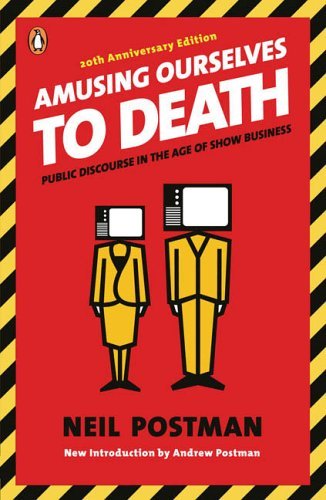
Of course the star attraction was Neil Postman’s Amusing Ourselves to Death. This book basically set the stage for much of the keynote by begging the question about whether we in education have fallen into the same trap that he wrote about in the mid-1980’s about ignoring serious discourse in order to package and produce our content in an effort to attract viewers (err, learners).  I’ve already posted a stream of consciousness that was a direct result of my references to Postman as well as the iPad during the presentation. Therefore, I won’t dwell any more on that book in this post.

I also referenced Brain Rules by Dr. John Medina. You can also check out the website for the book where he freely shares much of the info contained in the book. The main point of his that I used during the presentations was the one about human multi-tasking. First I asked the audience to use the clickers and answer this question.

As you can see, about half of the audience (n=252) believed that the human brain can multi-task. Here’s a brief audio-book intro to brain rule #4 that talks about multi-tasking. Remember that we (humans) can task switch, but not multi-task in any important way (yes, the walking and chew gum can happen at the same time, but that does not require concentration). There’s lots of good info in this book that should impact the way that we teach, because there’s lots of good evidence in here about the ways that we learn. Highly recommended.

I briefly referred to a book titled 33 Million People in the Room when we were talking about cell phones, Twitter, Facebook, and all the other ways that people in the audience could connect with other people in their networks without leaving the room in which we were all sitting. Behold the power of the network.

I moved on to a series of quotes to see who could name this author, slash professor (or is it the other way around?):

  • “Anyone who tries to make a distinction between education & entertainment doesn’t know the first thing about either.”
  • “I wouldn’t have seen it if I hadn’t believed it.”
  • “I don’t necessarily agree with everything I say.”
  • “All media exist to invest our lives with artificial perceptions and arbitrary values.”
  • “We shape our tools and afterwards our tools shape us.”
  • “We look at the present through a rear-view mirror. We march backwards into the future.”
  • “The medium is the message” as well as “The medium is the massage

I didn’t refer to any particular book of Marshall McLuhan’s, but here are a few possibilities:

During the whole riff about the B.S. that is the discussion about the different generations, I referred to several books. I’m not going to give the “millennials-are-different” pro side any ink here – let’s suffice it to say that they are already way too over-hyped, over-published, and over-sold. However, I highly recommend the book that I referenced as pointing out a very different view which is heavily based on research and has a direct implication for how we are choosing to educate young people these days. That book is The Dumbest Generation by Mark Bauerlein. This is the book that I mentioned had upset so many people, but I think you’ll find that it was not written for the purpose of upsetting the non-believers; rather I think it was intended to be a wake-up call to society in general and educators in particular about how we need to stay vigilant in making education a place with rigor and relevance.

There were several other books that influenced my thinking in one way or the other, but those are the main ones that I referenced during the talk. Anyone who is looking to add to their reading list could do a lot worse than adding those titles to their list (except one – do you remember which one I said was a good concept but not worth buying the book?).