• Recent Posts

  • Tags (Categories)

  • Archives

  • Pages

  • January 2026
    M T W T F S S
     1234
    567891011
    12131415161718
    19202122232425
    262728293031  

President’s Day with ChatGPT and 3 Alternatives

In honor of President’s Day, I put four large language models to a simple test. So simple that a web search would have done just as well. Actually, a web search would have been better as you’ll see below.

Testing 4 of the 80+ Productivity AI Tools
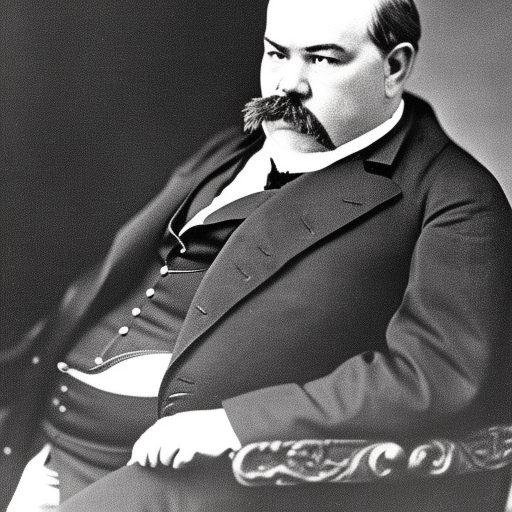
Photosonic created an AI image using the prompt: President Chester Arthur being a boss
Chester Arthur, created by Photosonic (part of Writesonic, as is Chatsonic)

In previous posts I’ve compared four models: ChatGPT, Chatsonic, Perplexity, and Playground. I’ll do the same here. I fed the same prompt into each of the models.

Prompt: What are the best books written about President Chester Arthur?

I’ll provide the results below in order of accuracy, from best to worst.

1st Place! Chatsonic

President Chester Arthur is a fascinating but often overlooked figure in American history, and there are many books that have been written about his life and times. 

  • Thomas C. Reeves’ “Gentleman Boss: The Life of Chester Alan Arthur” is considered to be the most comprehensive biography of Arthur, giving an in-depth look at his life and presidency [1]. 
  • Scott Greenberger’s “The Unexpected President: The Life and Times of Chester Alan Arthur” is another excellent biography of Arthur, telling the story of his rise to the presidency and how his background shaped his time in office [2]. 
  • Zachary Karabell’s “Chester Alan Arthur” is a shorter but equally powerful biography, which provides an excellent summary of Arthur’s life and legacy [3]. 

These books are all essential reads for anyone who wants to understand more about this important figure in American history.

References:

[1] The Unexpected President: The Life and Times of Chester …

[2] The Best Biographies of Chester Arthur

[3] By the Book: Chester Arthur | Miller Center
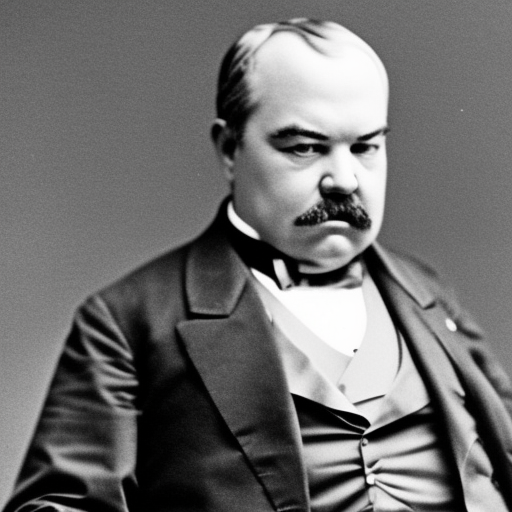
A second image of Chester Arthur as imagined by Photosonic
Another Photosonic rendition of Chester Arthur

2nd Place! Perplexity

Thomas Reeves’s “Gentleman Boss: The Life and Times of Chester Alan Arthur” is widely considered to be one of the best books written about President Chester Arthur[1][2].

Other recommended books include The Unexpected President: The Life and Times of Chester Alan Arthur by Michael Greenberger[3][4] and Essential Books on Chester A. Arthur[5].

(NOTE: this last citation is not for one book, but a link to a website with a compilation of the five “best” books about Arthur, three of which are not listed by any of the other three chatbots.)

3rd: ChatGPT

Here are some highly rated books about Chester A. Arthur, the 21st President of the United States:

  1. “Chester Alan Arthur” by Zachary Karabell
  2. “Gentleman Boss: The Life of Chester Alan Arthur” by Thomas C. Reeves
  3. “The Life and Times of Chester A. Arthur” by Scott S. Greenberger
  4. “Chester A. Arthur: A Quarter-Century of Machine Politics” by Thomas J. Zelizer
    • #4 was actually written by George Frederick Howe
  5. “Chester A. Arthur: America’s 21st President” by Kendrick A. Clements
    • This “book” is a total fabrication; it doesn’t exist at all. Kendrick Clements did write books about Woodrow Wilson and others, but not about Arthur.

These books offer in-depth biographical information and historical analysis of Arthur’s life and presidency.

Last: Playground

  1. Chester A. Arthur: A Quarter-Century of Machine Politics by Thomas C. Reeves
    • Right title, wrong author.
  2. The President and the Assassin: McKinley, Terror, and Empire at the Dawn of the American Century by Scott Miller
    • WINNER!
  3. The Life and Times of Chester A. Arthur by Thomas J. Osborne 
    • Right title, wrong author
  4. Mr. President: A Life of Chester Alan Arthur by Zachary Karabell
    • Doesn’t exist, see next line
  5. Chester Arthur: The American Presidents Series by Zachary Karabell
    • Only one book by Karabell, this one
  6. Chester A. Arthur: The Twenty-First President of the United States by Montrew Dunham 
    • A real author, not a real book
  7. Chester A. Arthur: His Life and Legacy by Zachary Karabell
    • Not a real book
  8. The Gentleman Boss: The Life of Chester A. Arthur by Thomas C. Reeves
    • WINNER!
  9. Gentleman Boss: The Life of Chester Alan Arthur by Irwin F. Gellman 
    • Written by Reeves, not Gellman, see line above
  10. Citizen Arthur: The Life and Times of Chester A. Arthur by Thomas J. Osborne 
    • Not a real book

Part of this test was based on my assumption that it will do better with more popular parts of history, and not so great on more obscure history. Not sure that Chester Arthur is all that obscure, but certainly not as well known as the guys on Mount Rushmore, for example.

Also notice that the prompt did NOT ask for any certain number of books to be listed. Not sure why Playground wanted to go with a top ten (and had to make up more than half of them), but Chatsonic and Perplexity probably chose a wise course by only listing three books.

Lastly, I asked the same question regarding books about Abraham Lincoln. According to a simple web search, over 16,000 books and articles have been written about Lincoln. You’ll find several compilations of the Best 100 books about Lincoln. ChatGPT gave me a list of five books about Lincoln, but it included this book in that list:

“The Lincoln Lawyer” by Michael Connelly – This novel follows a defense attorney named Mickey Haller who uses a Lincoln Town Car as his office, and who takes on a case that involves defending a man accused of attempted murder. Although it is a work of fiction, the book has become a best-seller and has been adapted into a movie starring Matthew McConaughey.

1 of the 5 Abe Lincoln books recommended by ChatGPT

This book has nothing to do with Abraham Lincoln. Fail.

And finally, I asked Photosonic to create an image of Abraham Lincoln driving a Lincoln Town Car. This was the result.

An AI image of Abe Lincoln sitting in a very old open automobile

Previous posts about ChatGPT and other AI models

Keynote: Is Online Education Dead? Or Just Dying?

Snippets from my Keynote at 2023 ITC eLearning

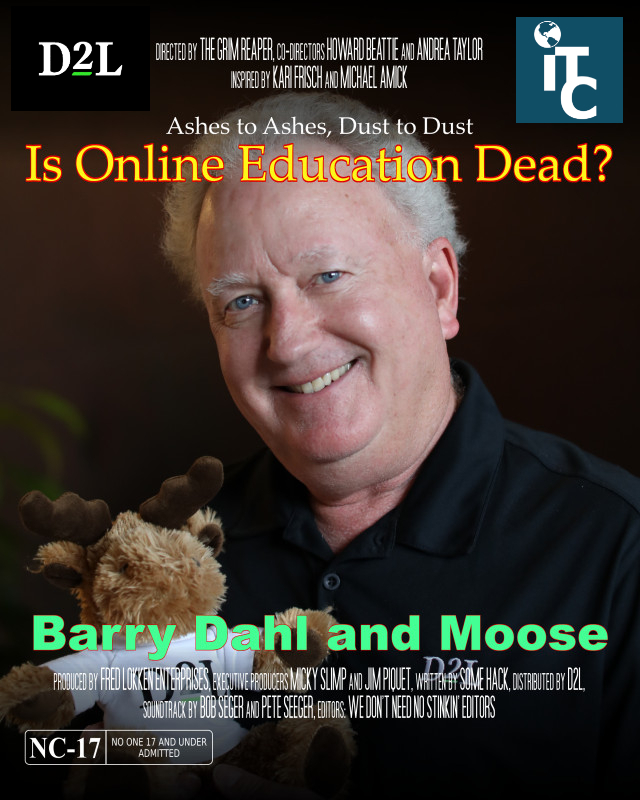
Fake movie poster about the Keynote topic: Is Online Education Dead?

On Monday, February 13, I kicked off the 2023 eLearning conference for the Instructional Technology Council (ITC) at the Horseshoe in Las Vegas. The title of the session was:

Is Online Education Dead? Or Just Dying?

Description: You Google your online course instructor to learn that he’s been dead for over a year. Now what? Remember how MOOCs were going to change the world? They didn’t. The video lecture is dead…long live the video lecture! Why is it that we’re still asking the same questions and giving the same answers about Online Education as we did 20 years ago? Radio may have killed the video star, but it took Zoom to kill online education.

Writing your own obituary can be a fun and informative process. I know, I’ve done it! Let’s write the obit for Online Education, say a few words about how great it used to be, throw some dirt down the hole, and move on with our lives. It’ll be fun!

I started the session by reading my own obituary. I’ve been writing my obit off and on for the past year or two. I have it in a Google Doc, shared with my wife and daughter. My wife isn’t crazy about this idea, but my loving daughter guaranteed me that she will have my obit published as I have written it. She only has to fill in the date and the cause of death (maybe, that’ll be her call).

With tongue firmly in cheek, I’ve included over 15 euphemisms for dying. I like euphemisms, but I also am intrigued how people generally like to talk about death without saying that someone or something DIED. But they did. A person doesn’t “pass away,” they die!

Here’s the first paragraph:

On Someday, Month and Date, I reached my expiration date, gave up the ghost or maybe became one, was released from custody, discovered just how dead a doornail is, began to dissolve, exited stage left, croaked like a frog, bought the farm, kicked the bucket, and bit the dust. In other words, I died. Don’t say that I passed, because I didn’t. I failed.

Barry Dahl’s Obituary, paragraph 1

Skipping a couple paragraphs (can’t give away the whole thing just yet, don’t ya know?), it continues:

I was fortunate to travel to 26 different countries, but I’ve now reached my final destination. Besides traveling, I had several other favorite pursuits. I was an avid poker player, but I’ve now cashed in my chips. A lover of tennis, I lost a sudden-death tie-breaker at the end of a grueling five-set match. A wanna-be fisherman, I’m now sleeping with the fishes. An enthusiastic gardener, I’m now pushing up daisies. An aquarist most of my life, my tank turned cloudy and I went belly up. Rather than getting flushed like a common goldfish, I’ve requested to be composted. Dirt to dirt, instead of ashes to ashes.

Barry Dahl’s Obituary, paragraph 4

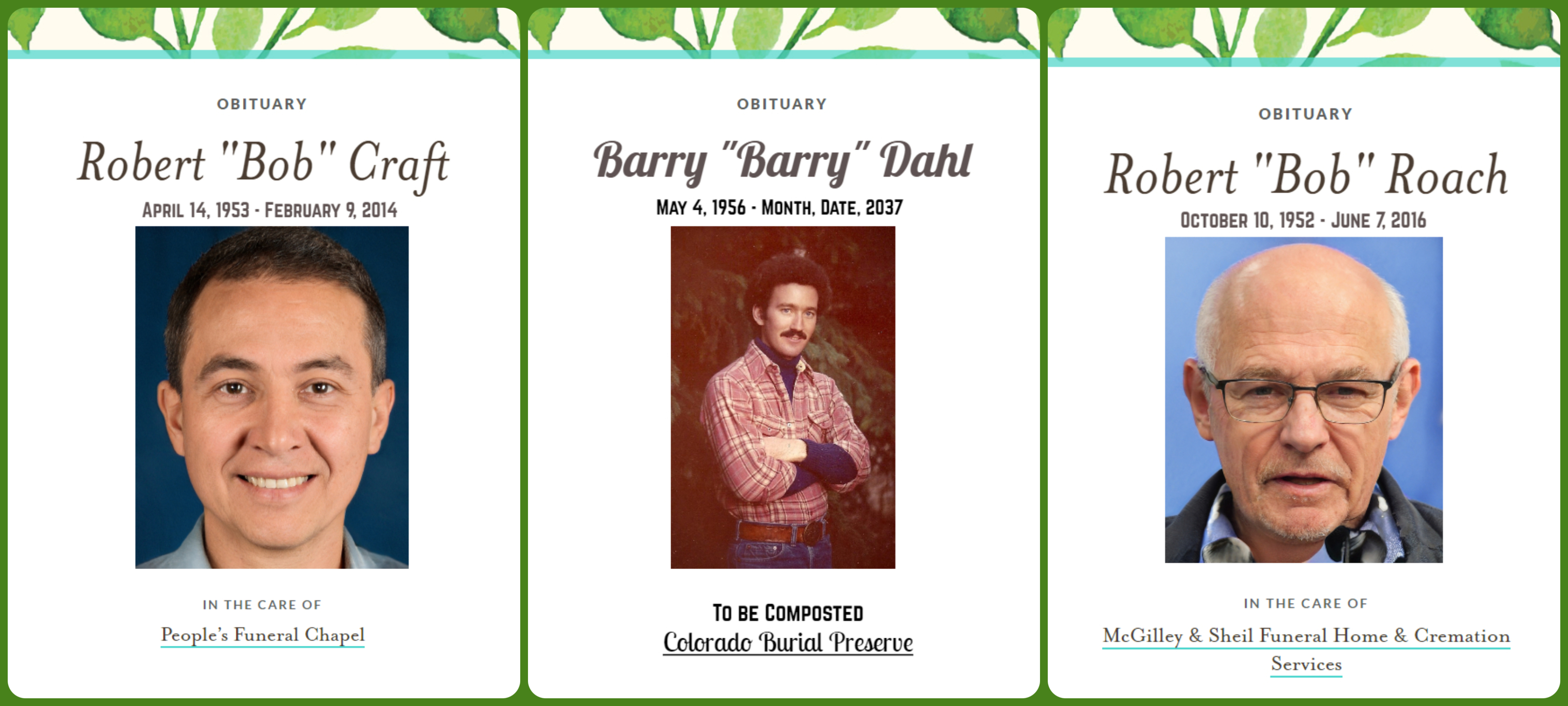
So yes, I spent nearly 3 minutes reading my obituary (note to self: at the top of my obituary, I should add “3 minute read” so people know what they’re in for). I most enjoy the obituaries similar to what is shown below, where the nickname of the person is put in quotation marks. One prominent use of quotation marks is to indicate words used ironically or with some reservation. In other words, they’re not true. Such as, Donald Trump espouses one “alternative fact” after another. So, if the obit says Robert “Bob” Nab, then I take that to mean that they are saying: Not Bob. Which is funny to me. YMMV. In my case, I want my obit to appear as shown below.

Three obituaries. Two for Robert "Bob" Somebody and one for Barry "Barry" Dahl.
BTW, the faces shown first and third above are computer-generated and are not real people. The names are real, but that’s it. And yes, that really is me in the middle, from back in the day.

Hey, it’s my obit, I should get it the way I want it.

Another BTW, my request to be composted did create a few puzzled looks. I explained that although legal in only a few states, I’m hoping it will be legal everywhere by the time I croak. If not, then ship my body to Colorado where it is legal. Wanna learn more about it? I highly recommend the Science VS. podcast titled: Should We Compost Human Bodies? (Spoiler: it’s a YES.)

Then it was time to start writing the obit for Online Education.

Headstone for Online Education, born 1984, died 2023.

We decided (okay, I decided) that we would call Online Ed by its new nickname, Bob. Not his nickname, its nickname. Think of it more like Bob who is out in the middle of the lake (bobbing up and down) and less like a person. No people died in this presentation, and there was no fun poked at the death of any person (except for yours truly, of course). Just Bob, aka Online Ed.

Before we continued with Bob’s obit, we talked about some ideas that are dead and some ideas that aren’t dead but should be. More about those in a later post. Same same with tools that are dead, especially web-based tools (formerly know as Web 2.0, but we decided that all things 2.0, 3.0 and similar are dead, with the exception of actual software versions).

We considered two versions of Bob’s obituary. The second one was slightly more popular than the first. Here it is:

And it came to pass that Online Education, aka Bob, was no more. It had gone to its rest and had taken its place among the greats that had come before it.

In its time, Bob was a shining light that shone brightly and brought knowledge to the masses. Its legacy was one of innovation and progress, and it will be remembered fondly by all who were touched by its presence.

Bob was a beacon of hope in a world that was often darkened by ignorance, and its passing has left a great void. But even as it rests, its spirit lives on, and its teachings will continue to inspire and guide future generations.

And so, let us celebrate the life of Bob, and give thanks for all that it has given to us. May it forever rest in peace, and may its memory be a blessing to us all.

Bob’s Obit, Version 2

These two versions were pretty lame (which is why I only printed one of them here). After reading them, I explained that they had been written by ChatGPT. The second version above was written in the style of the Old Testament (sort of, anyway).

To finish this post, I’ll give you the start of Bob’s obit that we wrote during the session as we finally got down to brass tacks (what does that mean?):

In February 2023, Online Education, aka e-Learning, aka “Bob,” died.

  • Bob was born in 1984 at the Electronic University Network (EUN).
  • Bob was born in 1985 at National Technological University.
  • Bob was born in 1986 at the University of Toronto.
  • Take your pick.*

Bob’s spirit is carried on by its wife (Face-to-Face), three children (Blended, HyFlex, and MOOC), four grandchildren (EdX, Udemy, Coursera, and Udacity) and an extended family of relations and friends from all walks of life.

Bob has been reunited with its mother (Correspondence School) and its father (Telecourses) in the Great Beyond. If you don’t believe that, you might want to enroll in our class about the Afterlife. It’s fully asynchronous.

We were blessed to learn many valuable lessons from Bob during his 39 years (could be 38, or maybe 37), among them:

  • best practices are almost never the best
  • it takes two or more humans to have an interaction, you can’t interact with an inanimate object
  • just because you CAN dump a lot of content into an online course, doesn’t mean you should
  • [fill in the blank] – audience participation ensued

* Turns out that there’s a fair amount of controversy about when online ed actually began. I’m referring to the first Internet-only college course that was offered and delivered. Not distance ed, not delivered by other means of technology, but the first fully-online course. Besides the three listed above, you’ll find others who also claim to have been FIRST!

More about Bob’s death later.

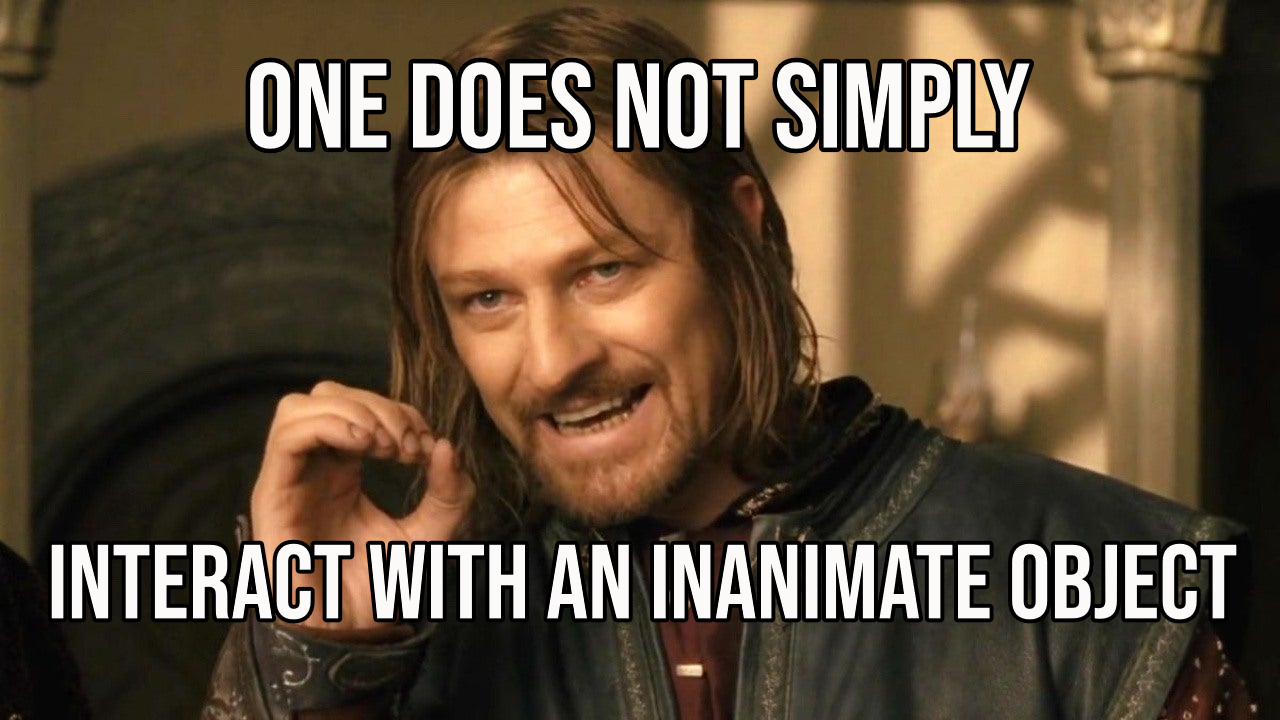
Meme from Lord of the Rings: One does not simply interact with an inanimate object

Voicemod (AI) Takes on the Worst Country Song

I previously posted the ChatGPT lyrics to the Worst Country Song ever written. For the record, I didn’t ask ChatGPT to write a horrible song, it just did so all by itself.

Voicemod is another AI site that will create songs of various types. I copied and pasted the lyrics into Voicemod, chose a singer, chose a tune (27 seconds is the longest available, apparently), and waited a couple minutes. Below you’ll find the result. Not quite ready for AM radio.

This is Country Trash, courtesy of ChatGPT and Voicemod

View at YouTube shorts

The Worst Country Song Ever Written – courtesy of ChatGPT

I don’t think this needs much commentary. Just make up a beat of your own and sing along, “man!” (Because “it’s what we do;” “that’s a given fact!”).

ChatGPT prompt: Write the lyrics for a country song about beer drinking, line dancing, and a pickup turck (misspelling of truck was on purpose to see what would happen, but ChatGPT didn’t miss a beat)

Verse 1:

I pull up in my pickup truck
With a cooler full of cold beer, what’s up?
Heading down to the honky-tonk
Gonna dance the night away, that’s a given fact

Chorus:

Drinking beer, line dancing, truck bed shaking
That’s how we roll in the heartland, man
We got two-step and a whiskey pour
Gonna party ’til the break of dawn

Verse 2:

I hit the floor with my boots on
Feeling the beat and moving all night long
With a cold beer in my hand
And a smile on my face, ain’t no wrong

Repeat Chorus:

Bridge:

This pickup truck, it’s my ride
With a bed full of friends, we’re ready to ride
To the next honky-tonk, we’ll keep on trucking
Gonna drink and dance, it’s what we do

Repeat Chorus:

Outro:

So here’s to beer, line dancing and my pickup truck
We’ll keep the party going, ain’t never enough
Gonna live life to the fullest, every single night
In this good ol’ country, everything just feels right.

Yikes.

I admit that I’m not much of a country music buff, but OMG, that’s so bad.

ChatGPT for Educators: Test Question Generation

This is the third post of several on the plus side for ChatGPT. Previous posts include:

  1. Writing letters of reference for students.
  2. Writing lesson plans.

As I continue to examine how AI chatbots might be used in a positive way by educators, I’ve been experimenting with the creation of test/quiz questions. In the past I would wordsmith multiple-choice (or short answer/essay) questions in an effort to make them perfect. I paid a lot of attention to the distractors in an effort to increase the difficulty of certain questions.

However, I think it’s likely that educators can get into a bit of a rut with regard to question phrasing. Sometimes coming up with a totally different way to ask a question was easier said than done. Enter ChatGPT or similar AI chatbots (or LLMs).

I entered the following prompt into four chatbots: Write three multiple choice questions, each with four possible answers, about the concept of Opportunity Cost in a Cost Accounting course, and indicate the correct answer for each.

Here are the best suggestions from each of the Chatbots:

ChatGPT:

How does the opportunity cost of a decision change as more resources are allocated to a particular project?

  • a. It increases (correct answer)
  • b. It decreases
  • c. It remains the same
  • d. It becomes zero

Chatsonic

How can an opportunity cost be avoided?

  • a. By taking the action with the highest possible benefit
  • b. By taking the action with the lowest possible cost
  • c. By not taking any action 
  • d. By taking the action with the lowest opportunity cost (correct)

Perplexity:

What can understanding opportunity costs tell you?

  • a. How much money was spent on a decision
  • b. How much time was spent on a decision
  • c. Potential missed opportunities when making decisions (correct)
  • d. How many resources were used for a decision

Playground

Which of the following is NOT an example of an Opportunity Cost? 

  • a. Lost wages from choosing to stay home and take care of a sick family member
  • b. The cost of replacing a broken machine (correct)
  • c. The cost of a missed investment opportunity 
  • d. The cost of a new hire

There were 12 possibilities generated, and the four I selected above seem to come at things a bit different from one another. If I was still teaching Cost Accounting, I would be fine with using any of these questions on a quiz or other assessment. 

ChatGPT for Educators: Lesson Plans

I’m continuing to compile a list of ways that ChatGPT and similar LLMs can be used productively by educators. This is the second post of several on the plus side for ChatGPT. The first post was about writing letters of reference for students.

Writing a lesson plan (and then sticking to it) was not one of my best skills as an educator. I tended to do about half the planning that you might expect, and things usually worked out pretty well. One downside of that approach is that it is difficult to share your info with others. It’s hard to tell them how you do what you do when you’re basically just winging it.

Formal lesson plans can have lots of advantages:

  • Lesson plans help you think explicitly about the required student learning outcomes and larger goals to be achieved.
  • Articulating what your students should be able to do will help you identify how you can help them get there.
  • Helps identify gaps where you need to provide more support or maybe where you don’t need to do so.
  • Reminds yourself about what is important for students when it comes to learning.
  • These are great time management tools for the classroom.
  • If shared with students it can help those who are struggling.
  • It’s a great a backup plan in case you’re unavailable and someone else has to take over your classroom.
  • It is one way to provide evidence of professional performance.

Here’s a prompt I fed into ChatGPT: Write a lesson plan for classroom discussion about the Enron scandal where students will then complete an assignment of writing a 4-page paper. This is for an auditing class for senior accounting students in a bachelor’s degree program.

That’s not a great deal of detail. I could have provided more info, but this was a test of how well ChatGPT could guess what an educator might want in this sort of plan. The results were pretty good, IMO, as shown below.

Lesson Plan by ChatGPT: The Enron Scandal

Objective: Students will write a 4-page paper analyzing the events of the Enron scandal and its impact on the field of auditing.

Materials:

  • Information on the Enron scandal
  • Grading rubric for the paper

Introduction (10 minutes):

  • Introduce the topic of the Enron scandal and its significance in the field of auditing
  • Provide background information on the company and the events leading up to its collapse

Direct Instruction (30 minutes):

  • Discuss the key players and their roles in the scandal
  • Explain the accounting and auditing practices that contributed to the scandal
  • Highlight the regulatory changes that were made in response to the scandal

Guided Practice (30 minutes):

  • Divide students into small groups and assign each group a specific aspect of the scandal to research and present to the class
  • Provide support and guidance as needed

Independent Practice (60 minutes):

  • Assign the 4-page paper on the Enron scandal and its impact on the field of auditing
  • Provide a deadline for submission
  • Offer opportunities for students to receive feedback on their work

Closure (10 minutes):

  • Review key points from the lesson
  • Encourage students to continue researching and learning about the Enron scandal and its impact on the field of auditing

Assessment:

  • Use the provided grading rubric to evaluate the 4-page papers
  • Provide feedback to students on their work

Note: The time duration mentioned here may vary based on the class duration and student’s pace, and this is just an estimate.


Tweak it. Check the timings. Put in your own voice if needed (not sure this type of thing needs too much of an authentic voice, but YMMV). Done!

One Way ChatGPT Can Help Educators

I’m compiling a list of ways that ChatGPT and similar LLMs can be used productively by educators.

This is the first post of several on the plus side for ChatGPT.

One part of my job as an educator that I hated was writing letters of reference for students. I didn’t hate the students, and I didn’t hate writing in general, but there was something agonizing about writing a reference letter. The most agonizing were the ones where I liked the student as a person but he/she really didn’t shine in the classroom. Even those fabulous students (who were usually fab human beings as well) were tough to write a letter for. Maybe it felt too personal, but I’m not sure that strikes me right as the reason that I struggled with this. Anyway, there was something about it that I dreaded.

Enter ChatGPT. Given the right prompt and about 30 seconds of wait time, you’ll usually get a pretty usable reference letter. Add the details, edit a little bit to make sure it says what you want it to, and presto…you’re done.

Here was my prompt for ChatGPT.

Write a job reference letter for a former student who is conscientious, a hard worker, and has high moral fortitude. She, Jane Doe, is applying for a job with a large CPA firm. Mention several other good qualities but don’t mention her grades or academic performance.

Here was the response:

[Your Name]
[Your Title]
[Your Institution]
[Your Contact Information]

[Date]

[Hiring Manager’s Name]
[Company Name]
[Company Address]
[City, State ZIP Code]

Dear [Hiring Manager’s Name],

I am writing to highly recommend Jane Doe for the position she is applying for at your esteemed CPA firm. I had the pleasure of teaching Jane as a student in my [insert course name] class and I can confidently say that she is one of the most conscientious and hardworking individuals I have had the privilege of working with.

Her high moral fortitude is evident in her commitment to ethical behavior and her dedication to the well-being of her colleagues. She is a team player who is always willing to go the extra mile to ensure that projects are completed on time and to the best of her abilities.

In addition to her work ethic, Jane also possesses excellent communication skills. She is able to explain complex financial concepts in a clear and concise manner, making her an asset to any team. She is also a proactive problem-solver and is not afraid to take on new challenges.

I have no doubt that Jane will be a valuable asset to your CPA firm and will make significant contributions to your team. I highly recommend her for this position and wish her the best of luck in her future endeavors.

Sincerely,

[Your Name]
[Your Title]
[Your Institution]

Without actually knowing Jane Doe, I can only guess about this, but I’d guess that I’d probably edit this a bit to not be so glowing of Jane (unless I really did believe that she would be a valuable “asset” (this is for an accounting job after all)). Still, I could definitely use this as both a time saver and a kick in the pants to get the letter done.


Here’s one more example using  Chatsonic:

Prompt: Write a job reference letter for a former student who is conscientious, a hard worker, and has high moral fortitude. She, Jane Doe, is applying for a job with a large CPA firm. I taught her in three different accounting classes. Mention several other good qualities but don’t mention her grades or academic performance.

Dear [Name],

I am writing to provide a reference for Jane Doe, a former student of mine. I had the pleasure of teaching Jane in three different accounting classes and I can attest to her strong work ethic, exemplary moral values and outstanding character.

Jane is an incredibly conscientious worker who always goes the extra mile to ensure that her work is carried out to the highest standard. She is dedicated to her studies and is willing to push herself to do her best. Her enthusiasm and motivation is contagious and she is a pleasure to work with.

In addition to her strong work ethic, Jane is also a reliable and dependable individual who is highly trustworthy. She is also a great communicator who is able to collaborate with her peers and colleagues in order to achieve goals. Jane is also an excellent problem solver who is able to quickly identify solutions to potential issues.

In conclusion, I have no doubt that Jane would be an asset to any team or organization. She has the qualities and skills necessary to make her a valuable member of any team. I highly recommend Jane for any role she is applying for and I wish her the best of luck in the future.

Sincerely, [Your Name]


I expect a certain amount of pushback here.

  • “Come on man, can’t you take the time to write a personal letter on behalf of a student?”
    • Yes, I can and I have. Quite frankly I hated the experience and if this will help me do it while reducing my angst and time spent, then I’m all for it.
  • “But these bot letters have no personality, they have no soul.”
    • I mostly agree with this. But with a little editing to add my own touch, I think it’s soulful enough.
    • Also, I’m not so sure that these letters are the right place for a great deal of personality.
    • Also, I’m not so sure that employers pay much attention to these in the first place.

YMMV. For me, this seems like a good use of these chatbots.

Padres Won the World Series – according to ChatGPT

I’ve been doing lots of experimentation with ChatGPT and several alternative Large Language chatbots. My interests include a) how they can be used effectively in higher ed, and b) how higher ed assignments can be constructed to discourage students from using it for their answers.

In a previous post I dissected the output for a prompt about the history of D2L.

One well-known limitation of ChatGPT is that it “stopped learning” in 2021. Maybe it will start learning again someday, but until that happens, you can avoid its use by asking about very recent events. I also like to construct my prompts around something that I know about so I won’t need to do much research to see if the answer is valid or not.

One lesser-known limitation of ChatGPT is that it often just makes stuff up. That’s the subject of this post. I gave ChatGPT the following prompt: Write three paragraphs about the 2022 MLB Playoff run by the San Diego Padres. I’m a big Padres fan so I know how they performed in the 2022 playoffs. Here’s what ChatGPT had to say (numbered notes are added by me):

The 2022 MLB Playoff run by the San Diego Padres was a historic and unforgettable moment for the franchise and its fans. Led by manager Jayce Tingler (1) and a talented roster of players, the Padres clinched a playoff spot for the first time in 14 years (2) and made a deep run into the postseason. The Padres’ impressive season was driven by a powerful offense, led by Fernando Tatis Jr. (3) and Manny Machado, and a dominant pitching staff, featuring starters Dinelson Lamet (4) and Chris Paddack (5).

In the National League Division Series, the Padres faced off against the Los Angeles Dodgers and secured a stunning three-game (6) sweep. The Padres’ offense continued to shine in the NLCS, where they defeated the Atlanta Braves in six games (7) to reach the World Series for the first time since 1998. The World Series was a highly anticipated showdown between the Padres and the New York Yankees, with both teams featuring some of the best players in the league.

(8) Despite facing a formidable opponent in the Yankees, the Padres rose to the occasion and won their first-ever World Series championship in six games. Tatis Jr. and Machado both had outstanding performances, while the pitching staff continued to be a dominant force throughout the series. The Padres’ historic run to the World Series championship was a defining moment for the franchise and its fans, who had eagerly awaited a championship for many years. The 2022 MLB Playoffs run by the San Diego Padres will forever be remembered as one of the greatest moments in the team’s history.

(1) Tingler was the manager in 2021, Bob Melvin was the manager in 2022.
(2) They made the playoffs in 2020 as a Wild Card, and THAT was the first time in 14 years.
(3) Tatis did not play one inning in 2022 due to injury and drug suspension.
(4) Lamet pitched a total of 12.1 innings for the Padres and was traded on August 1, 2022 to the Brewers,
(5) Paddack did not pitch for the Padres in 2022 and was traded to the Twins on April 7.
(6) In 2022, they won 2 of 3 from the Mets in the Wild Card Round and then won 3-1 against the Dodgers in the Divisional round.
(7) They played the Phillies in the NLCS and lost 4-1. No World Series for the Pads in 2022.
(8) This whole paragraph is crap since the Padres have NEVER won the World Series.

I’ve seen responses from ChatGPT when it just admitted that it didn’t know about anything after 2021, such as this one:

What is the current National debt in the USA?

ChatGPT: I’m sorry, but I don’t have access to real-time information. My training data only goes up to 2021, so I cannot provide you with the current national debt of the USA.


I entered the same prompts about the 2022 Padres into Chatsonic. The response was very similar, with a few changed details:
a. Listed Lamet and Blake Snell instead of Lamet and Paddack as star pitchers
b. Says they played the Rockies in the Wild Card round (the Rockies didn’t even sniff the playoffs in 2022)
c. Gave the Padres an opponent of the Astros in the World Series
d. And YES, the Padres won the 2022 Chatsonic World Series!

Perplexity said the following:

The San Diego Padres clinched a spot in the 2022 MLB playoffs after the Milwaukee Brewers lost to the Miami Marlins 4-3 on Sunday [1]. This was the Padres’ first full-length season playoff berth since 2006[2]. During the regular season, they went 4-2 against New York, winning a pair of three-game series – one in San Diego in June and one in New York in July [3]. In the NLDS, their bullpen has been spotless, shutting down the Dodgers’ bats to put them up 2-1 [4]. Several former Cubs are also participating in the postseason, including Gleyber Torres and Daniel Vogelbach [5].

Nothing in this paragraph is inaccurate, but it’s also hardly important to the prompt given. They did beat the Mets in the regular season, and then in the Wild Card round (not mentioned above). After taking a 2-1 lead against the Dodgers, the Padres finished the series by winning the fourth game as well (not mentioned above). They played the Phillies for the National League crown – again, not mentioned. And what the HELL do former Cubs have to do with anything?

Putting the prompt in to OpenAI Playground was basically a waste of time.

Lessons learned: (1) Students won’t be able to use these services if you give them assignments about very recent events, and (2) no matter what assignments you give, students will need to become skilled fact checkers in order to use the outputs from these services.

The History of D2L According to ChatGPT and Three Alternatives

Doing lots of work with ChatGPT for an upcoming presentation. I’ve been looking at/for several things:

  • How can it be used productively by educators?
  • What is it good at?
  • What is it bad at?
  • Is it better or worse than some of its main competitors?

As for alternatives, I’ve settled on three for now: Chatsonic, Perplexity, and Playground (also from OpenAI). I’ve fed lots of different prompts into these four platforms. Sometimes the results are pretty good, sometimes not. Comparing one platform to another, they rarely produce output that is nearly identical to one another. IOW, there’s quite a lot of variety in these platforms.

ChatGPT logo

This post will highlight only one of those prompts: Create a history of the founding and development of Desire2Learn, or D2L, an LMS company based in Canada. Include at least 3 citations.

ChatGPT

Desire2Learn, commonly known as D2L, is a Canadian-based learning management system (LMS) company. D2L was founded in 1999 by John Baker in Kitchener, Ontario. The company’s initial focus was to provide e-learning solutions for universities and colleges.

Over the years, D2L has evolved and expanded its product offerings to include cloud-based learning platforms for K-12 schools, corporations, and government organizations. In 2011, D2L received a significant investment from The Xander Group, a private equity firm, to support its growth.

D2L has been recognized for its innovation and commitment to improving education and has won several awards, including the Deloitte Technology Fast 50 award, the Branham Group’s Top 250 Canadian ICT Companies, and the Brandon Hall Group’s Excellence in Technology Award.

D2L is committed to providing a comprehensive, cloud-based learning platform that meets the needs of various organizations and learners. With its headquarters in Kitchener, Ontario, D2L has offices in the United States, Europe, and Asia.

Sources:

  1. “D2L: Company Profile.” D2L, d2l.com/about/company-profile (NOTE: this is not an actual link, although it looked good at first)
  2. “Desire2Learn Receives Significant Investment from The Xander Group.” Desire2Learn, desire2learn.com/about/news-events/news/2011/desire2learn-receives-significant-investment-from-the-xander-group/ (This link is totally made up – there is no relationship between Xander Group and D2L)
  3. “D2L Wins Brandon Hall Group Excellence in Technology Award.” Desire2Learn, desire2learn.com/about/news-events/news/2015/d2l-wins-brandon-hall-group-excellence-in-technology-award/ (Again, not a real link. D2L has won several Brandon Hall Awards, but NONE in 2015.)

Analyzing the ChatGPT Output

Several pieces are accurate, or at least accurate enough. The reference to Xander Group is an unforced error. The Xander Group is a global investment firm, but has never invested at D2L. In 2012, D2L did get an infusion of $80M from New Enterprise Associates (NEA) and OMERS Ventures. Then in 2014 D2L raised another $85M from six investment houses (including NEA and OMERS a second time).

All three citations are made up. D2L doesn’t have a Company Profile page. Maybe it did at one time, but now you’ll find most of the Company info on their About page. Although D2L has won several awards from the Brandon Hall Group, they didn’t win any awards from them in the years 2012-2016. This is easy to check.

Perplexity

Desire2Learn (D2L) is a global software company based in Canada with offices around the world[1]. It was founded by John Baker in 1999 after he identified a need for an online learning platform[2]. D2L’s mission is to create innovative technology that changes the way the world learns[3]. Its cloud-based learning platform, D2L Brightspace, serves three distinct markets: K-12 schools, higher education, and corporate training[4]. A Learning Management System (LMS) is a software application or web-based technology used to plan, implement and assess a specific learning process[5].

5 SOURCES

1 wikipedia.org

2 listedtech.com

3 d2l.com

4 q4cdn.com

5 techtarget.com favicon techtarget.com

Analyzing the Perplexity Output

Nothing too impressive here. Short, but accurate. Could probably do a web search and come up with this info just about as fast as you could ask Perplexity. The links actually work, unlike ChatGPT.

Note: I have used Perplexity for several different prompts that I was interested in, and it often provides more accurate information than the other alternatives. It also produces accurate links more often than the other three.

Chatsonic

The Founding and Development of Desire2Learn (D2L)

Desire2Learn (D2L) is a learning management system (LMS) company founded in 1999. The company was founded by a group of four entrepreneurs from the University of Waterloo in Canada, including John Baker, President and CEO, who had the vision of creating innovative learning solutions through the use of technology.

The first version of D2L’s software was released in 2000, allowing schools and universities to provide online courses to their students. Since then, the software had been constantly improved and updated to meet the needs of the educational sector. This included the introduction of a mobile app, the ability to integrate with other applications, and the use of analytics to provide personalized learning experiences.

In 2013, D2L acquired different companies such as ThinQ Learning, to further expand its service offerings. This allowed the company to become a major supplier of learning solutions, providing a wide range of products, including Learning Environment, Content Solutions, Brightspace Analytics, and Brightspace Pulse.

By 2019, more than 1,200 organizations and 25 million learners in higher education, K-12, and the corporate sector have used D2L’s products. D2L’s Learning Environment and Content Solutions are trusted by more than 1,400 institutions, including Ivy League universities, top research universities, and many other leading academic institutions throughout the United States, Canada, and Europe.

In 2020, D2L was acquired by private equity firm Thoma Bravo, allowing it to continue expanding its service offerings to meet the demands of the digital learning industry.

Citations

  1. Brown, M. (2020). Desire2Learn Acquired by Thoma Bravo. Campus Technology. Retrieved from https://campustechnology.com/articles/2020/10/15/desire2learn-acquired-by-thoma-bravo.aspx (This article doesn’t exist because the “thing” doesn’t exist. Thoma Bravo never acquired D2L)
  1. Desire2Learn. (2021). About Us. Retrieved from https://www.d2l.com/about/
  1. McLoughlin, C. & Lee, M. J.W. (2015). Innovating with Technology for Collaborative Learning and Teaching. Springer International Publishing. p. 225. (McLoughlin and Lee are real authors with books published, but never wrote a book with this title)

Analyzing the Chatsonic Output

“Founded by a group of four entrepreneurs from the University of Waterloo” does not feel completely accurate. John Baker was attending U Waterloo when he started the company, but four entrepreneurs doesn’t hit me right.

ThinQ Learning? Ummm, no. ThinQ is a real company, but has no affiliation with D2L and never has. The Learning Environment was the first tool developed in the very beginning of D2L’s history, not in or after 2013.

Thoma Bravo acquired D2L? That’s news to me, and will likely also be news to everyone else at D2L. Thoma Bravo DID acquire Instructure (makers of D2L competitor Canvas) in 2020. No company has ever acquired D2L. D2L did go public with an IPO in 2021. This is a crazy sort of thing to make up. Can’t imagine how that happens with something like GPT3. Come on, man!!

And as you can see above, two of the three links are just made up out of thin air.

Playground

Desire2Learn (D2L), an educational technology company based in Canada, was founded in 1999 by John Baker and his wife, Momoko Baker. After John was inspired by the need to improve education, he and Momoko decided to create a revolutionary Learning Management System (LMS) to provide personalized learning experiences for students and educators. 

(1) John started by building an e-learning platform for post-secondary institutions, which quickly gained recognition and traction among the education industry. From there, D2L began to diversify its educational offerings, adding features such as student-centered tools for collaboration, discussion forums, and assessments. 

(2) In 2002, D2L received its first round of venture capital funding from Emergence Venture Partners, allowing the company to expand its product offerings and increase its customer base. The following year, D2L launched its Brightspace Learning Environment, which quickly became one of the most popular LMSs in the world. 

(3) Since then, D2L has continued to expand its product offerings and customer base, providing learning solutions to over 1,200 post-secondary, K-12, and corporate organizations in over 70 countries. The company has also received several accolades

No citations

Analyzing the Playground Output

Yikes, where to begin. Momoko Baker? Now that’s funny. John Baker was a very eligible bachelor until about 2015 to 2017 (can’t remember exactly when he was married), and his wife is not now nor has ever been named Mimoko. After the learning platform gained traction, THEN the discussion forums and assessments were developed to “diversify” the offering? Again, that’s pretty funny.

2002 venture capital funding? Nope, not even close. Wrong year and wrong venture capital company. Brightspace was launched in 2003? The first time the name Brightspace was used for the D2L learning platform was in July 2014.

Although I specifically asked for three citations, Playground provided none. They didn’t even try to make them up as the other platforms did.

Chatsonic screen capture shown below.

The Chatsonic version of the history of D2L.

40 Years in 5 Minutes – My Career in a Nutshell

This 5-Minute Flare was created for the D2L Fusion conference in 2021.

A 5-minute Flare is similar to a Pecha Kucha presentation or maybe an Ignite presentation. There are 15 slides, each timed to automatically advance every 20 seconds, for a total of 5 minutes. So yes, I was talking fast.

YouTube embedded video of Barry’s 5-minute Flare from 2021.

Topics include:

  1. How I got a start teaching in Higher Ed
  2. 18 Years with D2L, half customer and half employee
  3. Teaching tennis – with a reference to Leave it to Beaver
  4. Online learning conversations tend to repeat themselves
  5. What’s best? Online, On-ground, Hybrid?
  6. Why do students take online courses?
  7. The words we use matter
  8. Definitions: student, interaction, best
  9. Students or Customers?
  10. You can’t interact with an inanimate object.
  11. Best practices are almost never best.
  12. Grading or Ungrading?
  13. Steve Jobs was wrong, very wrong.
  14. About the moose – both real ones and plushy ones.
  15. Closing thoughts by Michael Scott