• Recent Posts

  • Tags (Categories)

  • Archives

  • Pages

  • March 2026
    M T W T F S S
     1
    2345678
    9101112131415
    16171819202122
    23242526272829
    3031  

Reading List from MnSCU Keynote

I’ve had a few requests for more info about the books I referenced during the keynote address at the MnSCU ITS conference, Tuesday, April 27 at Cragun’s in Brainerd. Rather than reply to those individual emails, I decided to write a post about them instead.
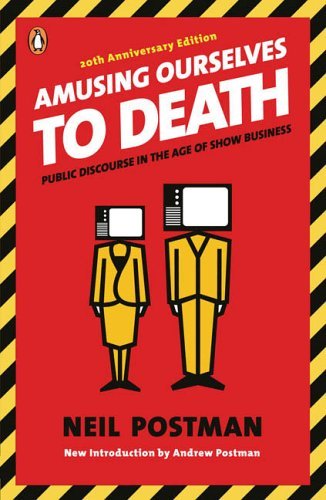
Of course the star attraction was Neil Postman’s Amusing Ourselves to Death. This book basically set the stage for much of the keynote by begging the question about whether we in education have fallen into the same trap that he wrote about in the mid-1980’s about ignoring serious discourse in order to package and produce our content in an effort to attract viewers (err, learners).  I’ve already posted a stream of consciousness that was a direct result of my references to Postman as well as the iPad during the presentation. Therefore, I won’t dwell any more on that book in this post.

I also referenced Brain Rules by Dr. John Medina. You can also check out the website for the book where he freely shares much of the info contained in the book. The main point of his that I used during the presentations was the one about human multi-tasking. First I asked the audience to use the clickers and answer this question.

As you can see, about half of the audience (n=252) believed that the human brain can multi-task. Here’s a brief audio-book intro to brain rule #4 that talks about multi-tasking. Remember that we (humans) can task switch, but not multi-task in any important way (yes, the walking and chew gum can happen at the same time, but that does not require concentration). There’s lots of good info in this book that should impact the way that we teach, because there’s lots of good evidence in here about the ways that we learn. Highly recommended.

I briefly referred to a book titled 33 Million People in the Room when we were talking about cell phones, Twitter, Facebook, and all the other ways that people in the audience could connect with other people in their networks without leaving the room in which we were all sitting. Behold the power of the network.

I moved on to a series of quotes to see who could name this author, slash professor (or is it the other way around?):

  • “Anyone who tries to make a distinction between education & entertainment doesn’t know the first thing about either.”
  • “I wouldn’t have seen it if I hadn’t believed it.”
  • “I don’t necessarily agree with everything I say.”
  • “All media exist to invest our lives with artificial perceptions and arbitrary values.”
  • “We shape our tools and afterwards our tools shape us.”
  • “We look at the present through a rear-view mirror. We march backwards into the future.”
  • “The medium is the message” as well as “The medium is the massage

I didn’t refer to any particular book of Marshall McLuhan’s, but here are a few possibilities:

During the whole riff about the B.S. that is the discussion about the different generations, I referred to several books. I’m not going to give the “millennials-are-different” pro side any ink here – let’s suffice it to say that they are already way too over-hyped, over-published, and over-sold. However, I highly recommend the book that I referenced as pointing out a very different view which is heavily based on research and has a direct implication for how we are choosing to educate young people these days. That book is The Dumbest Generation by Mark Bauerlein. This is the book that I mentioned had upset so many people, but I think you’ll find that it was not written for the purpose of upsetting the non-believers; rather I think it was intended to be a wake-up call to society in general and educators in particular about how we need to stay vigilant in making education a place with rigor and relevance.

There were several other books that influenced my thinking in one way or the other, but those are the main ones that I referenced during the talk. Anyone who is looking to add to their reading list could do a lot worse than adding those titles to their list (except one – do you remember which one I said was a good concept but not worth buying the book?).

Neil Postman and the iPad

I finished reading Amusing Ourselves to Death by Neil Postman on the same day that the iPads hit the stores in early April. I didn’t plan it that way; it just happened. As I’ve been pondering about the terrific book and also pondering about the hype surrounding the iPad, I keep bringing those two worlds together in some sort of weird mashup in my mind. (CC Flickr photo by cogdogblog)

Postman’s book was published in 1985 and is a treatise on how the world was being shaped (poorly) by the way that television had taken over the entertainment scene as well as the more serious forms of discourse such as news, politics, presidential debates, etc. He thought that Aldous Huxley got it right in the book Brave New World, where the people were oppressed by their addiction to all forms of amusement, rather than by George Orwell’s depiction of society in the book 1984, where they were oppressed by the government.

Here’s a terrific cartoon by Stuart McMillen that helps illustrate the push/pull going on throughout Postman’s book between the Orwellian view (1984) and the Huxleyan view (Brave New World). To steal a few lines from the cartoon (which are stolen from the book):

  • What Orwell feared were those who would ban books.
  • What Huxley feared was that there would be no reason to ban a book, for there would be no one who would want to read one.
  • Orwell feared the truth would be concealed from us.
  • Huxley feared the truth would be drowned in a sea of irrelevance.

Postman feared that Huxley was right and that it was an even worse outcome than Orwell’s version. Postman also spoke about the importance of education to get us through this changing landscape where television was turning us into passive consumers of televised content (actually it’s all about the form/style, not about the content). Postman (from Wikipedia – a decent article, really!) “also argues that television is not an effective way of providing education, as it provides only top-down information transfer, rather than the interaction that he believes is necessary to maximize learning. He refers to the relationship between information and human response as the Information-action ratio.”

Postman’s concerns about television (and computers which were just starting to proliferate in 1985) are not centered on the lousy, stupid stuff that was on TV during the time period that the book was written. It’s not the junk TV that dumbs down the culture, it’s the more serious stuff (news, politics, education, religion, etc.) that’s being packaged as entertainment rather than serious discourse. At least the low-level junk TV doesn’t pretend to be something more than it is.

He specifically mentions computers and education sporadically throughout the book. One particularly salient passage is reproduced below (pg. 161):

“For no medium is excessively dangerous if its users understand what its dangers are. It is not important that those who ask the questions arrive at my answers or Marshall McLuhan’s (quite different answers, by the way). This is an instance in which the asking of questions is sufficient. To ask is to break the spell. To which I might add that questions about the psychic, political and social effects of information are as applicable to the computer as to television. Although I believe the computer to be a vastly overrated technology, I mention it here because clearly, Americans have accorded it their customary mindless inattention; which means they will use it as they are told, without a whimper. Thus, a central thesis of computer technology – that the principle difficulty we have in solving problems stems from insufficient data – will go unexamined. Until, years from now, when it will be noticed that the massive collection and speed-of-light retrieval of data have been of great value to large-scale organizations but have solved very little of importance to most people and have created at least as many problems for them as they may have solved.”

I don’t know about you, but that sounds to me like he had a pretty accurate view (from the mid-1980s) about the future of the computing world and the massive collection of data (hint, rhymes with Doogle).

So, what would Postman think of the iPad? I don’t even begin to pretend that I would know what Postman might think about anything; this is just a first attempt at putting together some of his ideas. So here it goes.

  • I think that Postman would have lamented the entire movement toward edutainment over time. Making learning less serious and more fun would not be viewed positively and the results attained would be questioned fervently. (of course I could be wrong)
  • I think that Postman would have found the use of the Internet as not particularly compelling as an aid to education – especially the “Web 1.0” version of websites and services, since it was (1) very similar to the television as a one-way form of communication, (2) a great mixture of serious and trivial content (think of a page of serious and informative text on a page with a flashing ad of “Lose Belly Fat Now!” on the page), and  (3) that a great amount of web content was clearly designed to be amusing and not serious (not that he was against amusement all the time, just not mixed in with the serious matters of life).  (of course I could be wrong)
  • I think that Postman might have thought that the Read/Write web (Web 2.0) was a major step forward in providing easy opportunities for people to interact, collaborate, and learn in a more robust manner.  (of course I could be wrong)
  • I also think that Postman would have generally been positive about the whole era of user-generated content. Creating and publishing videos, podcasts, blog posts (etc, etc,) might have been favorably viewed as breaking away from the one-way communication of the boob tube and making minds active and engaged in learning and sharing. (of course I could be wrong)

My sense is that in a Postman-point-of-view you would see the iPad as a major step backward, at least in the short-run with version 1. Much of the content creation possibilities are not possible on the iPad; it feels much more like a “media consumption tool” than a creation tool. Truth be told – it’s just a big iPod Touch and that feels to me much more like a device for amusement than a device for serious learning and other purposes. I know that people are developing interesting educational uses for the Touch, but seriously, are those things better on the Touch than on a different device? I doubt it.

My sense is that the iPad is one more (big) straw on the back of the amusement camel.

Or, to put it another way, the iPad reduces the information-action ratio.

Of course I could be wrong.

If you’ve read all the way to the bottom, you might enjoy this photo. Let the hazing begin.

Great Parenting (Not) in Facebook

My middle child has been hounding us to allow him to create a Facebook page. He just turned 12 and is in the 6th grade. “Everybody I know has a Facebook page” is what he uses as his main sales pitch. The Facebook terms of service say that 13 is the minimum age for an account. You have to give them a birthdate when creating the account. If you lie and give a birthdate that is not accurate, but use one that indicates that you are 13 or older, then your account is created.

So far we’ve been standing firm on the whole “you’re not 13 yet” line of thought, but it feels particularly lame in this case. Most of his classmates already have an account and have had for some time, mainly since the start of 6th grade last fall. It’s not too easy to convince a 12-y-o that he shouldn’t have a Facebook account when everyone around him (11 & 12 years old) already has one. If anything, it makes us look like the evil parents for following the rules when no other parents appear to be doing so.

Nice job of parenting out there people. We appreciate it.

I’m actually pretty conflicted about the whole thing. On the one hand, I don’t see any rhyme or reason for Facebook to have set an age limit of 13. Can’t think of anything else in this world (at least nothing significant and I’m not saying that Facebook is significant) where 13 is the magic number. Clearly it’s more an issue of maturity than it is of raw age. It’s also an issue of parental oversight more than it is of age. If he was to have a Facebook account it is with the full understanding that his parents will know his password and that nothing he does on that site will be kept private from us. That’s the deal with his cell phone as well which he has lost several times because of the inappropriate language he gets in text messages sent to him (mainly by girls). Even though he is not using inappropriate language in his texts, he knows that if his “friends” use that kind of language that he will lose his phone for a while.

However, I’m also conflicted with the whole idea of “follow only those rules that you agree with.” Since we don’t think that 13 is a magic number for Facebook, then we’ll just choose to ignore that rule. Nope – don’t like that slippery slope that leads to more and more questions about how old you need to be to do certain things (driving, drinking, etc. etc.)

Yesterday morning he was sitting at the computer with his 11-y-o friend who has a Facebook account. I asked him to start writing down the names of his friends who are not yet 13 but who have a Facebook account. After writing two names they quickly realized that the easiest way would be to look at said friend’s list of Facebook friends and pick out those who are in the 6th grade (and under). He brought me a list of about 20 names and said they got tired of writing them down but would continue if I wanted them to. I said no, this was sufficient. Funny thing, those twenty names all started with the letters A, B, and C. In fact, they hadn’t even finished the C’s yet and they had 20 names just from the friend’s account. Since it’s publicly viewable, I then looked at his list of friends which led to more names and more names, etc.

By the end of this little exercise I was under the impression that my son is the only 6th grader at Superior Middle School without a Facebook account (I’m sure that’s incorrect, but that’s the way it felt).

So, the jury is still deliberating on this one. Maybe we’ll stand firm, and maybe we’ll cave like a house of cards. Either way, I feel like we lose something important.

My Presidential Qualifications

Why do I think I’m qualified to be a college president? Fair question. Here’s a first attempt at an answer.

I have enjoyed over 25 years working in higher education with a majority of that time being spent at Lake Superior College (LSC), a comprehensive community and technical college in the Minnesota State Colleges and Universities. During that time I have developed a strong sense of the overall importance of education to the future of our country in addition to an unwavering commitment to supporting the mission and values of community colleges. I’m currently serving as the Vice president of Technology and e-Campus at LSC.

My leadership aspirations are the culmination of my entire educational background and work experience. My career in higher education started in the classroom where I taught accounting for eleven years at research universities followed by another six years in the classroom at Lake Superior College in Duluth, Minnesota. My first administrative job came in 2001 when I was selected to serve in a newly created position as the academic Dean of Technology and Distance Learning at LSC. This position gave me significant experience in working with faculty on curriculum review and revisions while also directly managing the growth of online offerings at LSC. Serving as Chief Information Officer (CIO) helped me develop many connections with leaders at all of the institutions of the Minnesota State Colleges and Universities. One of the most important roles that I have played at my college is to work as an advocate for the bridge between academics and information technology. I have also been involved in building that same bridge system-wide in some of the committees and task forces that I have been appointed to by the MnSCU Office of the Chancellor. I firmly believe that academics is the engine that propels all that we do in higher education, and that the other units of the college are service providers who are needed to help support the primary academic mission.

My varied experiences in higher education create a rare confluence of skills, abilities, and interests. My years of experience as an academic dean and a faculty member qualify me to serve in the role of Chief Academic Officer (CAO). I also have the experience and expertise of a Chief Financial Officer (CFO) by virtue of my service as an interim campus CFO, two accounting degrees, and 17 years of experience in the accounting classroom; all of which have helped to prepare me to fully understand the financial issues facing higher education today. I have spent the past 9 years serving as the CIO at Lake Superior College, advocating for the proper role of technology in academia. I believe that my knowledge and skill set related to the CAO, CFO, and CIO positions give me a unique opportunity to lead an innovative institution of higher learning into the future.

There’s more to the story than that, but that should give you a good idea of my qualifications for a job as campus leader.

My Presidential Aspirations

I’m not much for keeping secrets – unless they are a matter of national security or personal embarrassment – neither of which apply in this particular case.

I have recently applied for two college presidencies within MnSCU (Minnesota State College and Universities), including my current employer, Lake Superior College. In both cases I was chosen as a semi-finalist for the first round of interviews, those 50-60 minute opportunities known as “airport interviews.” In both cases I was not chosen for the second round of interviews which consist of full-day extravaganzas on the campus, meeting with all the interested parties.

In each case, my failure to secure a second interview was a major disappointment to me both personally and professionally. I feel that I was close to reaching the second round, but not close enough. It’s been a long time since I’ve felt that level of failure – if ever.

I find it rather odd that most people think you need to keep your job search activities completely quiet and confidential. Feels way too much like sneaking around in the dark. I have no interest in trying to hide my aspirations for a position such as this. Becoming a college president is definitely an uphill climb for me, but I don’t give up easily. A few things that any interested party should know:

  • Lake Superior College is the best place I’ve ever worked – and it’s not even close.
  • I am not anxious to leave LSC, but would be willing to do so for the right opportunity.
  • I am an “employee at will,” which means at the will of the president. As a new president comes to the college, he will potentially bring a new “will” for the structure of the college administration. I need to make sure that I have a job and a paycheck to provide for my family.
  • I’ve told the employees in my division that it is true that I’m applying for jobs. I’ve also told them about the other reasons in this bullet list to assure them that I’m not trying to abandon ship.
  • I do have a presidential itch that I would like to scratch, if the right opportunity presents itself. Those opportunities won’t just drop into my lap; I have to go out and look for them. I will continue to apply for positions that feel like a good fit for me.
  • If I don’t achieve one of those positions, and if I have the opportunity to remain at LSC, I would be happy to do so.
  • I am NOT a disgruntled employee. As the photo attests, I am totally gruntled. 🙂

Fun Facts about the UAE

I was intrigued by many things about the country and the people, but these things deserve some special mention about my visit to the United Arab Emirates.

1. Derek Zoolander would feel right at home. Zoolander couldn’t turn left on the runway with all the other incredibly-good-looking male models. Neither can the Emerati. If you want to make a left turn while driving down a street, you generally have two choices: 1) maybe you’ll get lucky enough that your desired street is one of the nodes of a roundabout, or 2) more likely you will have to drive past the street where you would like to turn left until you get to a designated U-turn lane (see pic) and then proceed back to the street which is now a right turn. The major streets and the highways are all designed this way.

2. Cell phone ownership – I heard from more than one person that the number of cell phones per capita is 2 or more. That seems crazy, right? It is true that everyone seems to have a cell phone, but why would they have two mobile phones (on average, which means that some have more than 2)? My UAE friends tell me that the young Emirati women often carry multiple phones – one for communicating with their family members, and one or more others for communicating with people that their family doesn’t want them talking to (men/boys, of course). Seems like quite a game of cat and mouse.

3. The garbage strewn all over the countryside is very sad. Apparently there is no fine for littering and very little effort to stop the continuous disposal of trash anywhere and everywhere. I tried to get a shot of some of the trees that have 6 or more of the national flowers on them – where the national flowers are brightly colored plastic bags that get caught in the trees like one of Charlie Brown’s kites. While taking this photo of the camel, another camel off to the left was barfing up a green plastic bag that he had swallowed. Very sad.

4. They are tearing down mountains all over the Emirate of Fujairah. Sort of like clear-cutting the rain forest in a tropical country, they are bulldozing mountains in the name of progress. Seems to be multiple reasons for this. Some of the mountains are being leveled because they want some flat land for building purposes. Also, the rocks have a sales value – apparently they are selling it for various purposes, including the construction of the “palm islands” on the Persian Gulf and the Gulf of Oman.

5. In Fujairah, they continue the long tradition of bull-butting on Friday afternoons. Also called bullfighting, this is very different from the Spanish or Mexican bull fights with man versus beast. These are tests of strength with bull-versus-bull. The day that I was there was some sort of end-of-season championship. We watched about five of the bouts and then left since I needed to get to the Dubai airport that evening. Unfortunately we left just before a huge brawl broke out that would have been quite a scene. As my friend Andrew writes: “apparently shortly after we left a fight broke out between two opposing teams, which eventually developed into a crowd free-for-all. Fujairah is scandalized as something like this has never happened in the history of bullfighting in the city.” Rats.

6. There are more people in New York City than in all of the UAE. The population is currently between 6 and 7 million people. One reason I bring this up is that the country feels much more heavily populated than it actually is. Abu Dhabi and Dubai are both large, bustling cities with approximately 1 million residents each, which must give me the impression that there are a lot of people living here, which there isn’t. The other really interesting thing is that the native Emirati people make up 20% or less of the total population. Expatriates come from all over the globe and in increasing numbers. It is an incredible melting pot of people.

7. The Dubai financial collapse has left an unbelievable number of partially completed building sites scattered across the landscape. The number of construction cranes is simply astounding, yet many of them appear to be sitting idle while they wait for economic recovery. Even where construction continues, it seems to continue at a snail’s pace. Several buildings have reportedly been under construction for 3 or 4 years, with very little noticeable progress being made. It does appear that a great deal of the labor is done by hand, which seems to make for a long and arduous process.

8. They have some very interesting customs and/or religious beliefs when it comes to polygamy, drinking alcohol, male/female interactions, tribal warfare, work ethic for young men, and a host of other things. However, if I said too much about any of these things then I would probably never be invited back, So I won’t do that.

For the record: I loved it there. Had a great time and would go back in a heartbeat.

A Week of Workshops in the UAE

Barry Dahl in Fujairah workshop

Photo courtesy of Alan Nambiar - Fujairah Colleges

I’m trying to wrap my brain around the week I’ve just concluded with the fine people of the Fujairah Colleges in the United Arab Emirates. The workshops were held at the Fujairah Women’s College but also included faculty from the Fujairah Men’s College as they immersed themselves into a week of professional development activities during Independent Learning Week (sort of like Spring Break, except that the students work on individual projects and the faculty are not on leave – so really not like Spring Break at all).

In the computer lab

Photo courtesy of Alan Nambiar - Fujairah Colleges

Much of the time was used looking at how Web 2.0 tools can be used by faculty to create engaging content for their courses as well as possible uses for student assignments or group projects that are facilitated through the use of web-based technologies. I spent much of the time with the same cohort of faculty who are working on the development of a laptop program at the college. A few other sessions were open to various other interested parties at the colleges.

Fujairah is located on the Gulf of Oman and is about a 90-minute drive from Dubai which is located to the east on the Persian Gulf. Fujairah is mostly mountainous, and quite beautiful. One of the most amazing experiences for me was finding that the city is an incredible melting pot of people from all over the world. At the Fujairah Colleges alone, the faculty come from more than 30 different countries. I spent quite a bit of time getting to know Andrew Scholtz who is from South Africa and Peter Hatherley-Greene who hails from New Zealand. Talk about global education – here you live it!

Entrance to Fujairah Women's College

I owe a huge debt of gratitude to Mark Johnson, Director (aka President) of the Fujairah Colleges. He contacted me several months ago about the possibility of coming to the UAE to provide this professional development for his faculty and staff. Mark and I got to know each other when we were colleagues in Minnesota. He was the CIO at MSU Mankato

At Fujairah Colleges. Andrew, Barry, and Mark

L-R: Andrew, Barry, and Mark

and decided to leave Minnesota back in 2006 and move his family to the Emirates (story here). The accomplishments that Mark and his staff have achieved at these colleges are very impressive and he will undoubtedly be missed here in Fujairah when he returns to Minnesota at the end of the academic year.

This trip far exceeded my wildest dreams. The workshops were fun, seeing a new culture and country was fun, but by far the best part was all the great people I met here during the week. Really outstanding.

Tripping Out to the UAE

I leave April 2, 2010 for an exciting adventure to the United Arab Emirates. I’ll fly from Duluth to Dubai arriving on Saturday at 7:25 PM Dubai Time (GMT +4 hours). That looks like a bit more than 19 hours of travel time with plane changes in both Chicago and Washington, D.C.  I will be picked up in Dubai and driven by car for about 1.5 hours to reach the coastal city of Fajairah on the Gulf of Oman.

A friend of mine is now the Director (think President) of the Fujairah Colleges in the Emirate of Fujairah. We got to know each other when he worked for several years at Minnesota State University Mankato. He went to the UAE a few years ago and is now Director of both the Fujairah Women’s College and the Fujairah Men’s College.

They are bringing me to their colleges to provide a week-long series of workshops related to teaching with technology, Web 2.0, e-Learning, and other things related to technology in education. Their work/school week runs from Sunday through Thursday so I will hit the ground running (hopefully) on Sunday morning with the first workshop.

I’ve never been to this part of the world and am very excited about the whole trip. I hope to post several times from over there to share some of the things I’m learning about and some of the people I meet.

RUMOR MILL SQUELCHING: due to our recent budget cuts and the incessant rumor mill about who is doing what and why, let me clarify a few things about this trip.

  • This is not a personal trip. I am going in my official capacity as V.P. of Technology and e-Campus at Lake Superior College. I receive my normal salary for this week, with no extra nor lesser compensation.
  • The speaking fees for the workshops are all payable to Lake Superior College. The college will receive fees equal to roughly double my weekly salary.
  • All travel expenses are being paid directly by the Fujairah Colleges.
  • Any personal costs incurred while traveling are my own.

Another Brian Lamb Video Riff

A few months ago I posted a video of Brian Lamb (Who the Hell is Brian Lamb?) when he visited with the WCET Catalyst Camp leadership group at the WCET annual conference in October 2009. I have a few additional clips, so I thought I should get on the stick and share a bit more.

Here’s a 9-minute video of Brian talking about the importance of having skills to evaluate web resources, the value of having your own network of trusted colleagues, getting students to do work that matters to the world outside the classroom walls, and the value of lurking while learning. Follow him on Twitter @brlamb

Omni Hotel Rip-Off

There is an update to this story at the bottom of the post.

At the end of the ITC eLearning 2010 conference in Ft. Worth last month, a colleague and I conducted a post-conference workshop about e-Learning Quality. We spent about 8 hours (Tuesday afternoon and Wednesday morning) talking about different quality factors related to online learning.

My original plan was to make arrangements with one of my Texas educator friends to borrow an LCD projector from their college for the workshop. Alternatively, I could have easily brought along one of the portable units from my own college. Alas, old age being what it is, I forgot to make these arrangements in advance.

Never fear, the Omni Hotels A/V and conference staff could come to my rescue. As we stood there at the conference registration table, the guy gives me a verbal quote of $550 for a projector. Keep in mind that this guy knows that we are using their meeting room for both Tuesday afternoon and Wednesday morning for a total of about 8 hours. I’m thinking that $550 is a lot of money, but basically the price I have to pay for my own forgetfulness, slash, stupidity. So I agree and life goes on. They set up an old LCD projector, not quite like the old projector shown in the pic (cc photo by pedrosimoes7), but not much better either.

Imagine my surprise when the total bill for using this projector for 8 hours is over $1,440.

After I returned to campus, I filled out the online survey that I received from the Omni Hotel Ft. Worth. Below is the section of the survey comments that I provided to them about my projector unhappiness:

“I was conducting a post-conference workshop using one meeting room for one afternoon and again the next morning. In need of an LCD projector, the conference staff informed me that it would cost $550 to which I verbally agreed. My bill for this projector was $1,440. I didn’t receive the full bill until after I returned home. The projector was old and didn’t work properly, although we were able to continually reset it to make it work. This projector has a street value of no more than $200. I know, I buy them all the time. Rental charge of $1,440 for one day with a $200 projector – that’s absolutely ludicrous. There were also issues with the beverages for our small meeting of 10 people, but that pales in comparison to the projector outrage. As a board member for the Instructional Technology Council, I will strongly recommend that we not consider Omni Hotels for our future annual conferences of 300-500 people.”

“A little customer service training advice for your employees – do not tell a customer that something will cost $550 and then give them a bill for $1,440. Nobody will take that well.”

Not surprisingly, I have received no response from Omni Hotels from my survey submission. Obviously, they don’t give a damn.

The Omni Hotel charged me $1,440 to use a $200 piece of equipment for 8 hours. Payday loan companies have nothing on those guys.

UPDATE: March 29, 2010. Manager from Omni Fort Worth contacted me to discuss the situation and agreed to adjust the total charges to the $550 that I verbally agreed to. That type of response DOES differentiate them from the Payday Loan companies. Thank you.