• Recent Posts

  • Tags (Categories)

  • Archives

  • Pages

  • January 2026
    M T W T F S S
     1234
    567891011
    12131415161718
    19202122232425
    262728293031  

Neil Postman and the iPad

I finished reading Amusing Ourselves to Death by Neil Postman on the same day that the iPads hit the stores in early April. I didn’t plan it that way; it just happened. As I’ve been pondering about the terrific book and also pondering about the hype surrounding the iPad, I keep bringing those two worlds together in some sort of weird mashup in my mind. (CC Flickr photo by cogdogblog)
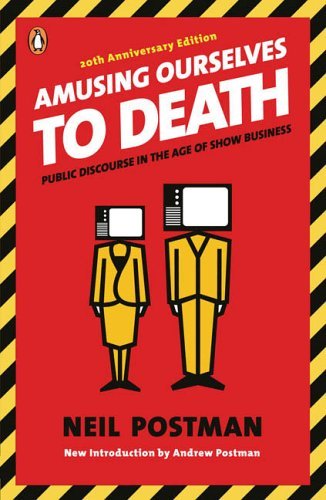
Postman’s book was published in 1985 and is a treatise on how the world was being shaped (poorly) by the way that television had taken over the entertainment scene as well as the more serious forms of discourse such as news, politics, presidential debates, etc. He thought that Aldous Huxley got it right in the book Brave New World, where the people were oppressed by their addiction to all forms of amusement, rather than by George Orwell’s depiction of society in the book 1984, where they were oppressed by the government.

Here’s a terrific cartoon by Stuart McMillen that helps illustrate the push/pull going on throughout Postman’s book between the Orwellian view (1984) and the Huxleyan view (Brave New World). To steal a few lines from the cartoon (which are stolen from the book):

  • What Orwell feared were those who would ban books.
  • What Huxley feared was that there would be no reason to ban a book, for there would be no one who would want to read one.
  • Orwell feared the truth would be concealed from us.
  • Huxley feared the truth would be drowned in a sea of irrelevance.

Postman feared that Huxley was right and that it was an even worse outcome than Orwell’s version. Postman also spoke about the importance of education to get us through this changing landscape where television was turning us into passive consumers of televised content (actually it’s all about the form/style, not about the content). Postman (from Wikipedia – a decent article, really!) “also argues that television is not an effective way of providing education, as it provides only top-down information transfer, rather than the interaction that he believes is necessary to maximize learning. He refers to the relationship between information and human response as the Information-action ratio.”

Postman’s concerns about television (and computers which were just starting to proliferate in 1985) are not centered on the lousy, stupid stuff that was on TV during the time period that the book was written. It’s not the junk TV that dumbs down the culture, it’s the more serious stuff (news, politics, education, religion, etc.) that’s being packaged as entertainment rather than serious discourse. At least the low-level junk TV doesn’t pretend to be something more than it is.

He specifically mentions computers and education sporadically throughout the book. One particularly salient passage is reproduced below (pg. 161):

“For no medium is excessively dangerous if its users understand what its dangers are. It is not important that those who ask the questions arrive at my answers or Marshall McLuhan’s (quite different answers, by the way). This is an instance in which the asking of questions is sufficient. To ask is to break the spell. To which I might add that questions about the psychic, political and social effects of information are as applicable to the computer as to television. Although I believe the computer to be a vastly overrated technology, I mention it here because clearly, Americans have accorded it their customary mindless inattention; which means they will use it as they are told, without a whimper. Thus, a central thesis of computer technology – that the principle difficulty we have in solving problems stems from insufficient data – will go unexamined. Until, years from now, when it will be noticed that the massive collection and speed-of-light retrieval of data have been of great value to large-scale organizations but have solved very little of importance to most people and have created at least as many problems for them as they may have solved.”

I don’t know about you, but that sounds to me like he had a pretty accurate view (from the mid-1980s) about the future of the computing world and the massive collection of data (hint, rhymes with Doogle).

So, what would Postman think of the iPad? I don’t even begin to pretend that I would know what Postman might think about anything; this is just a first attempt at putting together some of his ideas. So here it goes.

  • I think that Postman would have lamented the entire movement toward edutainment over time. Making learning less serious and more fun would not be viewed positively and the results attained would be questioned fervently. (of course I could be wrong)
  • I think that Postman would have found the use of the Internet as not particularly compelling as an aid to education – especially the “Web 1.0” version of websites and services, since it was (1) very similar to the television as a one-way form of communication, (2) a great mixture of serious and trivial content (think of a page of serious and informative text on a page with a flashing ad of “Lose Belly Fat Now!” on the page), and  (3) that a great amount of web content was clearly designed to be amusing and not serious (not that he was against amusement all the time, just not mixed in with the serious matters of life).  (of course I could be wrong)
  • I think that Postman might have thought that the Read/Write web (Web 2.0) was a major step forward in providing easy opportunities for people to interact, collaborate, and learn in a more robust manner.  (of course I could be wrong)
  • I also think that Postman would have generally been positive about the whole era of user-generated content. Creating and publishing videos, podcasts, blog posts (etc, etc,) might have been favorably viewed as breaking away from the one-way communication of the boob tube and making minds active and engaged in learning and sharing. (of course I could be wrong)

My sense is that in a Postman-point-of-view you would see the iPad as a major step backward, at least in the short-run with version 1. Much of the content creation possibilities are not possible on the iPad; it feels much more like a “media consumption tool” than a creation tool. Truth be told – it’s just a big iPod Touch and that feels to me much more like a device for amusement than a device for serious learning and other purposes. I know that people are developing interesting educational uses for the Touch, but seriously, are those things better on the Touch than on a different device? I doubt it.

My sense is that the iPad is one more (big) straw on the back of the amusement camel.

Or, to put it another way, the iPad reduces the information-action ratio.

Of course I could be wrong.

If you’ve read all the way to the bottom, you might enjoy this photo. Let the hazing begin.

Tripping Out to the UAE

I leave April 2, 2010 for an exciting adventure to the United Arab Emirates. I’ll fly from Duluth to Dubai arriving on Saturday at 7:25 PM Dubai Time (GMT +4 hours). That looks like a bit more than 19 hours of travel time with plane changes in both Chicago and Washington, D.C.  I will be picked up in Dubai and driven by car for about 1.5 hours to reach the coastal city of Fajairah on the Gulf of Oman.

A friend of mine is now the Director (think President) of the Fujairah Colleges in the Emirate of Fujairah. We got to know each other when he worked for several years at Minnesota State University Mankato. He went to the UAE a few years ago and is now Director of both the Fujairah Women’s College and the Fujairah Men’s College.

They are bringing me to their colleges to provide a week-long series of workshops related to teaching with technology, Web 2.0, e-Learning, and other things related to technology in education. Their work/school week runs from Sunday through Thursday so I will hit the ground running (hopefully) on Sunday morning with the first workshop.

I’ve never been to this part of the world and am very excited about the whole trip. I hope to post several times from over there to share some of the things I’m learning about and some of the people I meet.

RUMOR MILL SQUELCHING: due to our recent budget cuts and the incessant rumor mill about who is doing what and why, let me clarify a few things about this trip.

  • This is not a personal trip. I am going in my official capacity as V.P. of Technology and e-Campus at Lake Superior College. I receive my normal salary for this week, with no extra nor lesser compensation.
  • The speaking fees for the workshops are all payable to Lake Superior College. The college will receive fees equal to roughly double my weekly salary.
  • All travel expenses are being paid directly by the Fujairah Colleges.
  • Any personal costs incurred while traveling are my own.

Don’t Ya Love Those Baseball Analogies?

So today was a big day for me. I was getting a tryout for the major league team. One at-bat to impress the scouts and I pretty much needed to hit it out of the park.

I watched a strike or two fly past me early on but before I knew it I had worked my way to a full count. I stayed alive by fouling off a few pitches. Finally I laced a clean single through the drawn-in infield.

Not exactly the home run that I was hoping for. Not exactly the kind of thing that gets you called up to the majors. Still, it wasn’t an embarrassment. It was just a nice clean single. The side is not retired just yet. There’s still a small glimmer of hope that the single will be good enough – but I doubt it.

CC photo by Terry.Tyson

Twitter Twub: #itc10

If you’re heading to Ft. Worth for the ITC conference on Feb. 20-23; join the Twub for eLearning 2010 Twitter Twub: #itc10. A Twub is an aggregator of Twitter content about the conference plus a place to view photos, videos, and the like.

New Personal Mission Statement

Two things have happened in the past week to make me pay attention again to that strange convention called a mission statement. At Lake Superior College we are reviewing our mission statement as part of our continuous quality improvement process. I have been selected to be part of the writing team for that effort to develop a new set of mission, vision, and values statements. Secondly, I have a career opportunity that will require me to clearly define who I am, what I believe in, what my skills are, and why people should care about any of that.

Therefore, I decided it was time to also revise my personal mission statement. It doesn’t really matter what the old one is, but here’s the new one.

Yes, I prefer the simple over the complex. I prefer the direct over the indirect. I prefer to now move on to my next task.

Action Analytics Symposium – Day 1

MnSCU-ActionAnalyticsA two-day symposium on Action Analytics was held in St. Paul on September 22-23, 2009. I took lots of notes via Twitter. I’ll copy and paste several of those tweets from day one and call it a blog post. Twitter hashtag #ActionAnalytics

  • Symposium begins in 1 hour. First up: “Why action analytics for higher education?” My answer: to improve student success
  • Symposium getting started. MnSCU Chancellor states that the people are fed up with the completion problems in higher ed.
  • “I don’t think we can assume that our needs will be funded if we can’t demonstrate high levels of achievement.”
  • The key piece of #ActionAnalytics is not the analytics, it is the ACTION. Use the data to lead us to actions to span the achievement gap.
  • Who’s been invited to #ActionAnalytics ? Trustees, presidents, political leaders, policy makers, national associations (& me?)
  • Donald Norris has a blog titled: Linking Analytics to Lifting Out of Recession http://bit.ly/1TI4s
  • Higher ed has never said “Every student needs to succeed.” We accept failure – non-completers are expected & “normal”
  • Health care & education are similar in the “laying on of hands.” Nationwide discussion about reforming health care, will education be next?
  • Had breakfast this morning with Capella’s president. He told me some surprising things about their student demographics. Very impressed. Capella educates huge numbers of first-generation college students. I don’t think that’s widely know. He tells a great story about access.
  • Higher ed measures lagging indicators (persistence, graduation, etc), should focus on leading indicators (Wk1 engagement)
  • More open education environment will take us from education opportunity (now) to education assurance (future). Bill Graves
  • Getting data out of our systems is hard (costly) – we need better standardization of info systems. Michael Feldstein
  • The data is leaving the LMS for Web 2.0 apps – how do we build connections to all these tools (can we)? Michael Feldstein
  • “Smart Change” is the aggressive application of change management principles to develop institutional capacity (Baer/Duin)
  • Routine change happens everyday, transformative change gets you out of your comfortable box. Academics freak out with that.
  • My take on transformative change – largest barrier is TRADITION (think Topol singing in Fiddler on the Roof). For example: 300 bright minds may agree that we should extend the school year – but 300 million people disagree because of tradition of summer vacation.
  • John Campbell of Purdue. Building capacity for analytics is really about building community – getting buy-in
  • Purdue Signals Program – actionable intelligence – real-time predictions of student success in a course. Try to focus your data analysis – one question leads to another – must make choices and keep it simple. Purdue’s Campbell. Purdue’s info system hasn’t reduced course drops, but they drop earlier. More B/C grades, fewer D/F. Purdue students didn’t think it was Big Brother. They appreciated the info avail to them “thanks for kick in the butt.”
  • Alex Ushveridze – Predictive Modeling Expert at Capella. “How” questions depend on the “who”and the “why.” Persistence? Predictive Modeling is a continue cyclic process- a way of acting rationally. Online education is ideal arena for P.M. Capella – Early alert – how early? FIRST WEEK determines everything!! High predictability of grades at end of first week.
  • Jeff Gran- mgr of assessment at Capella will focus on measurement of learning. How can we collaborate to measure outcomes? Capella has 1,100+ faculty. Outcomes are measured with a fully embedded assessment model (FEAM) in each course.
  • Craig Scheonecker of MnSCU showing MnSCU accountability dashboards. Focus on fewer items and make easy to understand. Check out the MnSCU dashboards – available to the public http://bit.ly/Jq0lb You can even “drill down” (somewhat).
  • Conundrum: as we move to individualized learning models – how can we aggregate/analyze data with small N sizes?
  • Issue: there is a need for info literacy about these analytics – who’s doing something about that? Michael Feldstein
  • Will #ActionAnalytics evolve into a set of open tools that can be shared across institutions? It’s not happening yet.
  • ERP vendors, LMS vendors are all looking at (selling) these types of tools – but is that the direction Higher Ed should go.
  • http://twitpic.com/iq2vj – Lunch keynote speaker at #ActionAnalytics – Undersecretary of Education Martha Kanter.
  • During lunch: “When Blackboard is presented a business opportunity – their response is ‘What would the 19th century robber-barons do?'”
  • #ActionAnalytics panel discussion – What info, reports, dashboards are needed? 1st up: Dr. George Boggs, American Assoc. Community Colleges. Dr. Boggs: The old saying was “students have a right to fail.” Luckily, that point of view is changing – but not totally. Spellings Commission concerned with consumer info. That’s not the focus for CCs. We need the data to improve our outcomes. Voluntary system of accountability. One concern is improving the effectiveness of our remedial education programs.
  • Foreign dignitaries come to the US. to study our system of higher education. “Sorry, we don’t have one of those.”
  • 25-30% of the developmental ed is done at universities – but they don’t do remedial education. Name Game: Banana Fanna Fo.
  • Revenue per FTE at public institutions: $7,059 appropriations, $4,004 tuition revenues. (64% – 36% nationally)
  • If academe makes accountability studies without outside oversight, will they be viewed as being less than truthful?
  • “As an educator masquerading as a technologist, I now realize how little I know about what will happen next.” Michael F.
  • http://twitpic.com/iqgyd – From #ActionAnalytics – two bright minds: Mark Milliron and John O’Brien.
  • Data Quality Campaign website: http://bit.ly/e2bMb Using Longitudinal Data Systems to Improve Student Success.
  • We have a greater supply of data than demand for it. People don’t ask for it, don’t trust it, can’t use it effectively.
  • Next generation of analytics – interesting conversation since we are still making baby steps on the current generation. Next gen: move from high-cost business intelligence to value analytics for the masses. Next gen: move from users waiting for results to immediate results with dynamic analysis and changing parameters. Next gen: analytics currently driven by power users, move to end users deploying user-friendly tools. Next gen: move from institutional data sets to cross-institutional analytics and P-20 data sets.
  • Discussing some of the user-generated analytics – RateYourProfessors, PickaProf, CollegeResults dot org, etc.
  • Statistics is THE math that we need to be teaching in high school and college. More important to our future than Calculus.
  • One of the secret sauces for analytics is the predictive model – good place for collaboration. Open-source style. Al Essa
  • Our technical capacity is developing faster than our ability to make constructive use of the output. What does this mean?

Overall, it was a very good day, very long day, spent with very intelligent people. My brain is full.

2009 Student Technology Survey – Post 12

One of my goals with this survey is to inform students about services available as well as gather information from them. The final two questions on the survey fall into this category. Inside Desire2Learn we provide an optional tutorial titled “LSC Online Skills” that new students are encouraged to use to learn about course navigation, technology requirements, word processing expectations, and how to use various tools inside D2L. Question 24 is used to determine how many students have already used the tutorial or are planning to do so (the survey is given at the very beginning of the semester), and also to help inform students that this resource is available.

The survey indicates that only about 27% of the students have gone through the tutorial, that 36% are planning to use the tutorial, and that 36% DON’T plan to use the tutorial.

Question 25 is similar in that we also use a D2L course shell to provide information in each student’s account about academic dishonesty and plagiarism. The tutorial is titled “Academic Honesty at LSC.” Several instructors have included a requirement at the beginning of their courses for the students to go into the utorial and report back in some form about something they learned in there.

Only 25% of the students report that they are NOT planning to visit the academic honesty tutorial, and there are 35% that have already done so. I was initially a little surprised that more students were using this tutorial than the online skills tutorial. Most likely that is attributable to the directions that students are receiving from their faculty members.

That is the end of the questions for the LSC Student Technology Survey for 2009. Hallelujah.

2009 Student Technology Survey – Post 11

Question 22 was mainly interesting to me with regard to the percentage of our students who have never used some of the services that we provide them. Below is an approximation of what percentage of our online students have NEVER used these services:

  • Online library services = 59%
  • Online career services = 82%
  • Online tutoring services = 77%
  • e-Campus Help Desk = 76%
  • Student web portal = 33%
  • Online bookstore = 52%
  • Minnesota Online website = 69%

Click image to enlarge

2009 Student Technology Survey – Post 10

The results from question 18 indicate that about 30% of our students do not consistently protect their computers with anti-virus software. Granted, a small percentage are not using Windows-based machines and probably don’t have the same concerns as a Windows user, but that percentage is relatively small. This begs the question of how best the college should protect the networks and other users from the (potentially) virus-carrying student users. (Click screenshots to enlarge)

Question 19 indicates that over 94% of our online students have Internet access at home. Clearly, not having access at home would be a disadvantage for most students.

Question 20 below indicates that over 90% of our students access their online courses via a broadband connection. That may be closer to 95% depending on what the “Other” category might include for ways of accessing the Internet.

From question 21 above, you can see that 70% of our online students live within 30 miles from our main cmapus. The percentage of online students who live further away than 30 miles has actualy shrank in the past couple of years. I mainly attribute that shrinkage in the attendance of students at a distance to the greatly increased offerings in similar online learning opportunities from many of our sister institutions within Minnesota.

2009 Student Technology Survey – Post 9

Student Uses of Web 2.0 Tools

I added a new question for the first time this year in an effort to get at the level of usage of various Web 2.0 tools by students. Of course some students have used these tools because they were assigned to do so by one of their instructors, although that appears to be a fairly small phenomena at my school. This data helps debunk the theory that some people promote, thinking that all the students (or maybe all of Gen Y) are using these web tools all the time. Wrong again, Kemo Sabe.

This is a big chart, sorry about that. You probably want to view the chart full-size at Flickr so that you can read it better.

Out of 1,080 students, only 14 say they have used Delicious, and only 2 of them use it frequently. About 20% of our students use Gmail, but less than 20 people (17) use Meebo for instant messaging. About 3.5% of our students use Twitter. Only 6 of our students say they have used Second Life occasionally, frequently, or very frequently. By contrast, 73% say they use YouTube – so they’re clearly using some of these tools – butnot many of the tools that are considered more mainstream by the people I hang with. (click chart to enlarge)

The results here remind me of a poster I put together for use in workshops whenever people start thinking that everyone is using these Web 2.0 tools:

Original photo (CC) by ocean.flynn