

Just a little recording as I prepare to leave for Kitchener, Ontario to start my new job.
Filed under: Desire2Learn | 9 Comments »
Just a little recording as I prepare to leave for Kitchener, Ontario to start my new job.
Filed under: Desire2Learn | 9 Comments »
I’m hoping I can get all the smart people in my network to add to this little (asynchronous) brainstorm. For some time now I’ve been wanting to develop a rubric for measuring the amount of flexibility in online courses. I’m particularly interested in how the course design and student requirements relate to providing students with a reasonable amount of time flexibility for their online course work.

All the data that I have collected over the years from online students indicate that time flexibility is the number one reason that they enroll in online courses. Not cost, not distance, not even preferred learning methodology; but clearly they place a premium on having time flexibility that allows them to fit higher education into their otherwise busy lives.
UPDATE (4/23): This will probably not result in an actual rubric. I’m having a hard time figuring out the lousy-good-better-best type of hierarchy that you typically need for a rubric. Instead, I’m thinking that the output will be a list of effective (or maybe “promising”) practices for ensuring time flexibility in an online course. Please keep the comments coming.
The purpose of the rubric is to come up with a way of measuring the flexibility in various online courses, and to encourage more flexibility rather than less by those who are using the rubric. I have no doubt that some online students are frustrated when they enroll in an online course with certain personal expectations about flexibility, only to find that the course offers them very little of it. These are some of the factors that come to mind for me.
Time flexibility, measured by the size of the “window of opportunity” for:
Other factors affecting time flexibility:
One of the keys to this type of rubric will be to walk the fine line between enough flexibility and too much flexibility. An extreme example of “too much” flexibility would be those cases where there are no deadlines at all in the course except for the course ending date. This might work for an electronic independent study course, but not for online courses where learner interaction is expected and/or required. Based on my past online teaching experience, I find that I am in agreement with many faculty members I know who state that you must keep students engaged with the course every week (and probably 2 or more times per week) in order to not have them fall off the face of the earth (fall behind and drop out or just quit).
I’ve thought about including other types of flexibility rather than those focused on the students’ time availability. I’ve decided not to tackle those right now. For example, it might be interesting to include things related to the nature of assignments – do they allow students to choose different assignments or different methods of completing the assignment (write a paper, make a movie, make an oral presentation, etc.). I think that’s interesting, but I don’t think it captures the reason that students take online courses – which is clearly time flexibility.
Determining the specific parameters for each rubric item is yet to come. Right now I would love to have your input on other factors that could be included in a rubric to measure time flexibility for online learners. Please leave your thoughts in the comments or email me at barrydahl at gmail.
Thanks in advance, and yes, I realize this could be a colossal failure. I’m okay with that.
Filed under: Online learning | 9 Comments »
Let’s say you’ve been dating someone for 8 or 9 years. After all that time, you still get along really well. Maybe it’s time to tie the knot and make your relationship more permanent – or at least as “permanent” as those things can be.
Figuratively speaking, that’s what’s happening with my career in education. I recently signed a job offer sheet and all the other necessary paperwork to tie the knot with a company where I hope to spend the rest of my working years.
I’ve known some of the people in this company for nine years now. They are talented and driven and inspired. There are many other newer employees that I’ve haven’t yet met. I’m looking forward to meeting many of the newer folks during the next couple of months.
It will probably not come as a surprise to many people in the e-learning world that I’ve taken a job with Desire2Learn. I’ve told many people over the years that there was only one company that I’d dealt with while CIO of a college in Minnesota that I would be willing, even anxious, to work for. That company is D2L. Even after a nine year relationship, nothing has happened to change that point of view for me.
Almost every interaction with them has been pleasant, engaging, and positive. I consider many of the D2Lers to be friends of mine. The company is doing great and I look forward to being part of the team that continues to execute on their mission and vision.

My connection with D2L started in the spring of 2003 when I was the chair of the the MnSCU IMS of the Future task force. Desire2Learn submitted a response to our RFP and was selected to be one of the four finalists for the process. In May 2003, I met John Baker and Jeremy Auger for the first time at St. Cloud State University for the day-long demonstration of the D2L platform. Their presentation that day, along with a superior written response to the RFP, elevated D2L to the top of the list of the platforms being considered. Other milestones:

Just a few quickies.

Filed under: Desire2Learn, Higher Ed, Personal | 14 Comments »
 After leaving a job at a college in Minnesota, I’ve spent the past 16 months working as an independent contractor doing consulting, speaking engagements, webinars, and the like. It has been exhilarating, as long as that term equally applies to the highs and the lows that life sends our way.
Yep, lots of good things have happened. My network of educators around the country (and beyond) has really paid off as far as getting contracts from friends and from friends of friends. I’ve been able to do some really fun and fascinating work for a variety of clients. Much to my delight, I never was faced with the same project or task twice. Always something new, always more to learn, always the next challenge.
At the same time, it’s been a real roller coaster ride from a financial perspective. Overall, it was a definite reduction of the income with which we had grown accustomed. However, less income wasn’t the problem. Uncertainty about future income was a significant problem. I often talked about how I had a long list of “maybes” and how I needed a fair number of those maybes to turn into “yeses.” Sometimes a maybe turned into an actual contract for work to be done, but often times they didn’t. With three kids to put through college, the maybes really start to take a toll on you. “Maybe I’ll get that contract with XYZ College” quickly turns into “maybe I’ll be able to pay for my kids to go to college.”
When I told people about my adventure as a self-employed person working on the fringes of higher education, my standard line was something like this: “Being self-employed is a whole lot like being unemployed – just different paperwork.”
I’ve know for about the past year that I really wasn’t interested in trying to get another job at a college or university. I pretty much have a been-there, done-that feeling along those lines. 27 years working inside higher ed seems like enough, especially considering the uncertainty of those jobs going forward (I’m living proof of that). I was pretty sure that I wanted to always work in some way connected to higher ed, just not necessarily in the middle of it. That’s why the consulting gig was a good thing, but not perfect. That’s also why I think my next adventure will be totally awesome. I get to continue working in the education sector, I get to have a regular paycheck and other benefits, and I get to engage in totally new and exciting work with people that I genuinely like and admire.
Next week I’ll be ready to spill the beans about where this next chapter will be written and with whom. Until then, just know that this feels 100% right.
Thanks very much to my clients over the past 16 months; including Roane State CC, Minnesota State College – Southeast Technical, Broward College, MnSCU System Office, MnSCU 360 Program, Rowan-Cabarrus CC, TBR-ROCC, MCCVLC, all my webinar subscribers, and the many speaking engagements such as ELCC, Montana XLi, MODLA, WITC, SHOT, SC4, Gogebic CC, UW-Eau Claire, Davenport U, UW-Oshkosh, and many others.
Thanks very much to my mentors and references along the way: John, Kathy, Gary, Jowell, Myk, James, Lisa, and many more.
Thanks to my special colleagues, too numerous to mention, and too easy to leave some out. You know who you are (I hope!!).
This is starting to sound like an obit, which it most definitely is not. Just turning the page and moving on to the next chapter. Over the next month I’ll be wrapping up work on a couple of consulting projects and a few speaking engagements, and then I’ll be starting a new adventure. Next week I’ll be ready to tell you about that adventure.
Filed under: Higher Ed, Personal | 2 Comments »
In case you missed it, I recently published a rant about measuring ROI in higher ed, titled: ROI on Tuition Paid – Another Bunch of Hooey. Lo and behold, another of the innumerable infographics crossed my email path and got me going again. It’s titled “How Higher Education Helps the Economy.” The infographic was prepared using data from Bloomberg/ Business Week and an organization called PayScale. The data can be examined along the lines of the question “Does it pay off to go to college?”

This image was paid for. You do not have the right to reuse it.
The Payscale data used here is suspect (no sampling, unequal numbers and %’s of students from each school, self-reported income figures, etc.), but their methods of using that data seem to be pretty sound up to a point. The problem is that they stop short of making the important calculations – so I’ll make them here. They calculate a 30-year return on investment for bachelors degree students (one number for grads, different one for all students who attend regardless of graduation) based on the extra earnings that the average student/graduate has earned after attending each college after factoring in the total out-of-pocket costs of attendance (both before and after grants) and the average number of years to graduate from each school. They are looking at a 30-year time period, starting after the 4 to 6 years that they spent in college. They look at students from various colleges and factor in that school’s average years to graduation (but don’t share what those numbers are). The base income is the amount that the “average” high school graduate would earn over a 34-36 year period and comparing that to what the average bachelor degree graduate earns over the 30 year period, after spending 4-6 years in school prior to graduation.
So let’s see what Payscale came up with. They rank the schools based on “ROI.” Yep, here comes some more ROI Hooey!! But what the heck, let’s just go with it and see where it leads.
Here are their top 5 schools.
Many people will look at this data and say “what a great deal!!” Spending $75,710 to go to Stanford provides a return of $1,691,000 over 30 years. “That’s fantastic!”
Ummmm, no, it’s really not all that special. Here’s the deal. If you took the money spent to attend Stanford over a four year period and invested it in the stock market, and then let it ride for 30 more years after that (same 30-yr time frame used in the study for the college grad to earn more than a high school grad), you would come up with an expected value of $1,655,755 – which is only $35,245 less than the benefit of going to Stanford. And don’t forget that you would have a pot of money sitting there equal to $1,655,755, which is very unlikely to happen for the Stanford grad who made (and probably spent much of) the extra income.
Those numbers apply only if we are talking about getting out of Stanford in 4 years. What if Stanford is a five year proposition? That changes things substantially. Now the high school grad has the advantage over the college grad by $53,471. Yikes. Giving the lowly high school grad that extra year of stock market gains makes about an $89K difference.
Crazy talk, right? I’m not so sure. What’s so crazy about it?
Let’s recap.
I can hear some of the objections you’re raising, such as “sure, but these are averages, and my kid (or whoever) is way above average and will do much better than that.” Maybe so, but the same can be said for those above-average high school grads who will do real well for themselves without the college degree.
Another objection: “but going to college is much more than just maximizing your earning potential. It’s about the people you meet and the connections you make.” I always love that one. It makes it sound like a person who doesn’t go to college is doomed to a life in solitary confinement and cannot possibly live a fulfilling life or expand their mind or any of the other things that people tend to think can only be achieved through a college experience.
Another objection: “you have no way of knowing that the stock market is going to return 10% again over the next 30 years.” Yep, that’s right. We also have no way of knowing whether college grads will continue to earn this much more than high school grads over the next 30 years, nor do we know whether the jobs that your degree qualifies you for will even exist over the next 30 years. It’s definitely a series of dice rolls and we could crap out at any time on any one of them.
Another objection: “it’s completely unrealistic to think that non-college-goers could get their hands on that kind of money, and even if they did, they’d spend it rather than invest it.” That might be true, and it might not be true. It would probably be tougher for people coming from low-income families. But the math still works for those coming from high-income families. It still begs the question of whether they are better off investing their money rather than spending it on a college degree.
Another objection: “maybe that’s what the numbers say right now, but ‘past performance is not necessarily indicative of future results.’ All the experts say that a college education will be more important in the future than in the past. They also say that high school grads without college will find fewer and fewer job openings in the future.” How sure are you that those “experts” are right? Other experts are taking a different approach, such as the Thiel Foundation project that encourages entrepreneurship over college attendance.
It’s certainly not an exact science – which is exactly one of my major objections with the whole “ROI” malarkey in the first place. For the most part, they’re just making it up (and so am I).
Some of the things that Payscale doesn’t take into account, but probably should include:
Which leads me to the following adjustments:
Just a couple of other tidbits. I looked at a few schools of special interest to me.
In closing, let me make it clear that I am not an anti-college guy. I’m a pro-college guy. However, I think we need a dose of sanity when looking at the financial value of a college degree. High-achieving students need to go to college to be our professionals of the future. That includes the future doctors, lawyers, engineers, accountants, nurses, college professors, etc. etc.
However, I think this really begs the question of whether the lower-achieving students or less-prepared students who go to college would be better off going to work and investing their college funds. Looks like that’s a definite possibility, IMO.
Resources:
Filed under: Higher Ed | 1 Comment »
Here is a very short demo of some of the features of Screencast-O-Matic.
I’ve used at least 8 or 9 different screencasting tools. Some of the very expensive services are quite good, but if you’re looking for free – start with Screencast-O-Matic (SOM).
Some of the features of the free service:
For Pro users, I think you get much more than your money’s worth. Besides what’s shown in the video above, other features for a Pro account ($12/yr) include:
It’s incredibly simple to use. Lots of educators like Jing, but I’d choose SOM over Jing based on functionality.
It’s a web-based tool, but it does give you the option to download an applet that will allow you to make screencasts even when offline (both PC and Mac).
They have been rather prolific at introducing new features to the service. At this rate, they are well positioned to continue to be the leader in web-based screencasting.
NOTE: I’m a big fan of web-based tools in general, where there is no software download or install. This is a major benefit when working with students and having them capture screencasts of what they’re doing. I’m not saying it’s better than the expensive programs that are out there – but I am saying that it is a great, inexpensive, and easy-to-use screencasting tool.
Filed under: Computing, Web2.0 | Comments Off on Screencast-O-Matic – Fave Screencasting Tool

But there’s also some not-so-good things (okay, a lot of them):
This post tells me that I can expect ASUS to have a fix in place for all the Ice Cream Sandwich issues next week. (Update: I believe this was installed yesterday, and will report back if things are significantly different.)
Overall, I do prefer the Transformer to the iPud – for various reasons. But, as you can probably tell, I’m not very enamored with either of them. My HP TouchSmart convertible tablet (a full powered PC, with touch screen, stylus, Win7, and superior ease-of-use) is about ten times better, albeit considerably more expensive as well. YMMV.
Filed under: Computing | Comments Off on Me and My Transformer – NBD
 Maybe it’s a myth or maybe the truth, but Groucho Marx supposedly once said “I don’t care to belong to any club that will have me as a member.”
But what about those that WON’T accept you as a member?
This has been stuck in my craw since January, 2011 when I received an email reply from Terry Eberhart. Maybe he’s a great guy. I really don’t know. All I know if that he is (or at least was) the moderator of a LinkedIn group that I was trying to join.
The LinkedIn group is named the International Higher Education Teaching and Learning (HETL) Association. It currently has 13,475 members; including several friends of mine such as John Sener, Chris Duke, Alice Voorhees-Bedard, and John St. Clair to name a few.
Here are the vision, mission, and values statements from that group (copied form their info page):
I experienced a mixture of surprise and disgust when I received the email shown below.

I’ve let it sit this long, but now I’m wondering if Mr. Eberhart would care to elaborate on where my values fall short in meeting his standard. If anyone else would like to take a shot at that, I’d like to hear from you as well. Here is a link to my profile at LinkedIn – which is apparently what he reviewed to come to his conclusion that my values don’t measure up.
(NOTE: I did email Mr. Eberhart about three weeks ago, but he didn’t respond.)
CC-BY photo By Mykl Roventine
Filed under: Higher Ed, SoMe | 3 Comments »
Many faithful Picnik users were sad to learn that Google will be shutting down the photo editing site in April, 2012. I use Picnik all the time and it was one of the few Web 2.0 sites that I was willing to pay for over the past few years. I gladly paid the $25 annual fee for a Premium membership so that I could access all the tools and also do my part to help them be sustainable. Then it was purchased by Google, and things to started to change. My Picnik account was created five years ago, on March 10, 2007. This screenshot below of the Picnik website was edited using Picnik to add the mirror frame, the text on top of two geometric shapes, and the highlighting of their closure date.
New post 5/2/712: Collage feature added by Picmonkey

Google keeps saying that the Picnik tools will be rolled into Google Plus and that we shouldn’t be worried about the future of our photo editing. Maybe they’ll end up with something really great, but so far it is extremely disappointing. Some (not many) of the Picnik editing features have been rolled out in the G+ Creative Kit. This is a seriously crippled version of Picnik, and not even close to what Picnik users are used to having at their disposal. Maybe they’re not done with the Creative Kit, but they don’t seem to be offering much information about what the future of Creative Kit will look like.
Additionally – I really don’t want all my photos accessible from G+, which I assume would mean they’ll be viewable by people in my circles – unless I tightly lock them down – or whatever my privacy options (that’s not intended to be funny) might be for photos on G+.
On Friday, March 9, I received an email from a photo service that I had previously signed up for. Their email said that they were ready for us to start using PicMonkey. It turns out that PicMonkey was developed by some former Picnik employees and they claim it to be “faster, more powerful, and easier to use” (plus “78% more monkey” which I assume is sort of like more cowbell). I don’t think that I would agree with the “more powerful” statement just yet, because not all of the Picnik tools are available, but many of them are. Although the UI is different, many of the tools appear to be direct clones of the similar Picnik tools. Anyone can use PicMonkey and you don’t even need to create an account to get full access to the service. Just upload a photo, edit it, then save it back to your computer. The screenshot below was edited in Picmonkey by adding the matte frame and the text along the top of the frame.
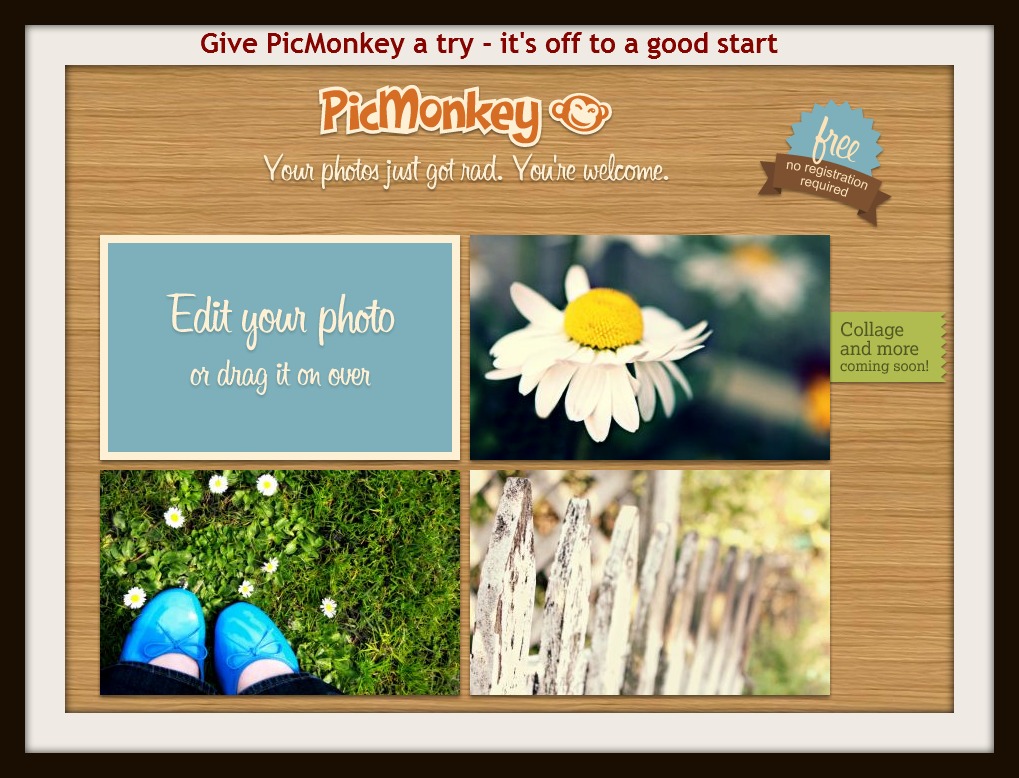
Probably because it’s new, PicMonkey doesn’t yet have all the tools that were available at Picnik. These are some of the Picnik features that I liked and used, and that I’m hoping become available at PicMonkey:
Some of the areas where PicMonkey is a match for Picnik include:
Overall, I’m impressed with the roll out of PicMonkey. I’m guessing that they’ll be busy working to add new features and to make it an even better replacement for Picnik. This is photo editing for the 99% (where the 1% are those Photoshop users who need it and actually know how to use all the powerful tools in it). Now, please give me more monkey.
Filed under: Web2.0 | 5 Comments »
For the past twelve years or so, I’ve heard the same argument time and time again. I wish I had a nickel (or preferably a beer) for every time someone has said something like:
Of course they don’t mean that you can’t offer it, they mean that you can’t possibly have a high-quality public speaking class if it’s offered online.
First. This class has been taught and taught well for at least ten years at various schools. The naysayers (and there’s lots of them) do not want to hear about people who have developed effective techniques for teaching this class – they (the naysayers) just aren’t willing to believe or accept any evidence that differs with their world view.
Second. Just because we use the word “online,” doesn’t mean that the entire class occurs only in front of a computer screen. Many online classes require students to engage in active learning or various other techniques that do not involve the computer – except maybe to document the work they’ve done or for other class communications. The idea that an online course eliminates face-to-face interactions is just plain wrong – unless you design it to avoid all interaction. You can absolutely require the F2F interaction, as you’ll see below (see fourth).
Third. This one is my favorite. The naysayers seem to think that there is something special about the traditional way of teaching the Public Speaking class on college and university campuses. Please explain this to me: How can you possibly call it “PUBLIC SPEAKING” when a student is standing at the front of the closed classroom with a dozen fellow students (mostly friends) and one instructor? What exactly is public about that? In what ways does that possibly resemble standing up in front of an audience in a normal public speaking venue? How did this ever become the gold standard for college public speaking courses?
Fourth. Although it is possible that some instructors primarily have their students record their speeches and post them online (more on that later), many that I am aware of require their students to speak in front of live audiences such as Kiwanis Clubs (Lions, Rotary, etc.), church groups, senior centers, Toastmasters groups, or many other similar groups. Compare this experience with the “classroom speech” described in number three above. It begs the following question: why don’t all public speaking classes (regardless of delivery method) have this same requirement?
Fifth. Last time I looked, the calendar says 2012. YouTube and other sites that allow anyone to communicate with the public are the norm, not the exception. Being able to communicate and effectively present yourself through electronic media is an extremely important skill for future success. Doesn’t matter whether you like that situation or not – it is what it is. A whole new audience opens up for those students when they record their speeches and post them online. That’s an interactive audience that can leave comments and suggestions, but not be restricted to being in the same room at the same time as the speaker. Does a student have extra incentive to do well knowing that both Grandma and a future employer might see this speech – or are they more motivated by their 12 classmates in the classroom?
Sixth. Even better than just recording a speech and posting it online, use live broadcasts via tools like Ustream.tv, LiveStream.com, or Justin.tv – or several other similar tools. All these free tools allow for the live broadcast to be recorded for future viewing and critique, but they also have the pulse-racing feature of going live to an unknown audience. A while back I asked someone if she would be willing to tune in to the LiveStream Internet channel to watch college students give their speeches for the online public speaking class. She replied that as long as she was not already booked, that she would “absolutely tune in to watch and comment.” The person that I was talking to was the college president. Hmmh, both grandma and the president (and many others) can watch your students perform in your public speaking class. Game changer?
Want to build an audience for student speeches? Embed your Livestream channel on the college Facebook page.
There’s also a Facebook app for Ustream.
All of these work on mobile devices (Ustream page).
Through face-to-face live events and both live and recorded Internet broadcasts, an instructor with a little imagination can build a high-quality, 21st century, online version of the college Public Speaking course.
Filed under: Online learning | 4 Comments »

 Barry Dahl dot com