• Recent Posts

  • Tags (Categories)

  • Archives

  • Pages

  • March 2026
    M T W T F S S
     1
    2345678
    9101112131415
    16171819202122
    23242526272829
    3031  

ITC09 Grand Debate – a Real Con Job

I was accused of being particularly snarky and ill-informed by some online posters during the grand Debate at eLearning 2009, the ITC annual conference (see previous two posts). All true. No denial here.

I don’t actually believe that I am ill-informed about Second Life and virtual worlds, but I was pretty much acting that way during the debate – you see, that was part of the strategy. Because above all else, I was trying to win. I hate to lose, and there was no way that I could see myself winning this debate unless I went over the top with both provocative content and a major splash of snark. (A friend saw these comments about me online and was concerned about how I was coping, but he also needed to know what snarky meant. After I told him, he said that my picture should be in the dictionary next to that word. Here’s my effort to do that.)

If it had been an academic debate based solely on reasonable arguments, any (or all) of the following would have occurred:

  1. I would have lost
  2. it would have been boring
  3. it would not have been a memorable event (not same as #2, boring can be memorable)

At the risk of disappointing some who voted for my side of the resolution, I need to say that I don’t really believe that SL is stupid, or that it sucks, or that it is a waste of time and money. Below the fold I’ll get into much more detail about what I really believe in regard to the development of virtual worlds for education.

BTW, that story about my kid wanting to go to the park to fly a kite? Totally made up. Not the kid, he’s real enough, but the rest of the story was just for affect. But I loved that story, and yes, it was to make the point that flying a kite in a virtual world will never be as good as (or even close to) flying a kite in real life with your kid. Doesn’t mean that SL is stupid, but it does mean that we want to use virtual worlds for what they’re good at, and probably not use them for what they’re not good at.

During the debate I barely touched on griefing in SL -well, maybe barely isn’t quite accurate considering that the image I used was quite graphic. But I only mentioned griefing in relation to that one slide – even though I had lots of material that would have scared the non-SLers completely over to the other side. Do I think that griefing is a reason not to explore VW? Of course not, but it is fun as hell to talk about.

You might notice that I turned the topic on its head a little bit. I concentrated on bashing Second Life and totally stayed away from the idea of virtual worlds in general. Again, I was trying to WIN. Much of what I could talk about regarding SL wouldn’t necessarily apply to virtual worlds in general. Fleep picked up on that a little bit, but I was afraid that she would use it as more of a hammer to beat me over the head.

Some of my best material was left on the cutting-room floor. I’ll throw in just a little bit of that material in this post, if for no other reason than to give some people another opportunity to get all worked up over this stuff. Probably the one piece that I regret the most not getting to during the debate revolves around the issue of vendor lock-in with Linden Labs, and the same piece also got at the question about whether our business practices are ready for all of this. I planned to make a few comments about the dangers of higher ed allowing for vendor lock-in to occur (“Haven’t we learned anything from the Blackboard debacle?”), but the “bit” that I planned to use has to do with trusting Linden Labs to want what is best for higher education. It would have gone something like this:

“So all these colleges and universities are rushing into Second Life to buy their own little Education Island. Education Island? That’s funny, apparently Creepy Treehouse would have been too direct. How does your purchasing agent react when you tell him that you are buying an island? An island that doesn’t actually exist anywhere (except as e-bits on a server that you have no control over), but that you’re still going to pay real money for? And let’s just assume that you’re able to jump this hurdle and buy your island – that doesn’t exist – what guarantees do you have that you’ ll always be able to access this island, that you’ll be able to do what you want to on this island – that doesn’t exist – and that Linden Labs won’t just change the terms of service on you without notice and leave you holding an empty (virtual) bag?”

“Here’s an idea. I’m willing to sell off sections of my brain. For the right price – you can own a section of my brain – where you can imagine yourself building anything there that you want to – where you can imagine yourself engaging in any kind of activity that you want to – and I promise to never deny you access to all the imaginary stuff that you have residing in my brain. Do you trust me? No? You trust Linden Labs more than you trust me? Ouch!”

Hyperbole? Of course. Snark – see picture above. Points? Well, I hope so. Even though I don’t believe that Second Life is stupid, I do believe that allowing ourselves (higher ed as a whole) to continue down this road to vendor lock-in is incredibly stupid.

What I Really Believe about VW in Higher Education

In no particular order, I think:

  1. That Second Life is stupid – (jk, seeing if you’re still with me), I mean that all of the development that is currently going into SL is mis-directed or poorly aimed.
  2. That we (higher ed in general) are setting ourselves up for another colossal vendor lock-in situation with Linden Labs. They cannot be trusted to act in our best interests, but we can be trusted (much more so, anyway) to act in our best interests.
  3. That operating an open source virtual world (Croquet, Cobalt, or other) for higher education has many advantages that we cannot get in a world owned by LL or anyone else who is not committed to directly supporting higher ed.
  4. That a large higher ed consortium of colleges and universities would be a fabulous thing where we can create a large VW (based on open source) in which we can interact and learn together. I’ll call that the HEVW (higher ed virtual world) for short.
  5. Policies and procedures – not only would we be better able to apply our policies (acceptable use, code of conduct, etc.) to behavior in a virtual world that we collectively own in higher ed, we may even be able to work together collaboratively to create those in-world polices and procedures that would apply to all consortium members.
  6. In our own collaborative virtual world, it would be much easier to control access to the site and student authentication issues- porn stars and others who might damage our learning environment would not be invited – except for academic purposes, of course.
  7. Collectively we could provide I.T. support for the HEVW without any one school or partner being depended upon to do it all.
  8. Purchasing virtual assets from the HEVW consortium just might prove easier for college purchasing agents and policies than when dealing with LL or other profit-seeking organizations that are selling us “property” without our best interests in mind.
  9. I think this list could go on and on, but you get the drift.

In and of itself, this approach does not solve some of the following issues, but it would allow us as a higher ed community to work together to help solve some of these issues:

  1. We would need to work collaboratively to improve accessibility of the virtual world we create.
  2. We will still need to learn how to help students protect their real identity in this HEVW (FERPA still applies).
  3. It will still be a creepy treehouse of sorts, but as least we will be able to keep some of the (other) creeps out, and over time we can lose the impression that we are just trying to show how cool we are.
  4. The lack of portability of objects (you can’t get them out of SL) might not be totally addressed with this approach, but at least we are reducing the likelihood that we’ll want to move our virtual builds to a different metaverse. As it stands now, I predict that within 3 or 4 years many schools will be wishing they could extract their objects from SL to move them elsewhere, but it’s highly unlikely that they’ll be able to.
  5. Maybe we can find a way to enable avatars to be better dancers (what? not academic enough for you?)

Why didn’t I mention these things during the debate? Because I would have lost. You can’t take the CON position and then make PRO arguments, at least I can’t.

ITC09 Grand Debate – Drilling Down the Clickers

In the previous post I showed the overall votes for the Pro and Con sides of the Grand Debate at ITC09 between Chris/Fleep and myself. I added a single question before the debate began in an effort to separate the SL users from the others. Here are those results.

Each of these groups went on to exhibit voting behavior that is not at all that surprising. Only 8% were frequent users of Second Life and 62% have not used Second Life or (most likely) any other virtual world.

As you might expect, the voting in group #2 (frequent users of SL) is quite different from group #4 (Never used SL and not much interest in doing so). So, let’s take a look at how they break down. Caveat: I only included people in this analysis if they answered the first question shown above, and voted in all of the three subsequent votes about the premise: Virtual Worlds are the Second Life for Online Learning. Therefore, people who only voted part of the time are excluded from this analysis since you can’t really tell whether they changed horses during the course of the debate.

The first chart shown below is for all of the voters who fit the criteria (voted throughout the debate).

Here’s how to read the above chart, from left to right. There were 116 people who voted for the PRO side of the argument prior to the beginning of the debate. Of those 116 voters, 34 of them shifted more to the CON side during the debate and 23 of those 34 actually switched their vote from PRO to CON by the time of the final voting. Therefore, 11 (34-23) people shifted more toward the CON side but still voted PRO on the final vote. Similarly on the CON side, of the 164 people who initially voted CON, 37 of them shifted more toward the pro, but only 16 of them actually switched their votes from CON to PRO.

I have created similar slides for each category as identified on the first slide at the top. In other words, how did SL newbies vote compared to the SL veterans, compared to those who don’t know much of anything about SL? Group #1 consists of those people who have a SL avatar but have used it very infrequently or are newbies to SL. In my opinion, this is the group that is the most interesting, and it is clearly the group that made the biggest impact on the final vote since the CON picked up a net gain of 5 votes from this group. All the rest of the charts are put into this SlideShare below where you can spend as much or little time as you desire seeing how the groups broke down.

Just a couple of interesting (to me, anyway) points from the clicker data:

  1. The SL newbies (Group 1) were clearly not sold on SL since there was a large block of CON voters in even the initial vote. Group 1 was also the most volatile group with quite a few shifters and switchers.
  2. The SL veterans (Group 2) weren’t going to have their opinions swayed, but I was surprised that 1/3 of them were on the CON side.
  3. The SL-wannbees (Group 3) aren’t that much different from the SL-newbies, but they do lean slightly more to the CON.
  4. The SL-NOTs! (Group 4) started and ended at about a 4:1 ratio for the CON side. Read into that anything that you choose.
  5. The No-Ideas (Group 5) showed very little movement from their 2:1 CON position.

The last post that I plan to make about this will lay down what I really think about Second Life and virtual worlds in higher education. Coming soon.

Recap of Grand Debate at ITC09

This is the first of probably three posts about the Grand Debate at the ITC eLearning 2009 Conference. This will be the most basic (just the facts, please) of the three posts.

  • When: Sunday, February 22, 2009 at lunch
  • Where: ITC eLearning 2009 Conference at Portland (OR) Hilton Grand Ballroom
  • What: Debate Topic – Virtual Worlds are the Second Life for Online Education
  • Why: The Grand Debate is a tradition at the ITC conferences
  • Who: Chris Collins and Barry Dahl (me)

fleep-small vs.

We used Turning Point clickers to measure audience reaction before, during, and after the debate. Many thanks to Turning Technologies for providing the clickers on very short notice. The technology worked flawlessly.

Initial vote – it is a tradition at the Grand Debate to take a straw poll of audience position before beginning the debate. 294 people voted on the slide shown below, clicking either button #1 for the Pro position or button #2 for the Con position.

After the coin toss by Michael Catchpole, ITC Board Member and debate moderator, Chris Collins (Fleep Tuque) made her opening statement taking the pro side of the argument (10 minutes max for openings).

A few of the points made by Chris during her opening argument include:

“Loyalist College is training their students to be border crossing guards between U.S. and Canada, and we’ve seen already from the initial reports that the retention rate is high. Students are actually learning valuable skills when they can be in the virtual environment and see what the spaces look like and role play searching the cars and doing the interviews. It has a tremendous affect on what they’re learning and how much they retain.”

fleep-border

“Also, regarding the Language Lab as shown below, “They can role play; if you’ve taught a foreign language class or taken a foreign language class, you know how stilted it can be in the classroom to get students to role play with each other. What if you could take them to Paris and actually speak with native speakers of French? How much different would that learning experience be for them”?

Fleep shot of language lab in second life

A few points made by Barry during his opening argument on the con side include:

“Linden Labs provides their users with no significant means of I.T. support, besides some frequently asked questions and a help page. So, is your college help desk ready to handle these new problems – and there WILL be problems. Second Life sucks up an enormous amount of bandwidth and requires superior processing power on the PC. Your minimum technology requirements will need to be severely upgraded if you begin requiring SL for your classes. Any student with a PC more than two years old can probably forget-about-it. Distance student on a dial-up connection? Forget-about-it. Second Life on a Mac? Forget-about-it, mostly. Sometimes it works, sometimes it doesn’t. Linden Labs has admitted that they have a hard time making their grid work with Apple products – and they don’t really seem to care. Do you care? Will you care when your help desk gets to handle these calls?”

tech-support

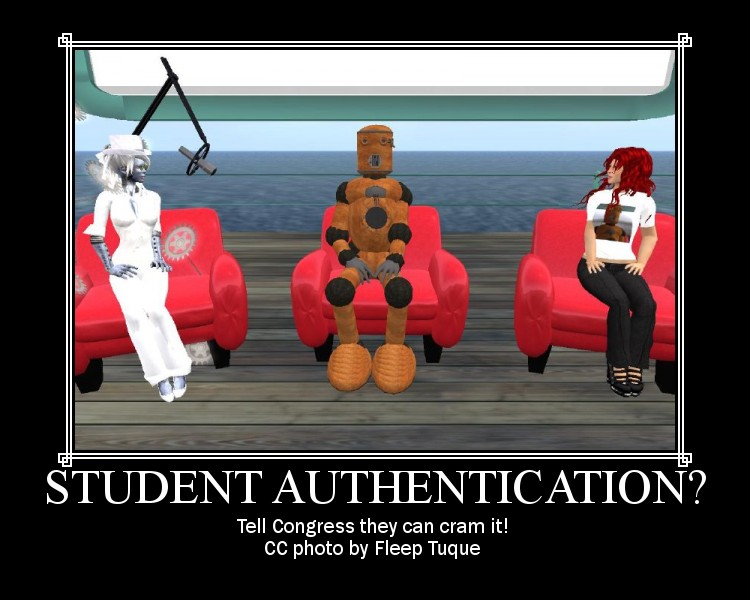
Have any of you been paying attention to one of the hottest topics in distance education during the past year – the whole student authentication deal-ee-oh? The whole “how do you know that it’s the right person at the other end of the fiber optics that is taking your online course”? That deal-ee-oh? (Side note: I was beaten up by someone posting online who couldn’t believe I used “deal-ee-oh” in a debate.) Is that robot really who he says he is? What about that silver surfer on the left? Who is she really? Is she really a she? (Chris said “no.”) Most people in Second Life do some combination of the following – gender bending, age shifting, or they resemble animals or other unworldly creatures – NOT THAT THERE’S ANYTHING WRONG WITH THAT!! – and of course, none of them use their real names. Come on now – is this really what you want your classroom to look like?”

student-authentication1

During the rebuttal sections, the audience voted with their clickers. The idea was that they would give a thumps up for points that they thought were useful, powerful, or on target; and they would give a thumbs down for points that they thought were the opposite of those things. #3 on the clicker was a neutral rating, with 1 and 2 being negative and 4 and 5 being positive ratings. The line chart updates every five seconds.

Chris’ rebuttal chart is shown below.

Barry’s rebuttal chart is shown below.

A few quotes from Chris’ closing argument: “Where are we in terms of using virtual worlds for education, we’re in the very beginning stages, we’re experimenting.” … “Why is Second Life the one that all the educators are flocking to and interested in? Because of all the virtual worlds, what SL does that no other virtual world at this point does is it allows you the ability to build and create and start experimenting with what it means to create your own virtual environment.”… “It’s the first software to make some of these tools available to somebody who has a lower level of technical skill. I’m not a programmer; but I can create a virtual environment and experiment, so that’s one of the reasons why Second Life has really taken off.”

A quote from Barry’s closing argument: “I didn’t write my own closing argument, but I’d like to share with you a little piece that I found that I think will serve quite nicely. I’ll give the citation at the end.” Then I read most of the information from section 5 of the blog post titled “2008: The Year of Limits” (section 5 is titled “Limits of the Second Life platform and our current Metaverse”). Of course, at the end of the closing it was revealed that Chris/Fleep had actually written my closing argument for me, for which I will be eternally grateful.

After the closing arguments, Michael asks the audience to indicate whether their opinions have moved during the course of the debate. This doesn’t indicate that they changed positions, a Pro person can now be more pro and that would register the same as a con person who is nor more pro, but still a con (etc. etc.)

None of the votes previous to this point really mean anything at all. I always think that the slide above is the best indicator of the success of the debaters – how many people were influenced one way or the other? However, the debate is considered to be won or lost on the basis of the final vote, shown below. In this case, the con side did get the most votes, and more than the number cast at the pre-debate straw poll. So this time there isn’t much question about the debate winner. However, we have had the situation before where the final vote was closer than the initial vote and still the winner was crowned despite losing some of the audience support during the debate. Therefore, it is fairly easy to conclude that you want to be on the most popular side of the argument, regardless of whether you have the best points, issues, and illustrations or not.

The debate did cause quite a stir, from audience reaction in the room, to tweets and live blog posts that included people in the room as well as many people not in the room. Some people really take this stuff seriously which you can get a sense of by reading the comments posted to Bryan Alexander’s live blog post about the debate. I was particularly saddened when someone who I respect and admire took shots at me for not being serious enough. I’ll talk about that more in a later post. Luckily, I did receive many favorable comments from people who were in the room. There were many first-timers in the audience who were unfamiliar with the tradition of the ITC Grand Debate at the eLearning conferences. The impression of these first-timers is most likely that the debate is not at all a serious exercise – and they’re somewhat correct in that conclusion, but not entirely correct or even close to it. There is definitely a serious nature to the debate – but we try to do it in a fun and entertaining way (this is my first and only time as a debate participant). My “performance” (please suggest a better word for that) was a bit more over the top than most. They’re usually a bit irreverent, they’re usually a bit strongly stated, and they’re oftentimes a bit snarky. In all cases my shot at it was more than just a bit of all those things. More about that in a later post when I plan to write about how I really feel about SL/VW.

To end this first post, let me say that meeting Chris was really a pleasure. She is a fabulous young lady who is working on some amazing things and who has an incredibly bright future. She is a great example of the many younger people who are working so hard to reshape the way that we do education. A tip of the virtual hat to her for her participation in the debate, for her enthusiasm about the topic and about education in general, and for her very good nature and kindness.

Image credits:

  • Loyalist College Border Simulation – jasonowalker.files.wordpress.com (Fleep’s slide)
  • Language Lab in SL – still looking for citation of Eiffel Tower pic (Fleep’s slide)
  • Tech Support – original CC Flickr photo by Alan Levine (Barry’s slide)
  • Student Authentication – original CC Flickr photo by Chris Collins (Barry’s slide)
  • Cill Creel at ITC09

    Gill Creel presented a great session at ITC09 titled: Cool Idea, But How Did It Really Work?

    Description: In Fall 2008 two instructors revamped their online American literature course from print, static Web pages, and a limited learning management system to Web 2.0. They threw out the textbook and went to the Web to provide all of the content and interaction. They tried to strong arm the LMS into acting like a Web 2.0 application. The presenters will discuss integrating Web 2.0 tools – such as Google gadgets, Google Calendar, Blogger, Trailfire, Pbwiki, Survey Monkey, Zoho Creator, WebEX, Adobe Captivate, and Diigo – into an online course from a pedagogical and technical perspective. They will show some “how-to” and explain “how-they-do” by offering a faculty level report on their successes and failures. What did they learn? Did the technology help or hinder? What didn’t work due to the technology, due to the personnel? What will they keep? What will they jettison?
    Here’s the tools he talked about.

    Tools I Use

    Audacity
    Blogger
    Desire2Learn
    Diigo
    Flickr Creative Commons
    Google Calendar
    PBWiki
    SimpleRSS Google Gadget
    SurveyMonkey *
    Trailfire
    Vimeo *
    WebEx
    Zoho Creator

    (Sorry Gill, but that’s the best pic that I got. Ouch)

    ITC09 – Portland – Bryan Alexander Keynote

    Bryan Alexander was the keynote speaker for the Sunday morning “sermon” at ITC09, the eLearning 2009 conference in Portland, OR. Heads were exploding throughout the nearly 90 minute session. Really great stuff. I shot some video snippets and will try to get it posted soon. Lots of talk about Web 2.0, Web 3.0, and gaming (and about 20 other topics). Hope to post more later.

    Suggested Conference Tag – ITC09

    The ITC annual conference is quickly approaching. eLearning 2009 will  be held in Portland, Oregon starting Saturday, February 21 with pre-conference workshops and ending Tuesday, February 24 with the final speaker during lunch. I’ve created a Netvibes page that will be used during one of presentations at the conference, but that can also be used as a resource page for anyone interested in tracking events as they occur at the conference.

    To accomplish this task, it is helpful if most people use a common tag for any blog posts, tweets, social bookmarks, photos, or other web content that they might post about the conference. It is best to keep a tag short (especially for tweets), so I propose that we use the following tag:

    ITC09 (or #ITC09 on Twitter)

    I’ve already checked Flickr, Twitter, Delicious, and Technorati to see if the tag is in use, and it appears not to already be in use except for one rogue blog post about some project in South Africa. We can bury that in short order.

    Second Life Presenters – Get a Clue

    I attended a couple of terrible conference sessions recently. The topic of interest was higher education uses of Second Life.

    Before I get into the SL portion of this rant, let me start with another pet peeve. One presenter introduced herself and immediately followed with “By the way, I hate PowerPoint, but it’s the best way show something.” Translation: I don’t know whether it is the best way to “show something,” but it’s the only way I know how. She proceeded to use PPT in one of the classic examples of Death by PowerPoint with slides that were nothing more than her lecture notes (for her benefit, I assume) and a few poorly made screen shots of empty spaces in SL.

    Also within the first five minutes she said, and I quote, that she has “dabbled in Second Life.” That’s exactly what I was hoping for – a one-hour presentation from somebody who has dabbled with the topic at hand. Whatever possessed her 8 or 9 months earlier to make a conference proposal about using SL? Possessed does seem to be the proper term.

    She went to talk about how they were building a teaching and learning environment within SL. She said their goal was to create a place with a PG rating, to provide a safe place for the students to interact. She admitted that they had no safe guards in place, but that they would ban people if they caused trouble. She said they really haven’t had any trouble yet. I pointed out that griefers rarely hang around uninhabited spaces within SL. That’s just not much fun for them. I’m not positive that she knows what a griefer is.

    The whole topic of appropriate behavior was basically brushed aside. Regarding the monitoring of student behavior in SL, she said, “We don’t monitor them in first life, so why in Second Life?” Excuse me, but we do monitor them in FL when they are in our learning environments – we just don’t continue to monitor them (much) after they leave our campuses or networks. For the record, I’m not too concerned with monitoring student behaviors in SL either, but I am concerned when people just make inaccurate statements in order to not deal with the question at hand.

    There were two things of which she seemed particularly proud. They have built a classroom in the sky and another one underwater. “You can do whatever you want in this flying classroom,” although she gave no examples of what those things might be. “You can show your PowerPoint on the screen under water. Oh boy, that’s what we’ve been missing from a quality education. I’ll grant you that it sure would be more difficult to show your PPT under water in first life, so this sounds like a great opportunity for someone to show their underwater basket weaving slideshow while actually (OK, not actually, but virtually) under water. Yes, technology enables us to do fabulous things.

    I was troubled by the screen shots that never showed any avatars on their educational island. I asked how much the space was getting used. “I believe they are using it, but I’m not really sure. I’ll be using it this week for the first time myself.” At that point, 25 minutes into the presentation, I decided that I needed to leave the room before my head (especially my mouth) exploded. So, I did. I wish I could report out on the last 35 minutes, but right now all I’ve got is yada, yada, yada; blah, blah, blah.

    Along with a couple of lousy presentations, I also saw a good one. Here the presenters were actually using SL, including one presenter who was back in New York state and was presenting and commenting in world. Not only was it far more effective to use SL as the presentation platform, but we actually had presenters who knew what they were talking about, who have taught real live students in SL, and who can give some concrete examples of useful things that can be done in world. They admitted to some of the lame things that they had tried, and took credit for some of the cool things that they have created. If you’re looking for some of the good examples of how higher ed is using SL, take a look at SUNY Live or search in world for Monroe CC. This presentation was really quite outstanding.

    CC Flickr photo by Hiro Sheridan

    Heading for CIT2008

    I leave Saturday morning for Salt Lake City and the League for Innovation’s 2008 Conference on Information Technology. The League conferences are always quite large and very smoothly run. I am involved in a total of five presentations during the conference, but I wanted to take a look at what else I would be doing during the four days.

    I took the key words from all the session titles at CIT and fed them into Wordle.net. This is what I found about the content of Track #1: Emerging and Future Educational Technology

    Now I don’t want to be a jerk, but this sure seems to be dominated by Microsoft, Adobe, and Certifications such as IC3. Maybe they should rename this the vendor track.

    The word cloud for Track #2:  Teaching and Learning seems a bit more to my liking.

    And last but not least, I combined the titles of the remaining (smaller) tracks 3 through 7 and came up with this:


    There’s sure to be something in that cloud worth attending.

    Teaching with Technology Conference

    Minnesota State University, Mankato will be hosting a one-day conference titled Teaching with Technology. Friday, November 7, 2008 at the beautiful Mankato campus. I have the pleasure of participating throughout the day.

    At their website you can view the rest of the sessions during the day and register to attend. This is a free conference. I am very much looking forward to participating.

    Dissecting the Backchannel

    I participated in a panel discussion during the Desire2Learn FUSION Conference during July in Memphis (FUSION08D2L). The other panelists were Robbie Melton, Stephen Downes, and Michael Feldstein. Our topic was “What would you like to see happen in the future of e-Learning?” Each panelist took approx 5 minutes to share some thoughts with the lunch-time audience about one topic that was near and dear to them regarding the future of e-Learning. After those opening comments, the floor was opened to the audience to either ask questions of the panelists or make comments about the opening remarks.

    Pie chart of backchannel usage

    Pie chart of backchannel usage

    We used Stephen’s chat function from his website to create a backchannel that was displayed on two large screens, one on each side of the front of the hall where the panelists were seated. Out of curiosity, I decided to take a look at the chat archives and analyze the types of entries that were made. Although there were a couple of premature postings, I started counting at 12:27:21 PM which is when posts started coming in for the panelists even though the opening comments were still being completed. For my analysis, the first posting was by Hiro Sheridan of Oral Roberts University. The last posting was at 13:16:21 by the ever-popular Anymouse (Stephen’s default username for those who don’t enter one). Altogether, I counted 167 posts from point A to point B.

    This presentation was also being streamed live on the Internet using UStream.tv (archive here). There were only a few questions that were asked by audience members using the two microphones that were available in the room, and of course there is no archive of those questions except for what you can hear on the UStream recording. Of the 167 posts in the backchannel, it is impossible to know how many of them came from people in the room with us and how many came from the 50+ people who were viewing the Ustream feed (which could have also included people in the room who opened the streaming video page on their laptops). In other words, questions and comments probably did come from anyone and anywhere.

    I arbitrarily categorized the backchannel posts into one of the following six categories:

    1. Panel questions: these were specific questions that were asked of the panel members that appeared to be serious in nature. There were a total of 32 of these questions. Examples:
      • How will MUVEs like Second Life impact education in the next five years?
      • Do you know of any study where K-12 online students were surveyed to see if they would be interested in an online degree environment?
    2. On-topic comment: here an audience member was making a comment about something that had been discussed by the panelists, or related to one of the questions asked by other audience members. It was deemed to be on-topic if it related to the future of e-Learning. There were 20 of these comments. Examples:
      • I would like to see truly adaptive eLearning systems — different paths for different learning styles … and a system that supports this well.
      • Laggards have just started to waste epic amounts of time and money on my campus and they do not care and not interested in learning…UGH
    3. Off-topic comment: this was the largest category and included many comments about the nature of the panel discussion and the use of the backchannel, as well as where to get the best BBQ in Memphis, and other idle chatter. There were 55 of these comments. Examples:
      • Wow, this is why we don’t want students having laptops in classrooms I guess
      • To really wreck a panel put up a backchannel
      • The Net gen student works this way ALLLLL the time…three windows and listening…the speaker has to “join in”
    4. Humor attempt: there were 40 posts that I categorized as (mostly) lame attempts at humor. Keep in mind that this was a room full of education professionals, not high school kids trying to impress their friends. Examples:
      • Play Freebird
      • I am going to get a patent on “Anymouse” tomorrow! And sue Stephen the next day.
      • Can someone please bring toilet paper to stall 3 in the men’s room?
    5. Shots @ D2L: a few people decided that it was an opportune time to direct some sort of put-down at D2L. Most of these could have easily fallen into category 4 (humorous), and overall I think D2L was very much NOT bothered by the shots across the bow, but I felt that given the nature of a D2L-hosted event that these comments needed to have a category of their own. There were 9 such comments. Examples:
      • Did D2L open their API yet?
      • API, what’s an API? –signed, John Baker
      • john baker, who’s john baker?
    6. The last category is sort of an Other for those empty posts or those that were clearly just testing to see how the backchannel system worked. There were 11 of these posts. Examples:
      • does html work in this thing
      • I guess HTML does work in this thing

    According to my (admittedly subjective) analysis, only about 31% of the backchannel entries were productive. In my opinion, only the first two categories listed above can be considered productive. I was not at all bothered by the use of the backchannel, in fact I was rather intrigued by the whole thing. So much so that I probably spoke a whole lot less than I am usually inclined to do since I was rather busy watching everything else that was going on. I was also able to see the chat postings on Stephen’s site as they were coming in, which was often a bit prior to the ten seconds that each message was displayed on the screen. In other words, I was oftentimes reading ahead and not paying attention to the task at hand.

    One additional observation has to do with the progression of the posts during the approx. 50 minutes that posts were being made to the backchannel. During the first 20 minutes, there were only 6 posts, 5 of which were productive (related to the presentation topic). During the third ten minute period, there were 26 productive posts and 22 non-productive posts. During the fourth ten minute period, there were 12 productive posts and 44 non-productive posts. During the last ten minute segment there were 9 productive posts and 47 non-productive posts. As my six-year-old might say, “I see a patteren” (sic) there.

    I hope you weren’t expecting a brilliant conclusion to this piece, because there isn’t one. I’m not going to make suggestions about how a backchannel could be used more productively, although I would appreciate some comments that might give other perspectives on this use of a backchannel or others that you are familiar with. Was this a train wreck, or more like a game of bumper cars?