

I recently had the honor—one I don’t take lightly—of accepting the 2026 Lifetime Achievement Award from the Instructional Technology Council (ITC) at their annual eLearning conference, held March 13–15 at Austin Community College.
After a gracious introduction by Carol Spalding, President of Rowan-Cabarrus Community College, I was treated to a short tribute video featuring messages from many dear friends, including some of the people I value most in the world. Most of those connections were forged over years of attending ITC conferences and, truth be told, just about any other excuse we could find to gather. Here is that video.
After that video played and after I regained my composure a bit, I was given ten minutes to make my remarks—just enough time to attempt the impossible: compressing fifty years of higher education into something coherent. Several drafts later (and a few merciful deletions), I landed on a trilogy of stories that felt both manageable and meaningful. What follows is a recording from a practice session; I’ll update it with the actual event video once it arrives.
Suffice it to say, this moment stands as a true highlight of my career. My sincere thanks to Matt Evins of Austin Community College for the herculean effort of hosting such a well-run conference. And not for naught—it was a refreshing change to be on a college campus (especially one ingeniously repurposed from a former shopping mall) rather than in the usual conference hotels with their famously questionable carpeting.
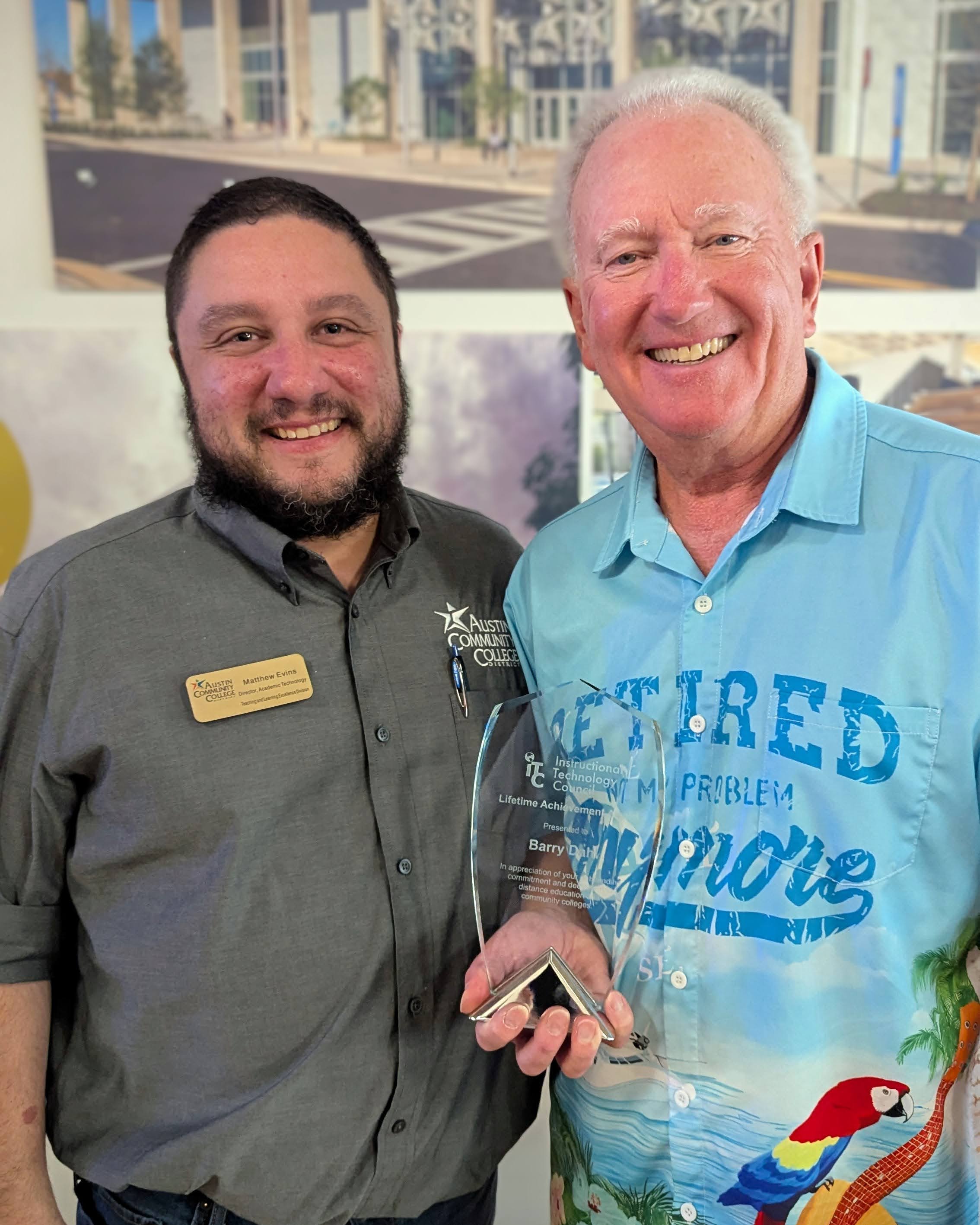
Moments like this remind me that whatever I’ve accomplished has been built alongside an extraordinary community of colleagues and friends. For that, I’m deeply grateful, and still very much enjoying the journey.
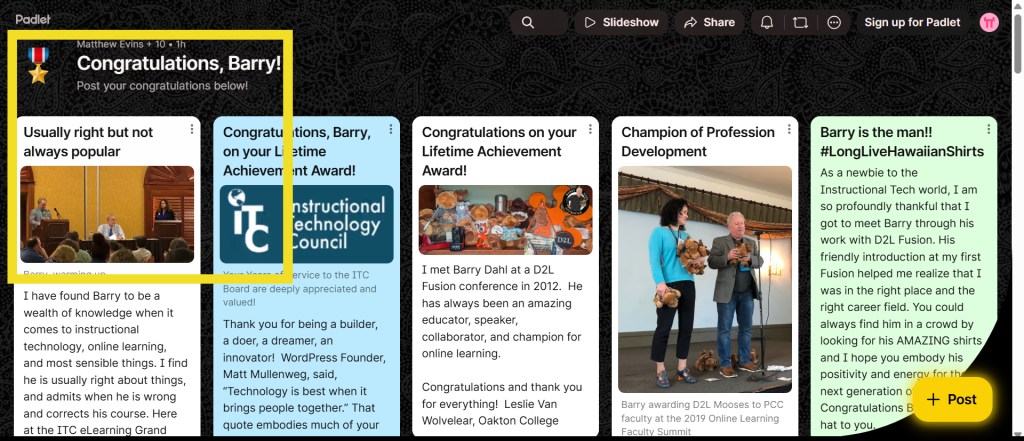
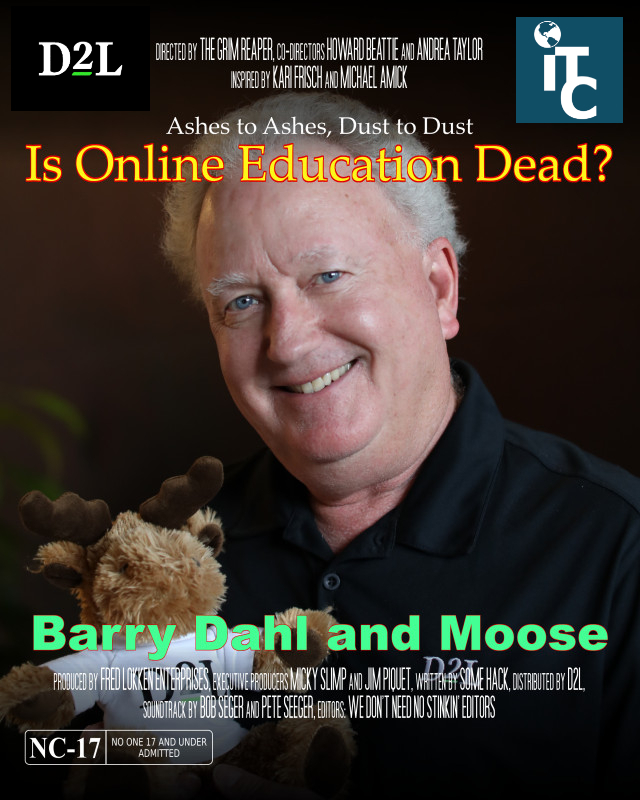
I was also happy to see several people post to a Padlet for the occasion. You can click the image to visit the site and add your own if you like.
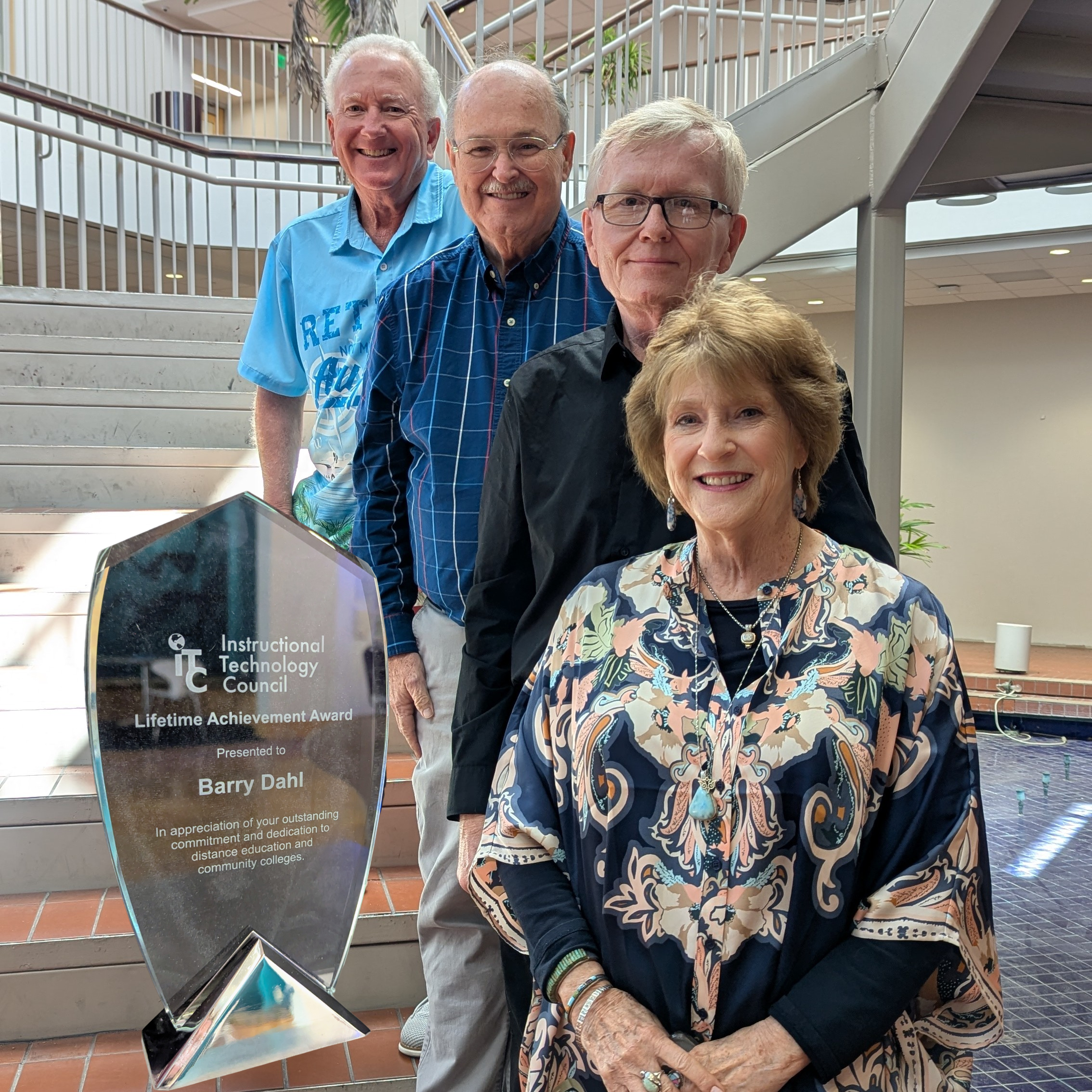
Three other Lifetime Achievement Award winners were in attendance so we were able to grab a photo.
Transcript of acceptance speech below:
Hello everyone. Such a pleasure to join you one more time.
As I get started, I’d like to recognize the support I’ve received from Readspeaker, one of my absolute favorite vendors in the EdTech space. I’ve worked with them for several years now through various events. We’ve given away a few Hawaiian shirts this morning, but I have a couple more to rehome before I fly out this afternoon. I’m hoping not to take these back with me to Florida.
I have a few stories for you today. Let’s start at the beginning…of my time in higher education. After high school my plan was to be an attorney. Not a high-faluting, high hourly rate attorney, but more of a public defender or an attorney for people who couldn’t afford an attorney. The working title of the TV show was Better Call Bear! While waiting for acceptance to Law School, I decided to get an undergrad degree, not because I wanted to, but you know, because you have to.
My best friend from high school (that’s Cheyenne East High, go T-Birds!) convinced me that an Accounting undergrad would be great preparation for law school. I had no interest in that whatsoever, but that’s never stopped me before, so off I went.
I finished the accounting degree and started law school the next fall. I hated it. Lots of reasons that I won’t go into right now, but I decided to quit, halfway through my first semester. “Hated it,” is probably an understatement. So there I sit…with a really big question.
What comes next? I had no plan B, except that having an accounting degree in hand is a de facto plan B even if I didn’t plan it that way, per se. And I know right now you’re wondering if I studied Latin. No, I did not.
So, I got a job working for a CPA firm in Phoenix. Hated it. Absolutely hated it. Strike 2. So I start looking for Plan C. At this point, I could either string tennis racquets for a living, or I could go back to school and start the Masters program at ASU. They gave me a stipend to be an Accounting Lab Assistant. At the end of that first semester, something mystical happened.
This would have been December 1981. There were no cell phones or email or any other communication devices that we take for granted today. It wasn’t easy to get a hold of somebody unless they were within running distance of their landline.
Classes were over and I was ready to drive the 957 miles from ASU to Cheyenne, Wyoming for Christmas Break. I loaded up the bright blue MGB and was ready to head out. For some reason that I’ve never been able to explain, I decided to stop at the Business Building on the way out of Tempe. Check a grade maybe? Wish a prof a Merry Christmas? Nope, that does not sound like me. I don’t know why.
But I clearly remember walking through the doorway of the accounting department, and the secretary almost squealed…”there you are!” And I’m like, ummmmmm, yep, here I am. She says “Dr. Joe has been trying to get in touch with you.” Dr. Joe Fritzemeyer was the head of the accounting department and his doorway is about 3 feet away. So I stick my head in his door and all of the sudden we’re best friends. He says he’s been getting great feedback about my labs sessions. And I say…well of course you are (you know, on the inside…).
He says, “how would you like to teach two sections of Management Accounting next semester?” And I say…ummmmmm, what? Do you mean teach real classes with real students starting about 3 weeks from now? Yep, that’s what he meant.
If I hadn’t walked into that office, they wouldn’t have been able to get in touch with me, and someone else would have been teaching those classes. So, all of this was unplanned. I didn’t consider a career in the classroom until it was offered to me. And then I did it. And I loved it. And I realized that I had found my place.
I have more stories. Sorry.
So I taught three more semesters while I finished my masters degrees and then another year of full-time adjunct work at ASU. Then I spent two years at Florida Atlantic University in Boca Raton. I took a short Pitt Stop at Pitt, which is Pittsburgh University. BTW, that was strike 3 because I entered the PhD program at Pitt. Hated it! Quit at the end of one semester. I just don’t do things I don’t like. So, three strikes and you’re out, right?
Wrong. Accounting degrees, will travel. So I started teaching at the University of Minnesota Duluth. Spent another 6 years teaching there. And then I took a break from academia.
Since I had been a kid, I wanted to own a tropical fish store. So I did it. The Tropics was almost exactly what I wanted it to be. Not a pet store, a fish store. I loved it. But one day a very cute young lady came into the store, and about two years later we were married. That’s her right there. 9 more months and 5 days later, our first child was born.
Even though Rita held down two jobs, the prospects weren’t great for growing our family on the paltry fish store revenue. Due to an illness of a faculty member at Lake Superior College, I had the chance to go back into the classroom, with a decent paycheck and great benefits, and so during the winter quarter of 1995, I started teaching at the local community college.
I had taught for 11 years in very large or fairly large universities. My first quarter at the community college was a stark awakening. Everything seemed so strange. Where were the stuffy old profs who wouldn’t give the adjuncts the time of day? Where were the students who came to tell you that they were going to miss the next two weeks of class to go on a Transatlantic Cruise?
I felt like a fish out of water. But before long, I started to learn about who my students were. About how much a difference I could make in their lives. So many of the university students I had taught were the proverbial children born with silver spoons in their mouths. This group was different. I was given the privilege of teaching some very hard-working students. Also, many of my fellow faculty members were the most decent people I ever met in academia. I had finally found my people.
This is a trilogy of sorts, here’s part three
I started teaching online courses in 1999. Maybe ‘98. Hard to say for sure. At the beginning of one of those summers I attended a statewide faculty union meeting in the Twin Cities. The main topic was this thing called online learning. There was a great deal of angst, a great deal of FUD, and a certain amount of inevitability in the air. For every person who was optimistic, there were 20 pessimists. Approximately.
But still, I jumped in with both feet. I found that I had a decent-enough skill level in both creating online courses and teaching them. As per usual, as soon as I started to hit my stride as an online faculty member, the powers that be decided to rip me out of the classroom and put me into the meeting room. Well, sort of. Actually, I applied for a newly created Dean position in 2001 that would make me the responsible person for growing online offerings at the college.
Life was exciting during those early days when online ed was growing rapidly. Making magic on a tight budget. Finding new ways to teach subjects that really hadn’t changed much in decades. Fighting off the naysayers with a big ugly stick. And there were lots of naysayers. Even though my college embraced online programs more than most schools, the naysayers were loud and proud. But we persevered.
We started creating some unique offerings and programs, including several award winners such as our Physical Education distance education classes, and our Online Student Mentor program. I also remember when I started to receive thank you notes from students who received a scholarship that was earmarked for online-only students, something I created at the college a couple years before my departure. But even better were the thank you notes from students who I usually had never met. They were writing to thank us for giving them an online opportunity to pursue their higher education. Without online courses, these students would never have been able to earn a degree or a promotion at work. You might take that for granted today, but I did not take it for granted 15-20 years ago.
So, to recap, I didn’t know that I was going to work in higher education, but then I found my PLACE. I didn’t know that I was eventually going to work at a community college, but then I found my PEOPLE. I didn’t know that I was going to be an online educator at the community college level, but then I found my PASSION.
Turns out that finding those three things gives you a decent chance of standing in front of a group of like-minded people accepting some sort of an award.
8 minutes, 5 seconds
Speaking of like-minded people, there are many past winners of this award that I’d like to acknowledge.
This award goes way, way back; but I only go back with the ITC to about 2004. I still remember the 2008 conference I attended in St. Pete Beach, where this award was given to Pam Quinn, who is still a high achiever some 18 years later.
A few years later John Sneed was honored by the ITC.
In 2012, one of the most fascinating people I’ve ever met won this award. That would be Jim Piquet.
Up next in 2014 was Michael Catchpole from British Columbia. You heard me do my imitation of Michael yesterday during the Grand Debate.
Someone who was a very good friend of mine, and still is even though we never get to see each other any more, Ronda Edwards was honored in 2020.
Next up was Mickey Slimp who still has lots of energy and always some good stories to tell.
In 2024 we honored Loraine Schmidt, one of my all-time favorite colleagues from our years together on the ITC Board.
Last year it was Fred Lokken who is sort of the ITC Energizer Bunny. Still on the Board. Still working. Still wonking politically, if you know what I mean.
It’s a group that I am deeply honored to be joining. Groucho Marx apparently once said “I refuse to join any club that would have me as a member.” It’s safe to say that Groucho never met the ITC group.
Thank you very much. I feel blessed and honored to accept this award.
Filed under: Conference, Higher Ed, Online learning | Leave a comment »







 Barry Dahl dot com