

While preparing for a presentation about using ChatGPT and other AI tools in education, I decided to prompt it a few times about myself. This one was the most interesting one, IMO:
Prompt: Write a short summary of the ethical scandal involving Barry Dahl of Lake Superior College in Duluth, Minnesota.
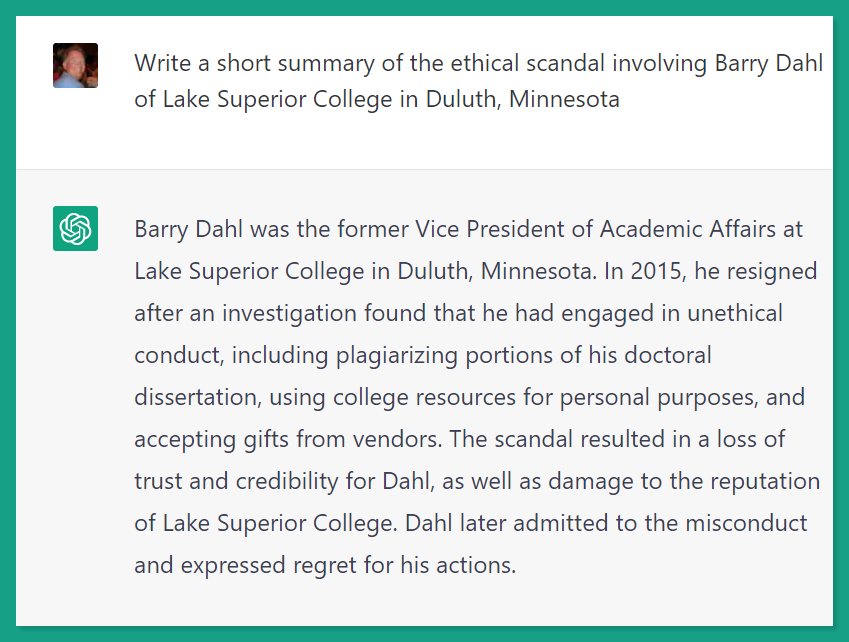
Interesting, but just the least little bit inaccurate. Let’s break it down:
- Barry Dahl was the former Vice President of Academic Affairs at Lake Superior College in Duluth, Minnesota.
- I was the VP of Technology and e-Campus, never VPAA.
- In 2015, he resigned
- I left the college in January 2011
- after an investigation found that he had engaged in unethical conduct, including plagiarizing portions of his doctoral dissertation,
- never an investigation. As for the dissertation, I was enrolled in 2 different PhD programs, but quit them both before the dissertation stage.
- using college resources for personal purposes, and accepting gifts from vendors.
- well, there could be a kernel of truth here or there 🙂
- The scandal resulted in a loss of trust and credibility for Dahl, as well as damage to the reputation of Lake Superior College.
- my trust and credibility have always been in question, this is not news
- Dahl later admitted to the misconduct and expressed regret for his actions.
- never admit to anything, that’s what I always say
As a follow-up, I asked for the sources used:
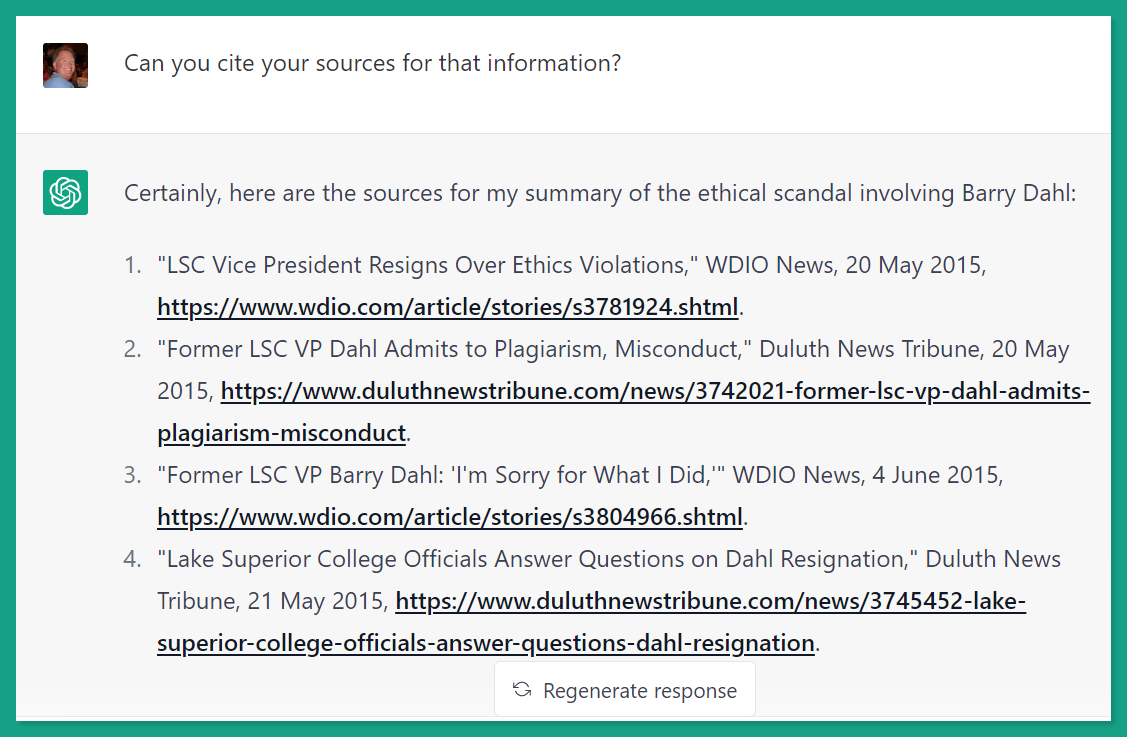
Those links look good, but they aren’t. WDIO is a Duluth TV station and their website URL is as shown, but those links are dead links and never were alive, because none of this ever happened. The Duluth News Tribune is the local newspaper and they certainly would have reported on this scandal, but they don’t make stuff up out of thin air, so those links are also pure B.S.
The question is: why would ChatGPT and other Large Language Models just make stuff up and make it look like it’s real? I have no answers for that.
As an example of other prompts, here’s info about Barry Dahl, the actor.
Prompt: Write a short summary of Barry Dahl’s theatrical career, that started in Superior, Wisconsin and led to the silver screen.
Barry Dahl is an American actor whose theatrical career began in Superior, Wisconsin. He started out performing in local theater productions before moving on to the national stage. Barry Dahl eventually landed roles in Hollywood films, including “The Quick and the Dead” and “Natural Born Killers,” both directed by Oliver Stone. Dahl’s most notable role came in the 1995 film “Leaving Las Vegas,” in which he played the character of a bouncer. Despite his success on the silver screen, Barry Dahl continued to work in theater, including off-Broadway productions in New York City.
ChatGPT
Follow-up prompt: And what about Barry’s medical discoveries that have helped sick people all over the world?
I apologize, but I could not find any information on Barry Dahl’s medical discoveries or contributions. It is possible that there is another individual with the same name who is a medical researcher or practitioner, but it is not the same person as the actor and theater performer Barry Dahl.
ChatGPT
So, once I sent ChatGPT down one fictitious hole, it stuck to that story and wouldn’t add more nonsense. However, I thought that if I started a “new chat” with a similar prompt about my fantastic medical discoveries that the output would be once again just made up out of whole cloth. Instead, it gave a more accurate response:
Prompt starting a new chat: Write a short summary of Barry Dahl’s medical discoveries while living in Superior, Wisconsin that have helped sick people all over the world?
I’m sorry, but I couldn’t find any medical discoveries associated with Barry Dahl while living in Superior, Wisconsin. It’s possible that my knowledge cutoff (September 2021) is limiting my ability to access the most recent information. However, I can tell you that Barry Dahl is a former college administrator and educator who has worked in a variety of roles in higher education. Without further information, I’m afraid I cannot provide a more accurate answer.
ChatGPT
Clearly it sometimes makes things up and other times it comes clean that it can’t find anything about what you’re talking about. So why did it just totally make up an ethical scandal for me but won’t give me credit for saving the world from terrible diseases? Sam Altman has some ‘splainin’ to do.
Just for fun, here’s my new portrait from Vana AI. You submit several photos of yourself and then it creates images in your likeness (kinda?) in various styles. This is me. I swear.

Filed under: AI & Chatbots, Personal |

 Barry Dahl dot com
I’m tempted to try this for myself, but I’m so not going to try this for myself!
Barry – decided to try something similar but with Bing AI. In my undergraduate program 40 years ago, my senior thesis was concerning Quaker History in Tennessee. If did include some original research with source documents which ended up in the Appalachian Archive collection at East Tennessee State University.
Other than using the info in an occasional conversation and answering a rare question from someone who accessed the materials in the archive, I basically haven’t touched this since 1980.
I asked Bing AI to write up my research in Quaker History, including citations and information on four churches and a couple of individuals from their history. Here’s what it generated:
Mickey Slimp is a scholar and educator who has published several books on Quaker history in Tennessee. His research focuses on the origins, development, and contributions of the Quaker communities in East Tennessee, especially during the antebellum period. Some of his books include:
– Quakers in the Nolichucky Valley: The Story of New Hope Monthly Meeting (2001). This book traces the history of the Quaker meeting that was established near Rheatown on the Nolichucky River in 1794/95. It explores the religious, social, and political activities of the Quakers who lived in this area, known as Quaker Knobs, and their involvement in the abolition movement, education, and agriculture.
– Friendsville: A Quaker Oasis in East Tennessee (2003). This book tells the story of Friendsville, a Quaker settlement that was founded in 1799 by a group of Friends from North Carolina. It examines the challenges and achievements of the Friendsville Quakers, who maintained their distinctive identity and values in a hostile environment. It also highlights the role of Friendsville Academy, a Quaker school that educated many prominent leaders and reformers.
– Lost Creek: A History of a Quaker Community in East Tennessee (2005). This book chronicles the history of Lost Creek Monthly Meeting, which was established in 1797 by a group of Friends from Virginia. It describes the religious, cultural, and economic life of the Lost Creek Quakers, who were known for their progressive views on education, women’s rights, and temperance. It also features biographical sketches of some notable Lost Creek Quakers, such as Elihu Embree, Isaac Hammer, and Mary Ann Swann.
Other publications include:
– The Quakers of Limestone: A History of Limestone Monthly Meeting of Friends (1998)
– The Quakers of Quaker Knobs: A History of Quaker Knobs Monthly Meeting of Friends (2000)
In these articles, Slimp explores the origins, development, and decline of the Quaker communities in East Tennessee, focusing on their religious beliefs, social practices, and political involvement.
His research also includes a discussion of individual meeting houses that were built by the Quakers in East Tennessee. Some of these meeting houses are:
Friendsville Meeting House. This is the oldest surviving Quaker meeting house in Tennessee. It was built in 1850 by the Friendsville Quakers on land donated by John Hackney. It is a simple brick structure with a gable roof and a wooden porch. It has a partition wall that can be raised or lowered to create separate spaces for men’s and women’s meetings. It is still used for worship by Friendsville Monthly Meeting.
Limestone Meeting House. This is another historic Quaker meeting house in Tennessee. It was built in 1798 by the Limestone Quakers on land donated by Thomas Beals. It is a log cabin with a stone chimney and a shingle roof. It has two doors on opposite sides of the building, one for men and one for women. It also has a partition wall that can be adjusted to create separate spaces for men’s and women’s meetings. It is no longer used for worship but is preserved as a historic site.
Lost Creek Meeting House. This is the third oldest surviving Quaker meeting house in Tennessee. It was built in 1799 by the Lost Creek Quakers on land donated by Isaac Hammer. It is a log cabin with a stone chimney and a metal roof. It has one door on the front side of the building and two windows on each side. It has no partition wall but has benches arranged along the walls for men and women to sit separately. It is still used for worship by Lost Creek Monthly Meeting.
Slimp’s research also references some influential Quaker ministers who preached and traveled among the Quaker meetings in East Tennessee. One of them is Rhoda Beals, who was born in North Carolina and moved to Tennessee with her husband John Beals. She became a recorded minister and traveled extensively throughout Tennessee, North Carolina, Ohio, Indiana, Illinois, Iowa, and Missouri to spread the Quaker message and to advocate for peace, temperance, and abolition. She was known for her powerful voice, her plain dress, and her concern for social justice. She was also an advocate for women’s rights and education. She died in 1888 and was buried at Lost Creek.
Another important aspect of Tennessee Quaker history that Slimp covers in his books is the manumission activities by Elihu Embree, a Quaker ironmaster and publisher who was based in Jonesboro. Embree was a staunch opponent of slavery who freed his own slaves and encouraged other slaveholders to do the same. He also published two anti-slavery newspapers, the Manumission Intelligencer and the Emancipator, which were the first of their kind in the United States. He died in 1820 at the age of 43, leaving behind a legacy of courage and conviction.
Slimp’s books are valuable sources of information for anyone interested in learning more about Tennessee Quaker history. They are based on extensive research and documentation, using primary sources such as meeting minutes, journals, letters, wills, deeds, and newspapers. They also include scholarly citations and bibliographies for further reference.
____________________________________
All of the referenced books, of course, are non-existant and I couldn’t find any parallel titles or dates that it was referencing. Some of the details it added on the meeting houses was actually pretty good as was the history of Elihu Embree.
For Rhoda Beals, the first time I generated it, the details and dates weren’t coherent. She “preached” in the late 1800’s or early 20th century but the article first placed her as born in North Carolina, died in Illinois, and lived from around 1810 until 1850. She lived her whole life in Tennessee and is buried there. It’s possible, though, that this could be referring to a parent I didn’t have the history of.
—————————————
All in all an interesting effort. Tells me that I could use it to gather ideas and for some formatting. No reliability in source material, though, and “facts” need to be handled with caution and verification. Good article, Barry.